Paavo Nurmi Statue in Turku: History & Monument Guide
The Monument to the Flying Finn
Standing along the eastern bank of the Aura River, the Paavo Nurmi statue honors one of Finland's greatest athletic icons. Paavo Nurmi was a nine-time Olympic gold medalist who earned worldwide fame as the "Flying Finn." Born in Turku in 1897, Nurmi grew up in a working-class home on Jarrumiehenkatu before rising to global prominence on the track.
The 2.2-metre-tall bronze sculpture stands on a stone pedestal at the intersection of Itäinen Rantakatu and Kaskenkatu, directly beside the Aura Bridge (Auransilta). Donated by the industrial enterprise Wärtsilä-yhtymä, the monument was unveiled to the public on January 26, 1955, firmly cementing the athlete's legacy in his hometown.
Artistic Vision and Biomechanical Fiction
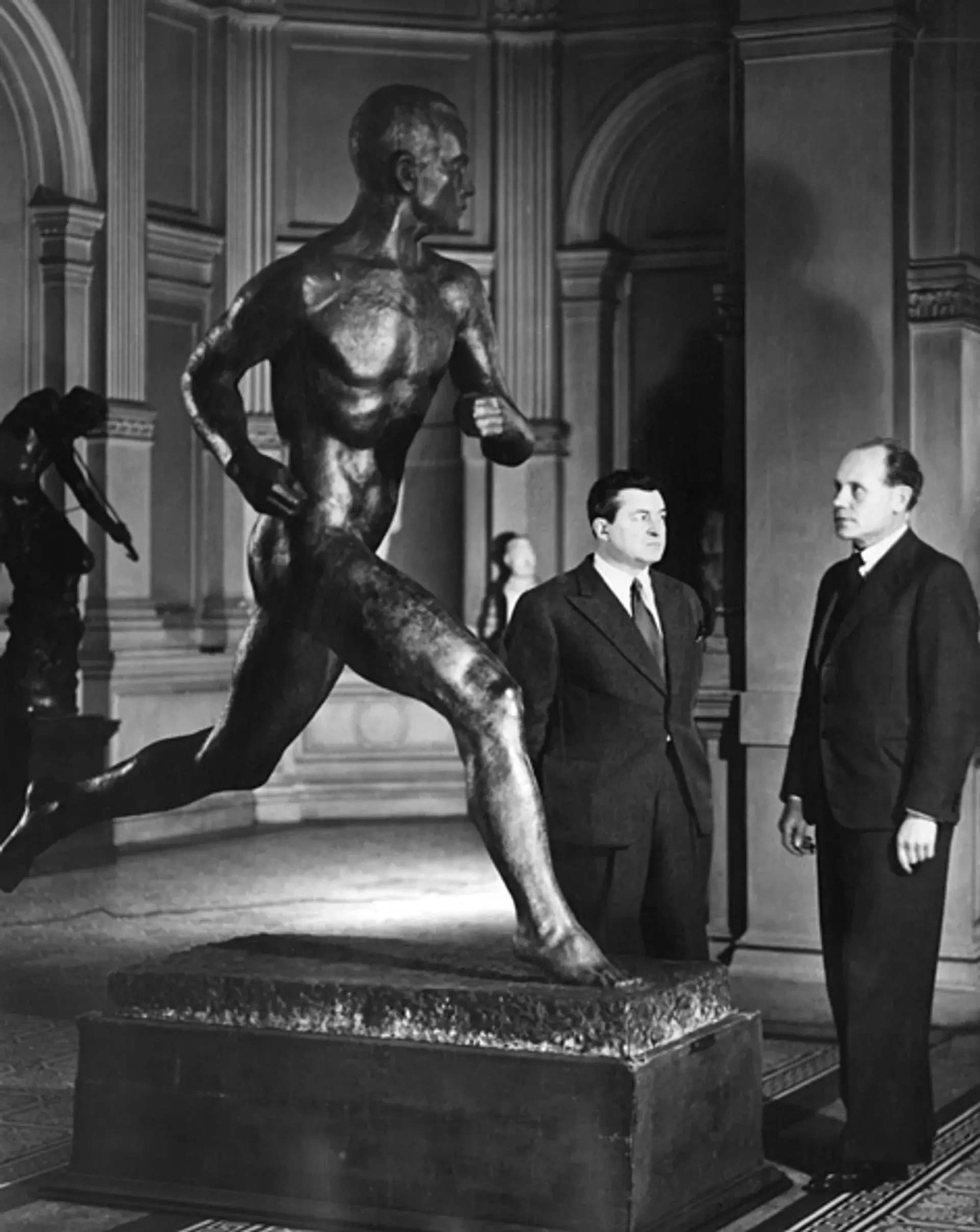
Created by renowned Finnish sculptor Wäinö Aaltonen, the original model was designed in plaster and clay in 1924 and first cast by Aukusti Veuro in 1925. Following Nurmi's triumph at the 1924 Paris Olympics—where he secured five gold medals—the Finnish state commissioned Aaltonen to sculpt the runner. This marked independent Finland's first official state art commission dedicated to an athlete.
Rather than creating an exact anatomical replica of the runner, Aaltonen and Nurmi agreed on an idealized portrayal inspired by ancient Greek heroes. In reality, Nurmi was widely known for running with a heavy, flat-footed stride. In Aaltonen’s bronze rendition, however, the runner bounds gracefully on the tips of his toes. The sculpture achieves a striking illusion of mid-stride weightlessness, anchored to its stone base solely through the toes of the trailing foot.
This heroic classical nudity sparked debate in the 1920s. Authorities and moralists considered the exposed figure unsuitable for an open public street. Consequently, the original 1925 bronze remained sequestered inside the Ateneum Art Museum in Helsinki for decades before outdoor casts were eventually permitted in public spaces during the 1950s.
The Five Authorized Casts
Under the terms established by Aaltonen’s estate, only five authorized full-scale bronze casts of the statue exist worldwide:
- 1925 original cast: Displayed indoors at the Ateneum Art Museum in Helsinki.
- 1952 cast: Installed outside the Helsinki Olympic Stadium.
- 1955 cast: Positioned along the Aura River in Turku.
- 1994 cast: Exhibited at the Olympic Museum in Lausanne, Switzerland.
- 2000/2001 cast: Located on the campus of the University of Jyväskylä.
Student Lore and the Vasa Prank
Today, the statue remains an integral part of Turku's cultural calendar. Pedestrians can view the open-air landmark year-round, set against the low rumble of bridge traffic on Auransilta and the breeze off the river. Every spring during May Day (Vappu) celebrations, local engineering students (teekkarit) carry out an annual tradition known as lakitus, crowning the bronze head with a student cap.
The sculpture is also linked to one of Finland's most famous student pranks (jäynä). In 1961, engineering students covertly boarded the newly salvaged 17th-century Swedish warship Vasa at night in Stockholm harbor. Before archaeologists had finished raising the historic hull, the students slipped a miniature replica of Aaltonen's Paavo Nurmi statue inside the wreckage.
Turku’s Sculptural Riverfront
The statue connects with Wäinö Aaltonen's broader architectural and artistic imprint along the Aura River. Downstream along the same riverbank sits the Wäinö Aaltonen Museum of Art (WAM). Together with several of the sculptor's civic works situated on nearby bridges and public squares, the monument forms a continuous thread of modernist sculpture throughout central Turku.
FAQ
Where is the Paavo Nurmi statue located in Turku?
The statue is situated on the eastern bank of the Aura River at the corner of Itäinen Rantakatu and Kaskenkatu, right beside the Aura Bridge (Auransilta).
Why is Paavo Nurmi sculpted running on his toes?
Although Paavo Nurmi ran with a flat-footed stride, sculptor Wäinö Aaltonen and Nurmi chose to model the figure after classical Greek ideals to give the bronze form a sense of lightness and dynamic motion.
How many full-scale versions of the statue exist?
Under the terms of Aaltonen's estate, only five authorized full-scale bronze casts exist: the original at the Ateneum in Helsinki, and casts at the Helsinki Olympic Stadium, central Turku, the Olympic Museum in Lausanne, and the University of Jyväskylä.
What is the student prank involving the Paavo Nurmi statue?
In 1961, Finnish engineering students snuck onto the 17th-century Swedish warship Vasa at night while it was being salvaged in Stockholm, placing a miniature replica of the statue inside the ship before archaeologists finished raising it.