Grand Théâtre de Bordeaux: History and Architecture
Neoclassical Vision and the Colonnaded Façade
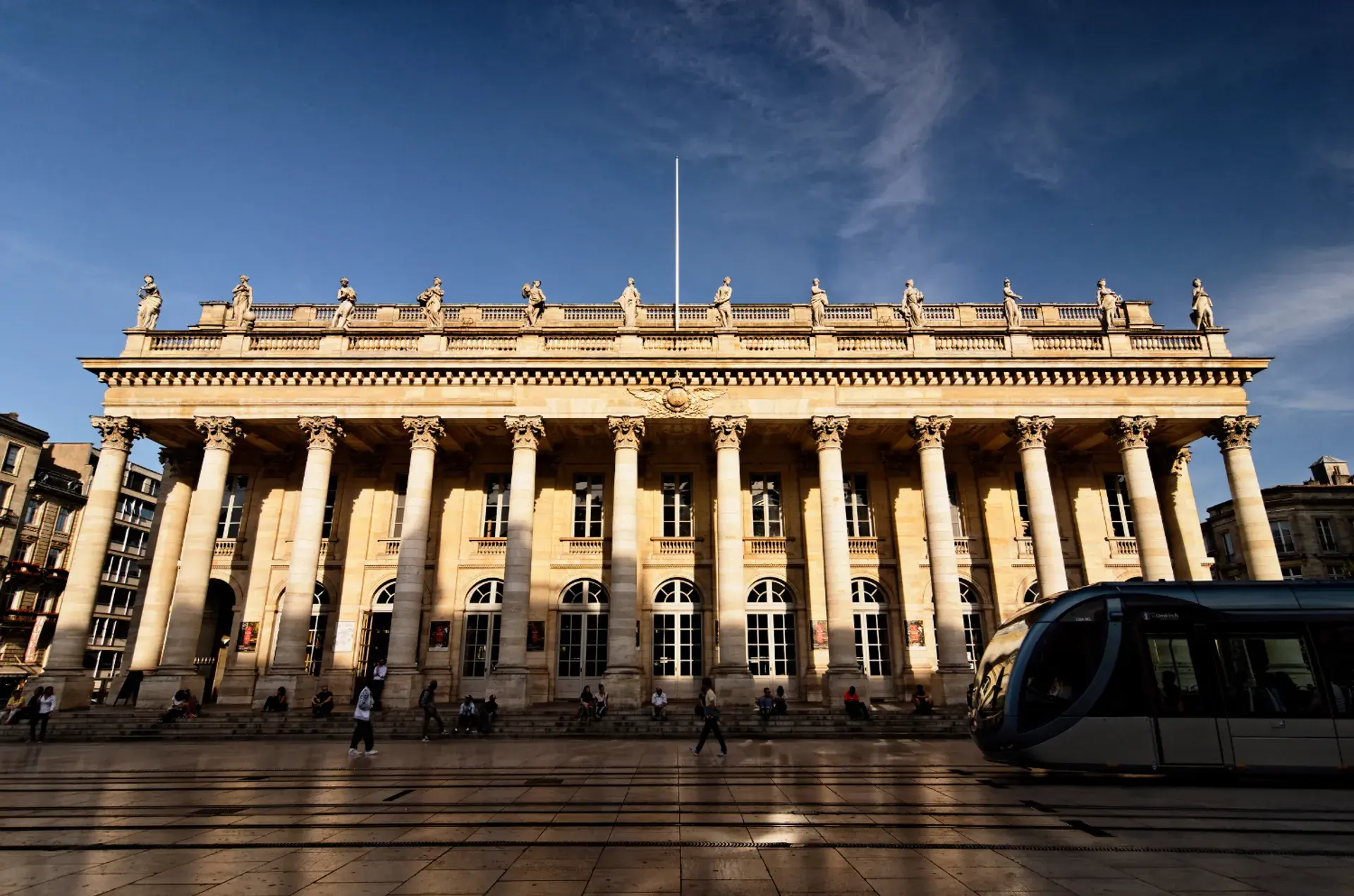
The Grand Théâtre de Bordeaux stands on Place de la Comédie as one of Europe's premier examples of neoclassical civic architecture. Commissioned by Louis Armand du Plessis, Duke of Richelieu and Governor of Guyenne, the project was conceived to replace an earlier venue destroyed by fire in 1755 and provide a theatre commensurate with Bordeaux's 18th-century maritime prominence. Designed by architect Victor Louis, the landmark was inaugurated on April 7, 1780, with productions of Jean Racine's tragedy Athalie and Blincourt's Le Jugement d'Apollon.
The exterior is defined by a monumental portico supported by twelve colossal Corinthian columns. Above the entablature, a balustrade supports twelve stone statues sculpted by Pierre-François Berruer and his assistant Van den Drix. These figures represent the nine classical Muses alongside three Roman goddesses: Juno, Minerva, and Venus. Despite creating the city's most acclaimed monument, Victor Louis was neither present nor formally named during the 1780 opening due to municipal friction regarding his royal appointment and his reliance on non-local artisans.
Self guided walking tour of Bordeaux with audio guide
2 hours8 stopsAudio guideStart any day, at your own paceTicket on your phone · 30-day refundThe Grand Staircase and Influence on the Palais Garnier
Decades before Paris built the Palais Garnier, its most celebrated structural innovation was already operating in Bordeaux. Victor Louis designed a monumental vestibule and grand double staircase that Charles Garnier later used as the direct architectural blueprint for the Paris Opera.
The staircase receives natural illumination from overhead ceiling glass apertures. Victor Louis specifically planned the dual flights as a social stage: the ascent was arranged so that affluent patrons displayed their formal attire in full profile to onlookers in the vestibule below before pausing on the landing.
The Timber Auditorium and Acoustic Design
The Grand Théâtre is one of the oldest surviving wooden-framed opera houses in Europe that has never burned down or required structural rebuilding. The warm, resonant acoustic character of the auditorium is created by this enclosed timber framing concealed behind the ornamental plasterwork.
Between 1989 and 1991, the auditorium was restored to its original Ancien Régime aesthetic of royal blue, white, and gold leaf. The ceiling features a fresco painted by Jean-Baptiste Robin, which combines representations of Apollo and the arts with allegorical scenes of Bordeaux's 18th-century commercial foundations, including the wine trade, maritime shipping, and colonial commerce. Illuminating the hall is a 1.2-tonne Bohemian crystal chandelier fitted with 400 lamps, installed in 1917.
Historical Milestones in Dance and Governance
The theatre holds a prominent place in the history of classical dance. In 1789, it hosted the premiere of Jean Dauberval's seminal comedic work La fille mal gardée, and it later served as an early stage for choreographer Marius Petipa.
Beyond cultural milestones, the building served an essential political role during the Franco-Prussian War. In 1871, when the national government temporarily relocated to Bordeaux, the Grand Théâtre briefly housed the French National Assembly.
Urban Anchor and Contemporary Performances
The Grand Théâtre occupies a strategic civic position in Bordeaux. Facing the Grand Hôtel across Place de la Comédie, it serves as a central hinge connecting the medieval quarters to the riverfront quays and the Esplanade des Quinconces. It also anchors the northern end of Rue Sainte-Catherine at its junction with the Allées de Tourny and the upscale Triangle d'Or district.
Today, the building operates as the primary home for the Opéra National de Bordeaux and the Ballet National de Bordeaux. It stages annual seasons of opera, symphonic concerts, chamber recitals, and ballets, while regularly opening its historic halls for public guided tours and cultural programming.
FAQ
Which statues appear on the façade of the Grand Théâtre de Bordeaux?
The balustrade above the portico is adorned with twelve stone statues sculpted by Pierre-François Berruer and Van den Drix. They depict the nine classical Muses and three Roman goddesses: Juno, Minerva, and Venus.
How did the Grand Théâtre influence the Paris Opera?
The theatre's vestibule and grand double staircase, designed by Victor Louis, served as the direct architectural inspiration and model for Charles Garnier's design of the Palais Garnier in Paris.
Why was the architect Victor Louis absent from the 1780 inauguration?
Victor Louis was neither present nor acknowledged at the opening due to political friction with local authorities over his royal appointment by the Duke of Richelieu and his decision to employ outside craftsmen.
More places in Bordeaux
bordeaux, france
Maison Gobineau: the flatiron of the wine trade
Maison Gobineau: the flatiron of the wine trade
bordeaux, france
Monument aux Girondins: the fountain of bronze horses
Monument aux Girondins: the fountain of bronze horses
bordeaux, france
Porte Cailhau: a gate built to impress