Monument aux Girondins: Bordeaux's Bronze Horses
Origins and Revolutionary Dedication
Standing at the western edge of Place des Quinconces in Bordeaux, the Monument aux Girondins is a monumental civic tribute created under the French Third Republic. Built between 1894 and 1902 and inaugurated in 1902, the structure was designed by sculptor Achille Alphonse Dumilatre alongside architect Victor Rich. In 2011, the complex received official recognition as a French Monument historique.
The monument commemorates the Girondins, a faction of moderate republican deputies in the French Revolution. In October 1793, during the Reign of Terror, these representatives were ousted by the radical Montagnard faction and executed by guillotine. A century after their deaths, Bordeaux commissioned the monument to honor their legacy and rehabilitate their standing as martyrs of the republic.
The memorial occupies the historical grounds of the Château Trompette, a royal fortress erected after the Hundred Years' War to supervise the city's populace. Following the demolition of the fortress in the early 19th century to open urban access to the Garonne river, the site was transformed into the 12-hectare Place des Quinconces. Named for the offset tree arrangement planted in 1818, the square serves as an urban link between the neoclassical Golden Triangle and the historic Chartrons wine-merchant district.
Self guided walking tour of Bordeaux with audio guide
2 hours8 stopsAudio guideStart any day, at your own paceTicket on your phone · 30-day refundArchitectural Grandeur and the Bronze Fountains
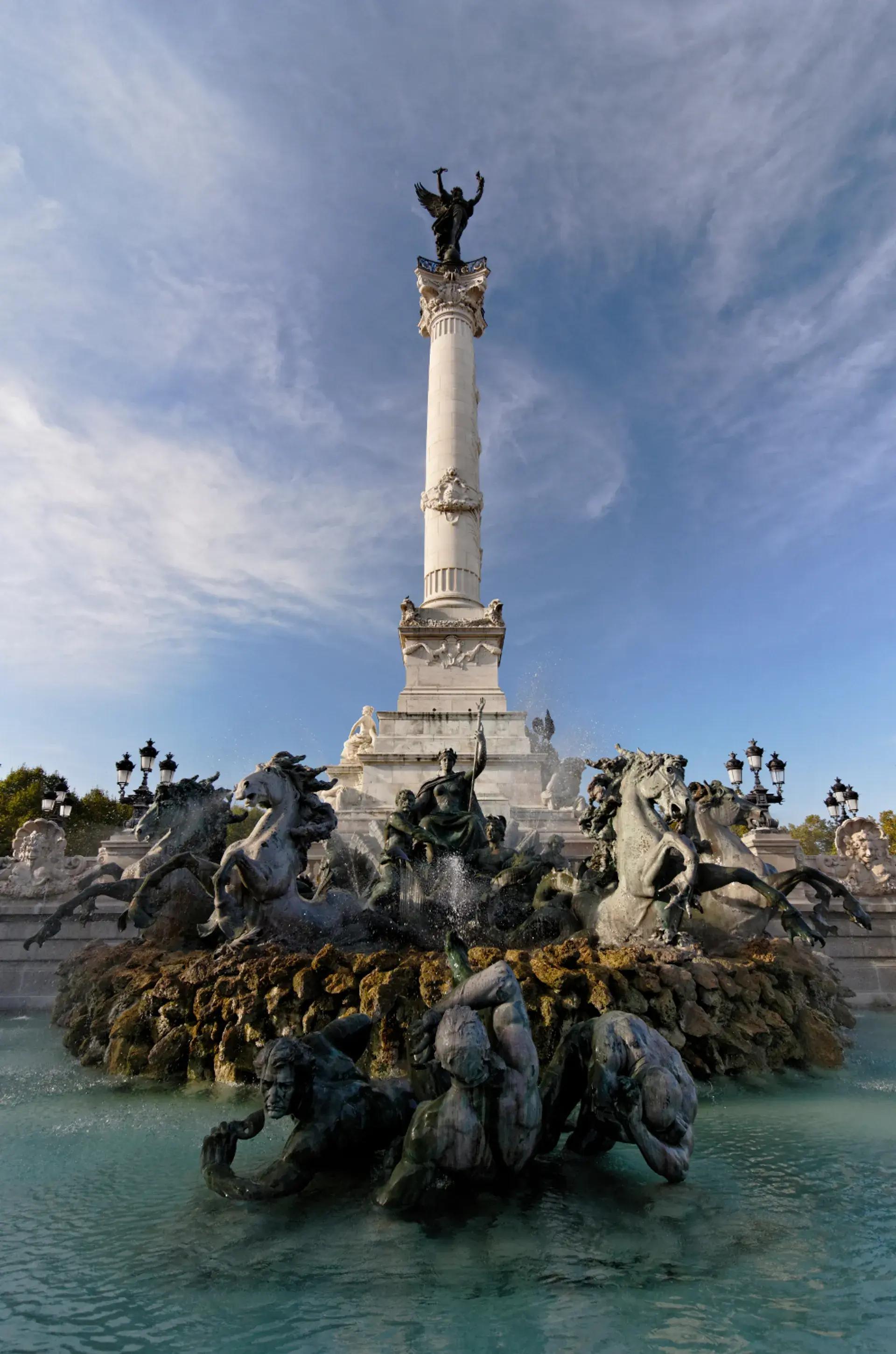
The central feature of the memorial is a 43-meter stone column that reaches a total height of roughly 54 meters. At its pinnacle perches the gilded bronze Génie de la Liberté (Spirit of Liberty), depicted breaking chains while brandishing a victory palm.
Flanking the base of the column are two large semicircular fountain basins filled with intricate allegorical metalwork. The southern basin features Le Triomphe de la République, populated by sculpted representations of Work, Security, and Force. Facing north, the basin titled Le Triomphe de la Concorde celebrates civil peace and fraternity.
Dynamic bronze horses draw the allegorical chariots through the water. These chimeric figures possess equine heads and forelegs ending in webbed hooves, while their hindquarters transform into scaly, serpentine fish tails. Powerful water jets surge from beneath the chariot wheels and the mouths of attendant sea creatures, filling the basin with rushing water and sending a cool, fine mist across the surrounding stone plaza.
The Missing Deputies and Subtle Symbolism
Despite the monument's dedication to the Girondin politicians, none of the martyrs are depicted on the structure. The original design included eight individual portrait statues of deputies intended to sit upon pedestals behind the fountains. Budget shortages forced the municipal authorities to abandon the statues, leaving the pedestals vacant. It was not until 1989 that a simple plaque listing their names was added to the site.
The project was also shaped by earlier financial considerations. In 1888, Bordeaux explored commissioning sculptor Frédéric Auguste Bartholdi to create a monumental fountain on the esplanade. The municipality ultimately deemed Bartholdi's proposal too expensive. Bartholdi subsequently sold the fountain design to the city of Lyon, where it now resides on Place des Terreaux.
Careful observers can find local iconography woven into the column's stonework. Just below the capital, carved capital letters "G" for Girondins interlock with crescent moons. The crescent is Bordeaux's traditional heraldic emblem, signifying the sweeping curve of the Port de la Lune along the Garonne.
Wartime Survival and Modern Public Life
The bronze figures narrowly avoided destruction during World War II. In August 1943, under German occupation and Vichy metal requisition orders, 34 bronze sculpture groups totaling over 50 metric tons were removed from the basins to be melted down for weapons. Transported by rail to the Savigner foundry in Angers, the sculptures were concealed and protected by foundry personnel until France was liberated.
Following the war, the bronzes were returned to Bordeaux in July 1945. They remained in storage inside maritime warehouses in the Bacalan district for almost forty years. A municipal restoration initiative finally reassembled and reinstated the bronze horses and allegorical figures in January 1983.
Today, the Monument aux Girondins stands beside a multimodal transit hub where Bordeaux tram lines B, C, and D intersect. Beyond serving as a cooling retreat during hot summers, the surrounding esplanade hosts major civic and seasonal gatherings, including open-air concerts, antique markets, travelling circuses, and the biannual Foire aux Plaisirs funfair.
FAQ
Why are there no statues of the Girondin deputies on the monument?
Although eight individual statues of the Girondin deputies were originally planned to sit on dedicated pedestals behind the fountains, they were canceled due to municipal budget overruns. The pedestals remained empty until a commemorative plaque listing their names was installed in 1989.
How did the bronze sculptures survive World War II?
In August 1943, over 50 metric tons of bronze figures were confiscated under Vichy requisition orders to be melted down for armaments. They were transported to a foundry in Angers, where foundry staff managed to conceal and protect them until the Liberation of France.
What kind of creatures are depicted in the bronze fountains?
The horses drawing the allegorical chariots are mythological hybrids featuring equine forequarters, webbed hooves, and scaly, serpentine fish tails.
More places in Bordeaux
bordeaux, france
Maison Gobineau: the flatiron of the wine trade
Maison Gobineau: the flatiron of the wine trade
bordeaux, france
Grand Théâtre: the temple of the twelve muses
Grand Théâtre: the temple of the twelve muses
bordeaux, france
Porte Cailhau: a gate built to impress