Grand Place in Lille: A Historic City Square
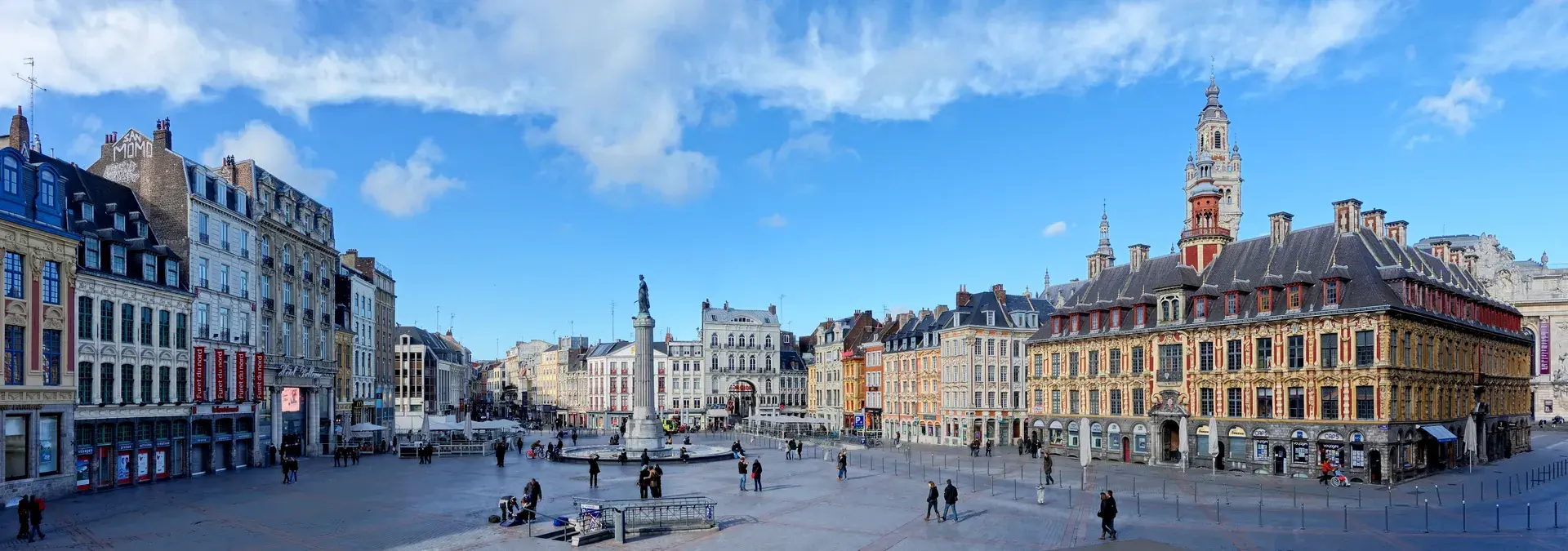
Officially known as Place du Général-de-Gaulle, the Grand Place is the bustling heart of Lille. This central square, which originated as a medieval marketplace, is a testament to the city's resilience, surrounded by a blend of Flemish and French architecture that reflects its history as a cultural crossroads.
From Marshland to Marketplace
The area of the Grand Place was originally marshy land that was drained during the Middle Ages. By the 14th century, it was officially established as the city's main market square. A significant transformation occurred between 1652 and 1653 with the construction of the Vieille Bourse (Old Stock Exchange). This new structure effectively divided the area, creating the Grand Place and the adjacent Petite-Place, now known as Place du Théâtre.
The Siege of 1792 and the Goddess Column
A defining event in the square's history was the Siege of Lille in September 1792. During the French Revolutionary Wars, an Austrian army bombarded the city for nine consecutive days, firing approximately 30,000 cannonballs. Despite the immense destruction, which included the complete demolition of the Saint-Etienne church on the square, Mayor François André-Bonte famously refused to surrender.
To commemorate this heroic resistance, the Colonne de la Déesse (Column of the Goddess) was inaugurated in the center of the square on October 8, 1845. The monument, reaching a total height of 15.51 meters, features a grooved granite column designed by architect Charles Benvignat. Atop it stands a bronze statue by Théophile Bra, an allegorical figure representing the city of Lille. The defiant words of Mayor André-Bonte are inscribed on the column's base.
Architectural Highlights
The Grand Place is framed by several significant buildings. The Vieille Bourse, an exquisite example of 17th-century Flemish Renaissance style, was designed by Julien Destrée. Its inner courtyard, composed of 24 identical houses, now hosts second-hand booksellers, florists, and chess players.
Another notable structure is the Grand'Garde, a classical building constructed in 1717 by Thomas Joseph Gombert, which originally housed soldiers and is now home to the Théâtre du Nord. A subtle but powerful reminder of the city's past can be found on the facade of the Rang du Beauregard building, where twelve cannonballs from the 1792 siege remain embedded.
The Grand Place Today
In September 1944, the square was officially renamed Place du Général-de-Gaulle in honor of the French leader, who was born in Lille in 1890. Today, it remains a vibrant hub filled with cafes and shops. The square frequently hosts cultural events, artistic exhibitions, and the popular Christmas market. Uniquely for a major European square, it lacks a central church, as the Saint-Etienne church was never rebuilt after its destruction in the 1792 siege. The city continues to enhance the area by expanding pedestrian access.
FAQ
What is the official name of the Grand Place in Lille?
The official name is Place du Général-de-Gaulle, a name it received in September 1944 to honor Charles de Gaulle, who was born in Lille. It is also colloquially known as Place de la Déesse.
Why is there a column in the middle of the Grand Place?
The Colonne de la Déesse (Column of the Goddess) was inaugurated in 1845 to commemorate the city's heroic resistance during the Austrian siege of 1792. The statue atop the column is an allegory for the city of Lille.
What are some key buildings on Lille's Grand Place?
Notable buildings include the Vieille Bourse (Old Stock Exchange) from the 17th century, now a book and flower market, and the Grand'Garde, a classical building from 1717 that now houses the Théâtre du Nord.
Are there any hidden details to see on the Grand Place?
Yes, twelve cannonballs from the 1792 Austrian siege are still embedded in the facade of the Rang du Beauregard building, serving as a permanent memorial to the event.