Porte de Paris in Lille: A Royal Triumphal Arch
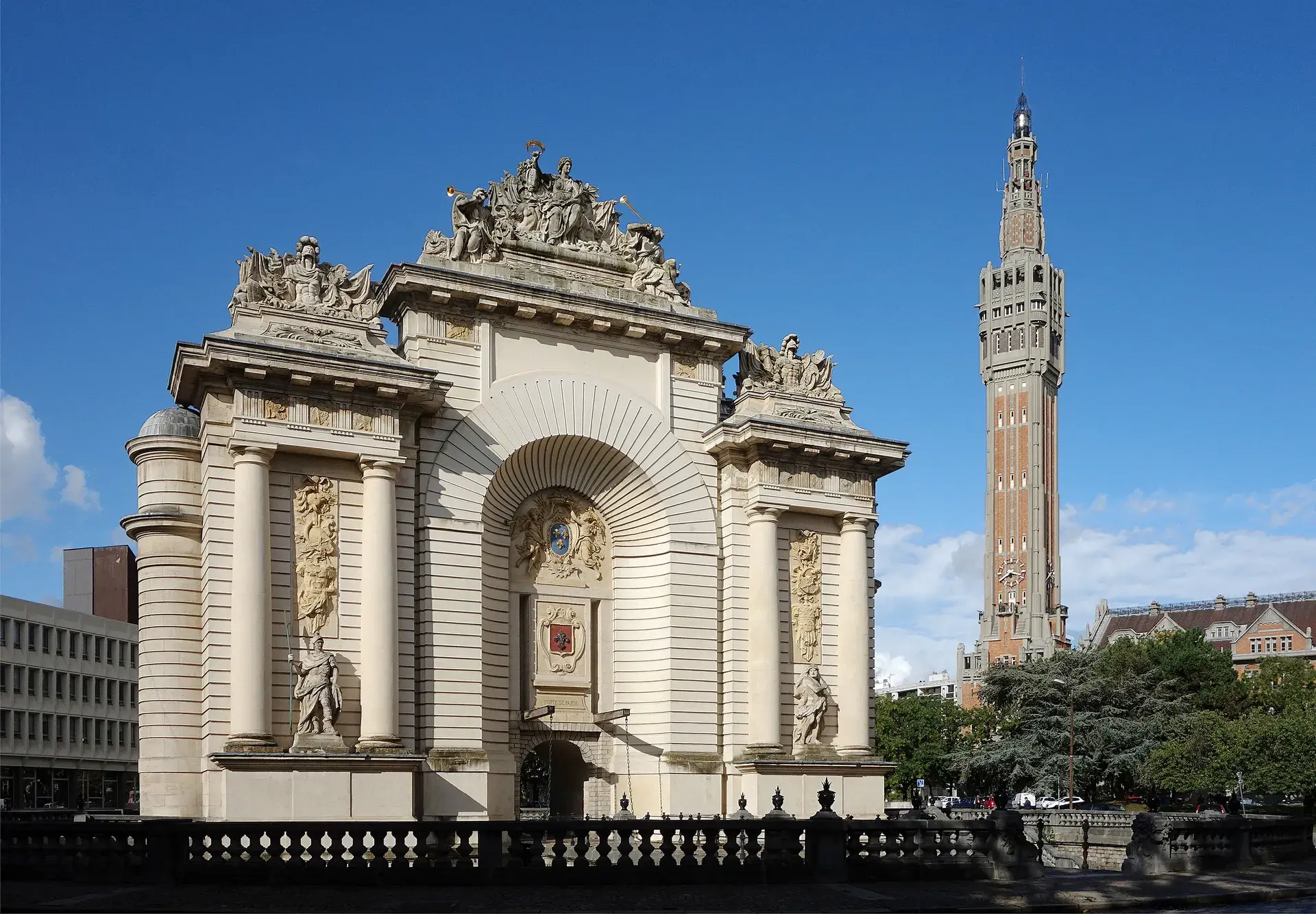
Stand before the triumphant Porte de Paris, a magnificent 17th-century arch towering proudly, commemorating a pivotal moment in Lille's history. This landmark embodies the city's transition from Spanish to French rule, serving as a lasting symbol of royal power and urban elegance.
A Monument to Royal Conquest
The Porte de Paris was commissioned by King Louis XIV to immortalize his capture of Lille from the Spanish in 1667. Following a siege of just over two weeks by an army of 35,000 men, the 'Sun King' himself entered the city and received its keys. To mark this victory and Lille's integration into the French kingdom, construction of a grand triumphal arch began.
Built between 1685 and 1692, the arch replaced a more modest medieval gate known as the Porte des Malades (Gate of the Sick). The new structure was a powerful statement, transforming a military victory into a permanent architectural feature of the city.
Architectural Grandeur and Design
Standing approximately 29 meters high, the Porte de Paris showcases a blend of Baroque and Classical styles. The original design is primarily attributed to engineer Simon Vollant, who had also worked on the formidable Lille Citadel. The renowned military engineer Sébastien Le Prestre de Vauban, who laid the foundation stone for the Citadel, also oversaw the arch's construction as part of the city's new fortifications.
A unique feature of the monument is its two distinct facades. The southern facade retains much of Vollant's original 17th-century design. In contrast, the northern, city-facing side was redeveloped between 1888 and 1892 by architect Louis-Marie Cordonnier, giving the arch a different architectural character on each side.
Sculptural Symbolism
The arch is adorned with intricate sculptures rich with meaning. On the left stands a figure of Mars, the Roman god of war, while on the right is Hercules, symbolizing strength. At the center of the composition, an allegorical figure of Victory is depicted, poised to place a crown upon the head of King Louis XIV, forever cementing his triumph in stone.
From City Gate to Urban Landmark
Originally an integral part of Lille's defensive walls, the Porte de Paris now stands as an isolated monument in an open square. When the city's fortifications were dismantled in the 1860s, the arch was saved from demolition by a commission that recognized its historical value. Today, it is often described as a 'floating gate leading nowhere.'
The Porte de Paris is freely accessible to the public and has become a popular spot for photography and a starting point for tours of the city. It serves as a prominent historical landmark where Lille's past and present intersect.
FAQ
Why was the Porte de Paris in Lille built?
The Porte de Paris was commissioned by King Louis XIV to commemorate his conquest of Lille from the Spanish in 1667 and to symbolize the city's integration into the French kingdom.
When was the Porte de Paris constructed?
The triumphal arch was constructed between 1685 and 1692.
Can you go inside the Porte de Paris?
No, it is not possible to enter the monument. However, it is located in a public square and its exterior can be viewed freely 24 hours a day.
Why does the Porte de Paris stand alone?
The Porte de Paris stands alone because the surrounding city walls, of which it was once a part, were dismantled in the 1860s. The arch itself was preserved as a historical monument.