Bamberg’s Altes Rathaus: The Town Hall in the River
An Island Between Two Powers
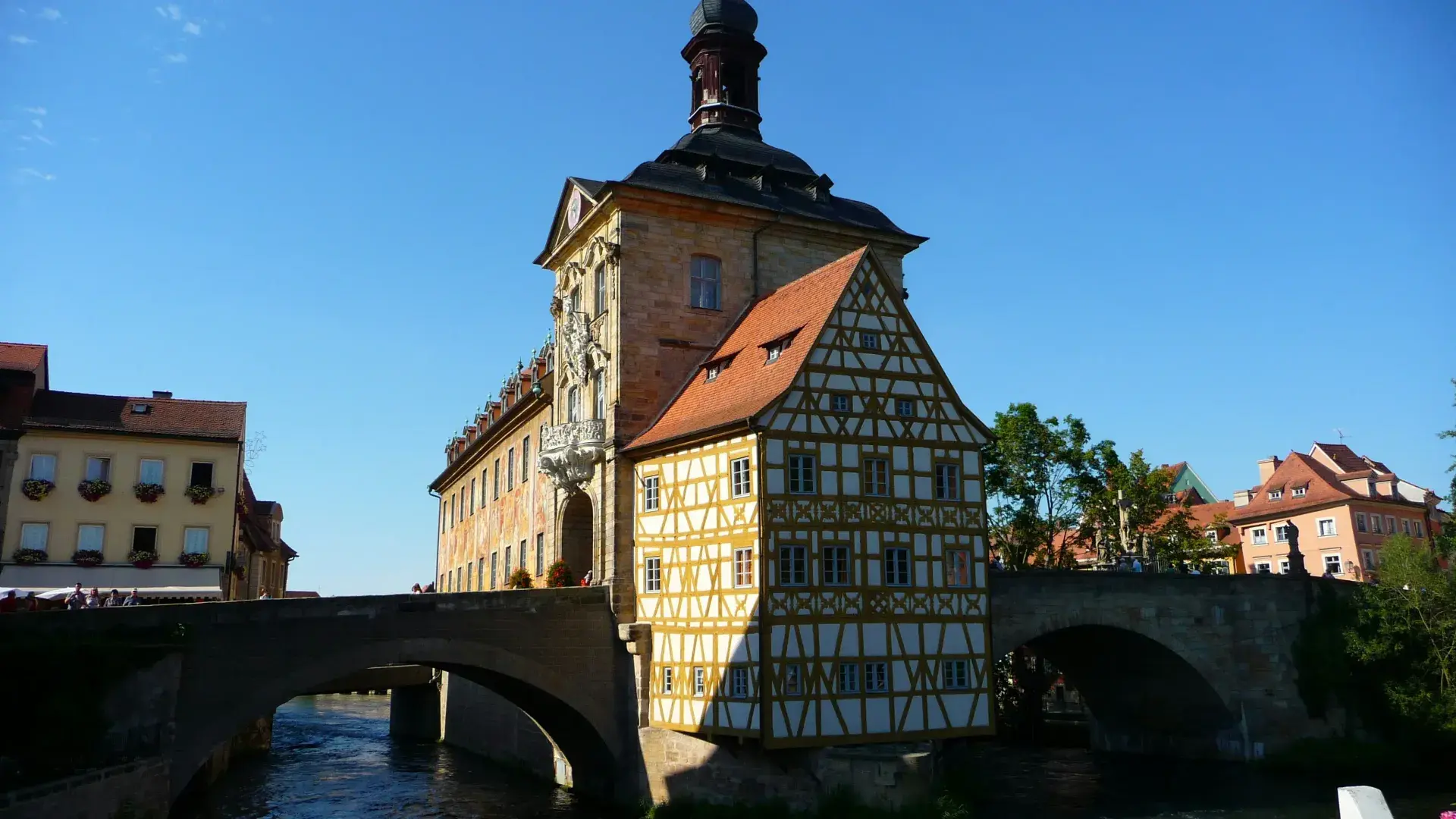
Bamberg's Altes Rathaus (Old Town Hall) occupies an extraordinary setting in the left arm of the Regnitz River. First documented in 1386 or 1387, the building was situated along a historic political frontier. It sat directly on the civic boundary dividing the ecclesiastical domain of the Prince-Bishops on the hills (Bergstadt) from the bourgeois merchant settlement situated on the river plains (Inselstadt).
A enduring local legend claims that the townspeople drove oak piles into the riverbed to construct their own artificial island after the Prince-Bishop refused to grant them municipal land for a town hall. While this tale endures in popular lore, historical documentation indicates that the river-bound location was chosen for bridge control and boundary demarcation, standing as a deliberate symbol of civic self-assertion.
Bamberg walking tour with audio and quizzes: bishops, beer and bridges
2 hours8 stopsAudio guideStart any day, at your own paceTicket on your phone · 30-day refundArchitecture from Gothic to Rococo
Following a destructive fire in 1460, the town hall was rebuilt between 1461 and 1467 in late-Gothic style. Several centuries later, between 1744 and 1756, architect Johann Jakob Michael Küchel redesigned the complex into a blend of Baroque and Rococo styles. Although the town hall symbolized secular municipal authority, this mid-18th-century reconstruction was initiated by Prince-Bishop Friedrich Karl von Schönborn, who aimed to monumentalize the avenue ascending toward Cathedral Hill (Domberg).
The ensemble is spanned by two bridges: the Obere Brücke (Upper Bridge) and the Untere Brücke (Lower Bridge). The complex consists of three main elements: the central bridge tower (Brückenturm), the council hall (Rathausbau), and the timber-framed annex known as the Rottmeisterhäuschen.
The Rottmeisterhäuschen and Wartime Restoration
Cantilevered over the river, the picturesque half-timbered annex originally housed the Rottmeister, the officer commanding the local civic defense watch units (Rotten). For centuries, its decorative timber framing was hidden behind protective plaster.
In April 1945, wartime bridge demolitions inflicted severe damage on the adjacent bridge arches and the annex’s exterior. During post-war repairs, conservators opted to strip away the damaged plaster entirely, permanently revealing the dark timber framing that overhangs the water.
Trompe-l’Œil Murals and the Three-Dimensional Putto
The exterior of the Rathausbau features allegorical trompe-l'œil frescoes executed by Johann Anwander in 1755, which were later reconstructed in the 1960s by Anton Greiner. These elaborate paintings depict classical virtues, the elements, and the four seasons.
On the eastern façade, an architectural curiosity breaks the illusion of the flat wall. One of Anwander's painted cherubs (putto) features a leg sculpted in full-relief stucco that projects out from the wall into physical three-dimensional space, creating a playful visual contrast against the surrounding two-dimensional artwork.
River Setting and Preservation
Positioned at a natural geographic bottleneck connecting the merchant hub at Grüner Markt with the historic ascent toward Bamberg Cathedral and the Alte Hofhaltung, the Altes Rathaus remains one of the city's key historical landmarks. From vantage points such as the Obere Brücke or the pedestrian Geyerswörthsteg, the steady roar of the Regnitz River can be heard rushing directly against and underneath the building's massive stone piers.
Inside, the building houses the Ludwig Collection (Sammlung Ludwig Bamberg), an assemblage of 18th-century porcelain and Strasbourg faience donated by Peter and Irene Ludwig. The complex also preserves its ceremonial Rococo council chamber (Rokokosaal). The Altes Rathaus and the Ludwig Collection are currently closed for extensive structural renovations.
FAQ
Why was the Altes Rathaus built in the middle of the river?
The town hall was constructed on an artificial island in the Regnitz River along the border separating the Prince-Bishops' territory on the hills (Bergstadt) from the merchant settlement (Inselstadt). It served as an assertion of civic autonomy and provided bridge oversight.
What is the three-dimensional feature on the painted façade?
On the eastern façade, a sculpted stucco cherub's (putto's) leg extends outward into physical space, breaking through the flat plane of Johann Anwander's 1755 trompe-l'œil frescoes.
Can visitors access the interior of the Altes Rathaus?
The Altes Rathaus and its interior Ludwig Collection are currently closed to the public for structural renovations.