Bishop Otto Statue: Bamberg's Medieval Rebuilder
The Monument at Ottoplatz
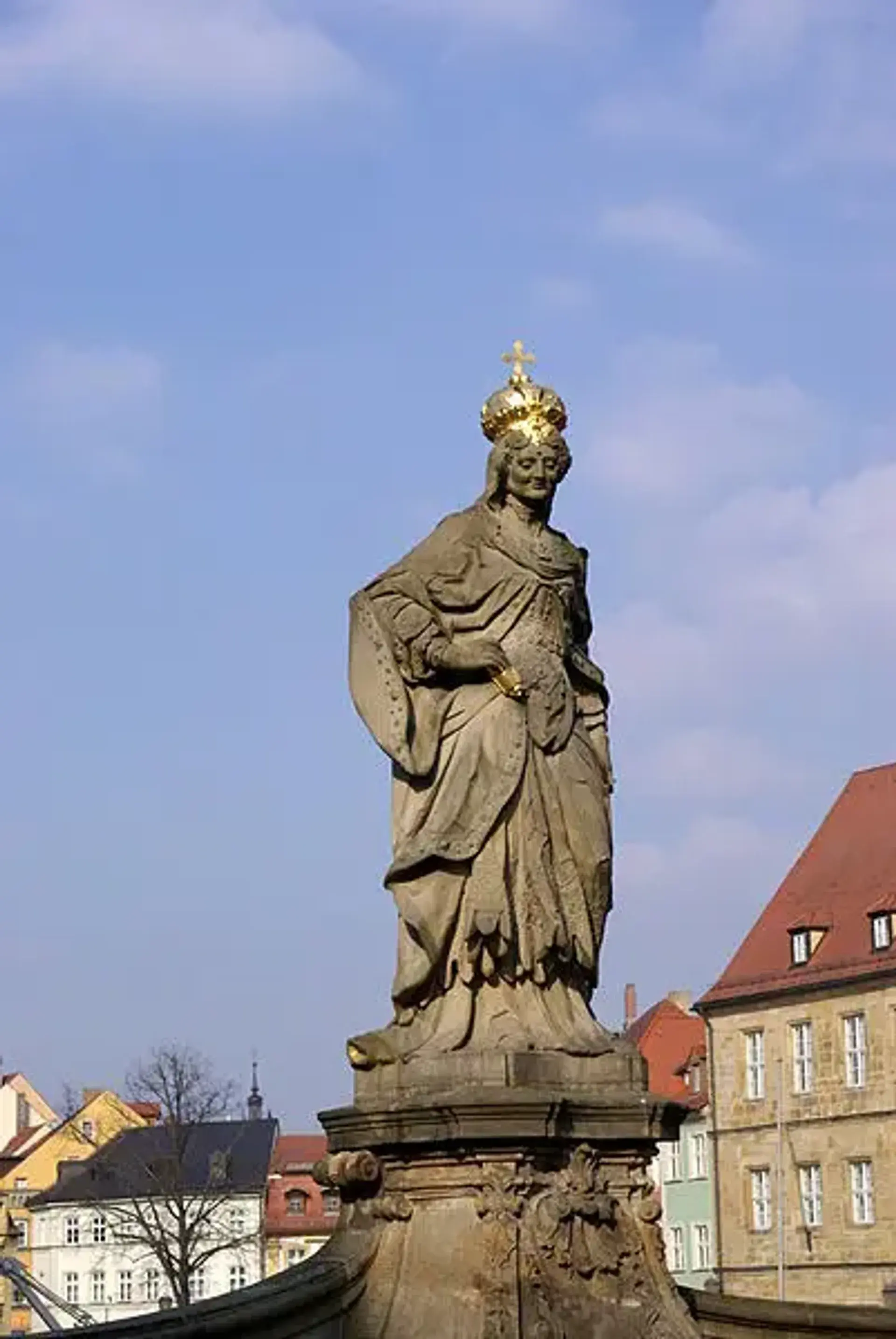
The Bishop Otto statue stands in a publicly accessible garden forecourt fronting Ottoplatz 1, the former late-18th-century Felsecker Economic Institute. Situated at the western base of Cathedral Hill (Domberg), this monument marks the transition between Bamberg's historic riverfront Sand quarter (Sandgebiet) and the uphill pedestrian pathways leading toward the Cathedral and Michaelsberg Abbey.
Created around 1881 by local Bamberg sculptors Adam Christ (1856–1881) and Philipp Dorsch, the sculpture is an officially registered Bavarian cultural heritage monument (Baudenkmal D-4-61-000-1170). Carved from pale limestone and sandstone, the figure rests atop a dedicated stone pedestal. It depicts Bishop Otto I in full pontifical vestments, crowned with a mitre, holding a crosier, and elevating a crucifix. The weathered stone surface exhibits fine-grain tooling marks that create a distinct texture set against the backdrop of garden foliage and historic masonry.
Bamberg walking tour with audio and quizzes: bishops, beer and bridges
2 hours8 stopsAudio guideStart any day, at your own paceTicket on your phone · 30-day refundImperial Diplomat and Church Rebuilder
Saint Otto I of Bamberg (c. 1060–1139) served as the city's eighth bishop from 1102 until his death. Before his episcopal appointment, Otto was chancellor to Holy Roman Emperor Henry IV, during which time he supervised the Romanesque completion of Speyer Cathedral. His diplomatic prominence culminated in 1122, when he played an instrumental role in negotiating the Concordat of Worms, resolving the Investiture Controversy between the Papacy and the Holy Roman Empire.
Within Bamberg, Otto became celebrated as a restorer. While Emperor Heinrich II had founded the bishopric a century earlier, Otto preserved and solidified its monumental heritage. Following a devastating fire in 1081, he oversaw the restoration of Bamberg Cathedral. He also reconstructed Michaelsberg Abbey after it was damaged by the 1117 earthquake, completed the church of St. Jakob in 1109, and founded numerous charitable houses and monastic settlements throughout Franconia and Bavaria.
Missions to Pomerania and Canonization
Beyond his administrative and architectural contributions, Otto is remembered for his evangelizing work. In 1124–1125 and again in 1128, he conducted missionary journeys across the Baltic region, which earned him the historic moniker "Apostle of the Pomeranians."
Bishop Otto died in Bamberg on June 30, 1139, and was canonized by Pope Clement III fifty years later, in 1189. Following his sanctification, he became one of the diocese's principal patron saints. In the late 19th century, civic commemorations across Bamberg celebrated Otto's legacy, including his depiction on Ferdinand von Miller’s 1880 Maximiliansbrunnen in the lower island city and the placement of the limestone monument at Ottoplatz.
Traditions and Healing Relics
Otto’s memory in Bamberg is intertwined with several unusual historical traditions. Documented through 1781, a local ritual involved dipping a reliquary containing Otto’s jewel-encrusted jawbone into wine. The resulting mixture, known as Ottowein, was distributed to the sick to treat fevers and bodily ailments.
Otto chose Michaelsberg Abbey as his final resting place. His medieval high tomb inside the abbey church, dating from around 1335 to 1340, includes a structural passage beneath the stone slab known as the Durchschlupf. For centuries, pilgrims have crawled through this narrow opening, maintaining a belief that direct physical proximity to the saint’s tomb offers relief from spinal conditions and back pain.
FAQ
Who created the Bishop Otto statue at Ottoplatz?
The statue was crafted around 1881 by Bamberg sculptors Adam Christ and Philipp Dorsch using carved limestone and sandstone.
Why is Bishop Otto called the 'Apostle of the Pomeranians'?
He earned the title after leading major Christian missionary expeditions to Pomerania in 1124–1125 and 1128.
What was the historical tradition of 'Ottowein'?
Documented through 1781, local custom involved dipping a reliquary containing Saint Otto's jawbone into wine, which was then given to the sick to alleviate fevers and physical ailments.
What is the 'Durchschlupf' at Bishop Otto's tomb?
The Durchschlupf is a narrow opening beneath Saint Otto's 14th-century tomb slab at Michaelsberg Abbey, through which pilgrims have crawled for centuries in search of relief from back pain.