Bremen Town Hall and Roland: A Free City's Pride
Monuments to Civic Autonomy
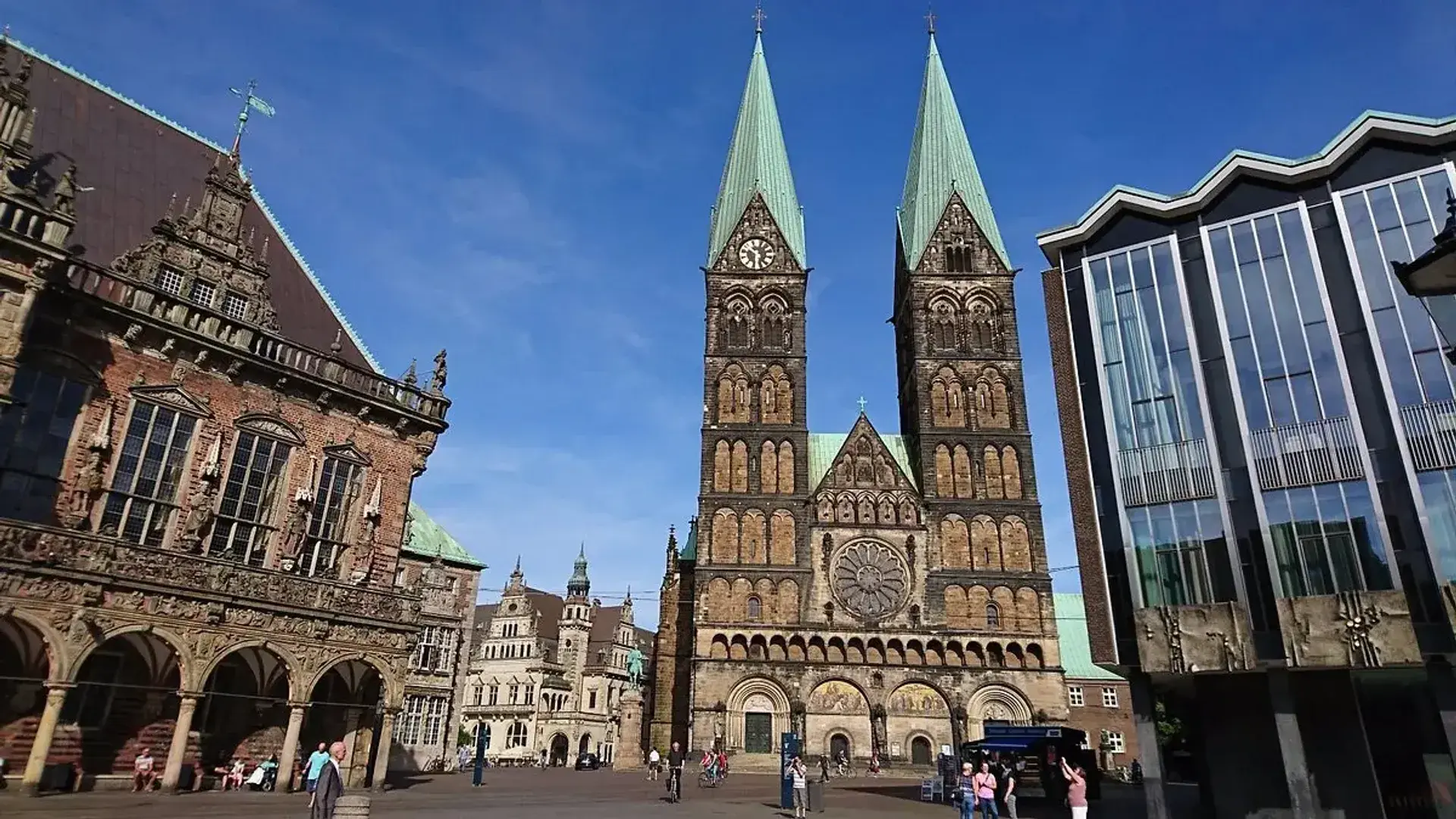
Standing on the northeastern edge of Bremen's Marktplatz, the ensemble of the Town Hall (Rathaus) and the Roland statue represents centuries of municipal independence and civic pride. Inscribed on the UNESCO World Heritage List in July 2004 under criteria (iii), (iv), and (vi), these landmarks serve as testaments to market freedom and secular sovereignty within the Holy Roman Empire.
The Town Hall unites two distinct eras of municipal administration: the Old Town Hall (Altes Rathaus), constructed as a Gothic hall building between 1405 and 1409, and the New Town Hall (Neues Rathaus), designed by Gabriel von Seidl and added between 1909 and 1913. Between 1608 and 1612, architect Lüder von Bentheim transformed the Old Town Hall's market-facing facade into a masterpiece of Weser Renaissance architecture, incorporating elaborate scrollwork gables, balustrades, bay windows, and intricate sandstone reliefs directly above an open ground-level Gothic stone arcade. A copper roof replacement in 2016 briefly shifted the building's familiar skyline profile before weathering returned it to its historic patina.
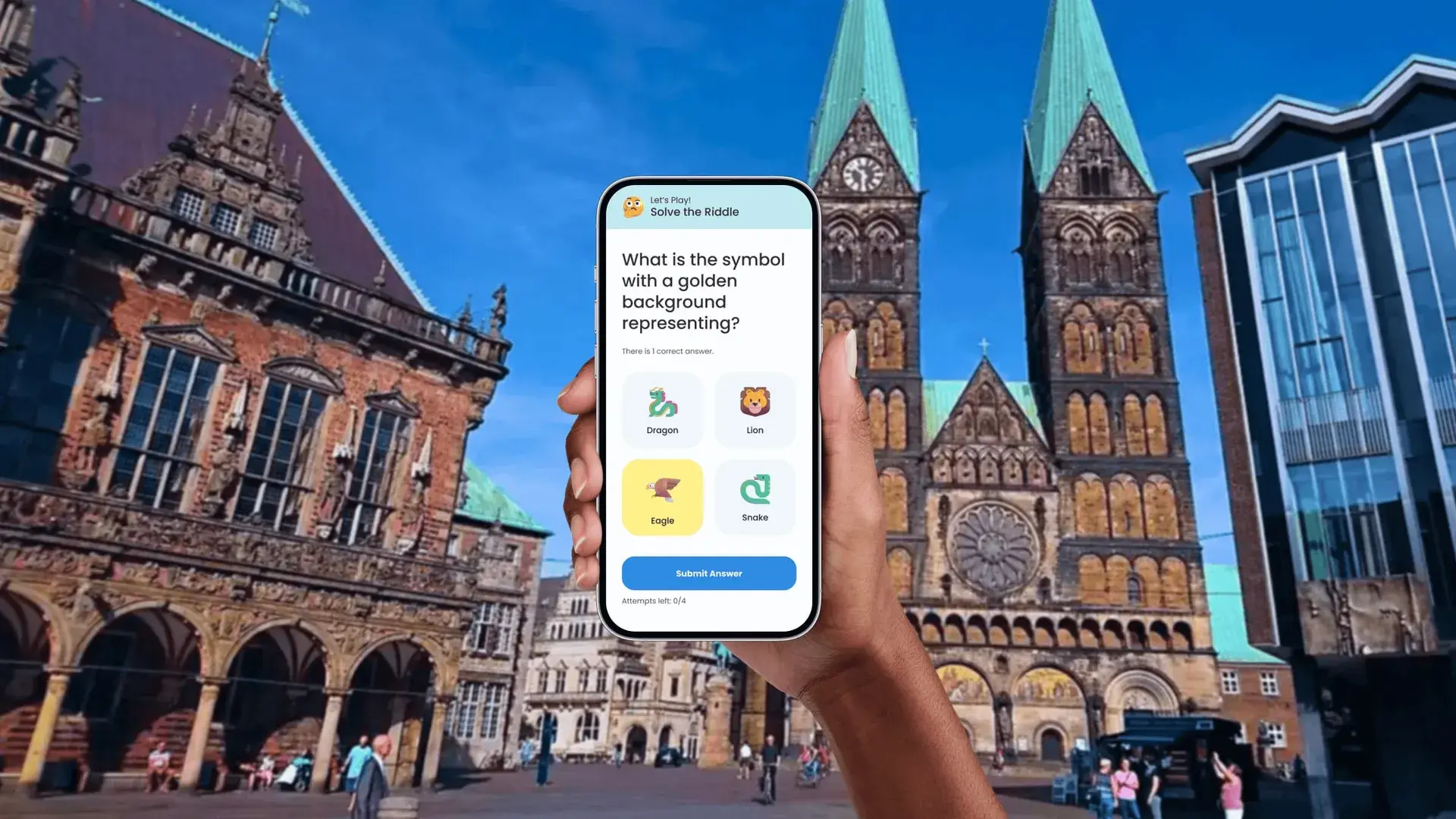
Bremen walking tour with audio and quizzes: Town Musicians and Roland
2 hours8 stopsAudio guideStart any day, at your own paceTicket on your phone · 30-day refundThe Roland Statue: Guardian of Market Rights
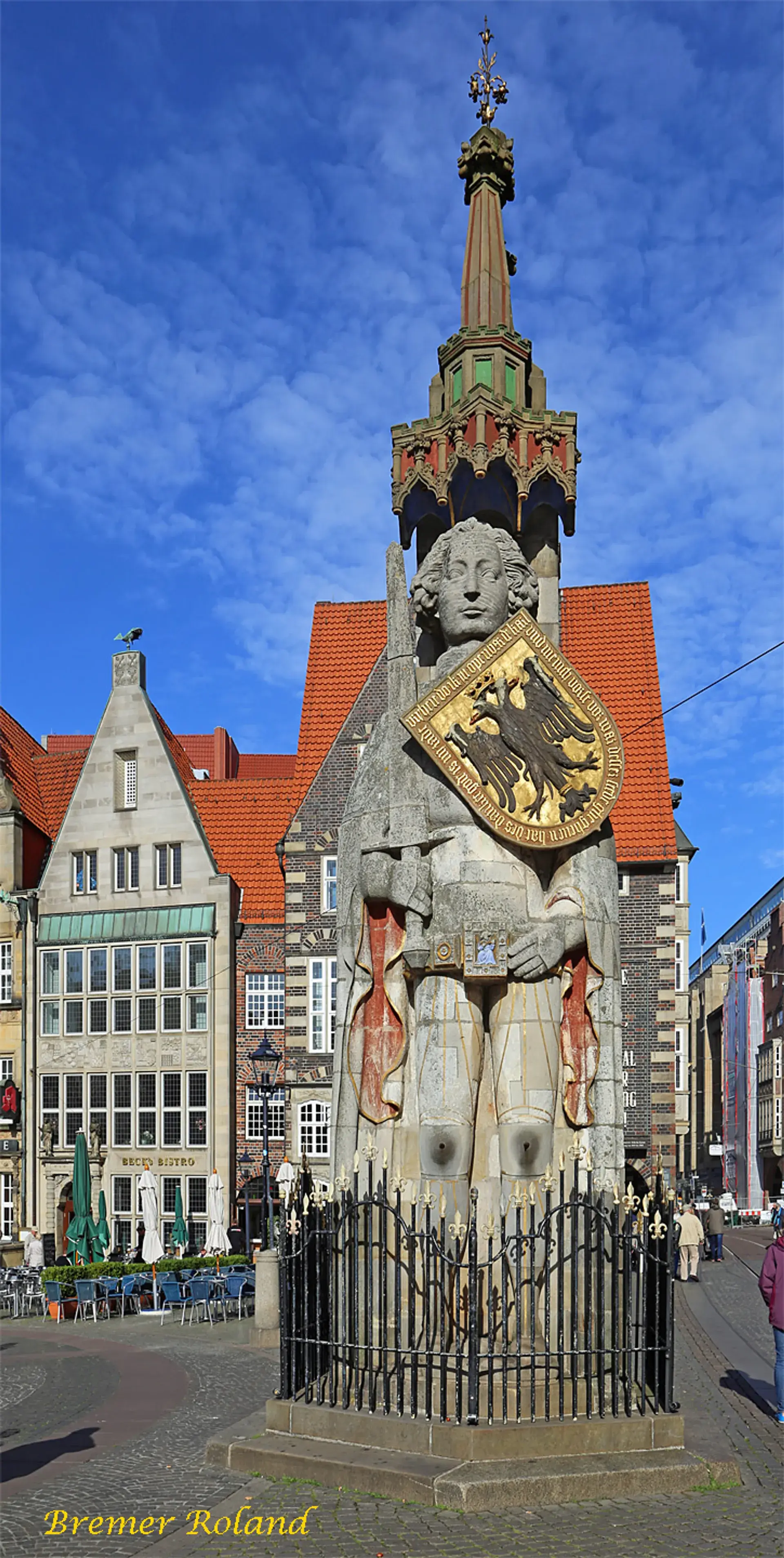
Erected in 1404 to replace a wooden predecessor burned down in May 1366 by troops loyal to Prince-Archbishop Albert II, the stone Roland statue stands as a sentinel of civic liberty. Carved primarily from Elm limestone, supported by a sandstone column, and topped by a Gothic canopy, the monument reaches an overall height of 10.21 meters, with the figure itself measuring between 5.47 and 5.55 meters. This scale makes it the largest freestanding sculpture surviving from the German Middle Ages.
The knight holds an unsheathed sword of justice and an imperial shield bearing the double-headed eagle alongside an inscription in Middle Low German affirming imperial privileges. Between Roland's knees lies a precise span of 55 centimeters, which established the "Bremer Elle"—the official medieval trade unit used by marketplace consumers to measure textiles and prevent merchant fraud. Carved between the statue's feet rests the small weathered half-figure of a "cripple," associated with municipal pasture grants. To preserve the original limestone head from environmental weathering, it was moved to Bremen's Focke Museum; the head on display today is a replica carved in the 1980s.
Defiance and Survival Across Centuries
Bremen's alliance with the Hanseatic League began in 1358, prompting local burghers and the city council to commission physical manifestations of their autonomy to counter ecclesiastical hegemony. Roland's placement was deliberate: his gaze and drawn blade orient directly across the square toward St. Peter's Cathedral, confronting the seat of the Prince-Archbishop with secular civic law. While many historic civic centers were destroyed during World War II, the Town Hall complex survived the air raids largely intact, and the Roland statue was protected throughout the conflict beneath a protective casing of brickwork and timber.
Operational Governance and Historic Interiors
The Town Hall remains the active administrative center of the Free Hanseatic City of Bremen, housing the mayoral offices and the Senate Chancellery. The Senate of Bremen holds its weekly meetings every Tuesday around the oval table in the Senate Hall. Guided tours periodically grant public access to the building's historic ceremonial rooms, including the 40-meter-long Upper Town Hall—where four historic model warships with miniature rigging and cannons hang from the wooden ceiling beams—as well as the Ballroom and the Güldenkammer, an Art Nouveau chamber redesigned by Heinrich Vogeler in 1905. Below, the Lower Town Hall hosts civic gatherings, public receptions, and cultural exhibitions.
Beneath the building lies the subterranean Bremer Ratskeller, an institution operating continuously since 1405. Beneath its dimly lit brick barrel vaults rests a collection of roughly 500,000 bottles of German wine and massive historic oak casks, including a 1653 Rüdesheimer vintage stored in the Rose Cellar. The Ratskeller also houses small private booths known as "Priölken," where municipal rules historically dictated that doors could only be closed if at least three patrons were inside, a measure instituted to deter clandestine political plots.
FAQ
Why does the Roland statue face St. Peter's Cathedral?
Roland was deliberately positioned holding an unsheathed sword facing St. Peter's Cathedral to symbolize secular civic authority, market liberties, and municipal autonomy in direct opposition to the Prince-Archbishop's ecclesiastical power.
What is the historical significance of the distance between Roland's knees?
The distance between the statue's pointed knees measures exactly 55 centimeters, serving as the official medieval trade standard known as the "Bremer Elle" for measuring textiles in the market square.
Is the original head of the Roland statue still on the monument?
No. The original limestone head was transferred to Bremen's Focke Museum to protect it from weather damage, and the head visible on the monument today is a replica created in the 1980s.
What is notable about the wine collection in the Bremer Ratskeller?
Operating continuously beneath the Town Hall since 1405, the Ratskeller stores approximately 500,000 bottles of German wine, including Germany's oldest cask-aged wine, a 1653 Rüdesheimer vintage stored in the Rose Cellar.