The Four Towers of Koblenz: Historic Oriel Windows
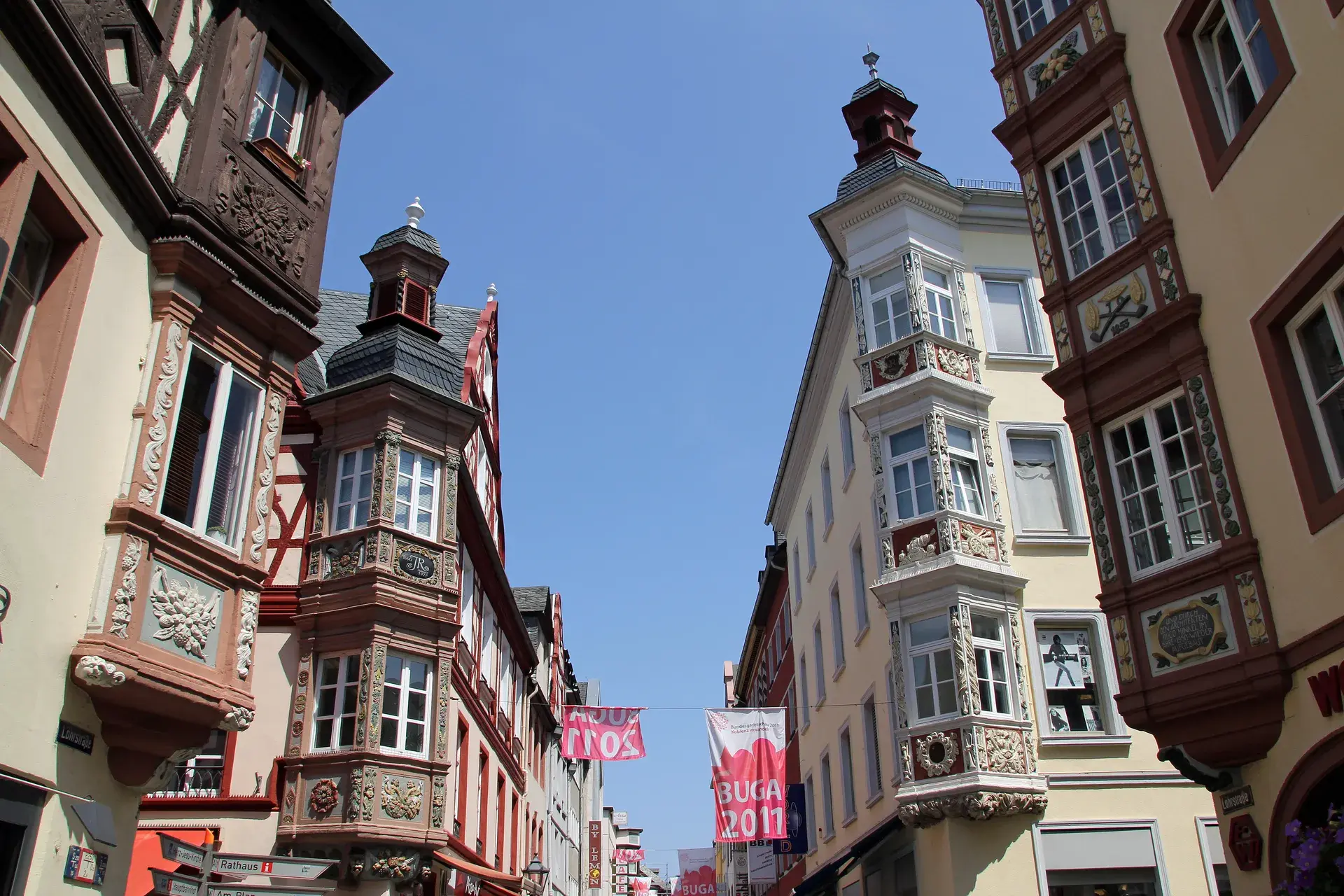
The ornate historical oriel windows defining the iconic Four Towers intersection serve as a visual centerpiece in Koblenz. Known locally as the Vier Türme, this architectural ensemble is located at the central crossing of Am Plan, Löhrstraße, Marktstraße, and Altengraben. It takes its name not from freestanding towers, but from the richly decorated, multi-story bay windows (oriels) projecting from the corners of four historic townhouses.
A Crossroads of History
The corner buildings were designed during the transition between the Late Renaissance and Early Baroque periods. Constructed between 1689 and 1692, the project is primarily attributed to Electoral Court Master Builder Johann Christoph Sebastiani. The street layout at this crossroads mirrors the ancient Roman urban street grid, having developed over a former ditch alongside the old Roman defensive walls.
The four specific properties include Am Plan 2 (built in 1692), Marktstraße 2 (built in 1689), Marktstraße 1 (built in 1690 with upper-level half-timbering), and Löhrstraße 2 (built in 1690 or 1691). Together, they mark the spatial transition point connecting the Am Plan market square to the commercial Löhrstraße and the historic central alleys.
Destruction and Reconstruction
Predecessor buildings on the site dating back to 1608 were destroyed in 1688 by French troops during the Palatinate War of Succession. This destruction led to the systematic rebuilding of the intersection with matching corner bay windows.
During World War II air raids in 1944, three of the four buildings suffered severe damage or total destruction. Only Marktstraße 1 survived the bombing virtually intact. Between 1949 and 1960, the three destroyed buildings were carefully reconstructed. Builders used original templates and surviving historical drawings to preserve the unified visual appearance of the intersection.
Hidden Curiosities in the Architecture
Each oriel window features distinct historical details. Because Marktstraße 1 survived World War II intact, its oriel retains original Baroque stone carvings of putti, fruit garlands, and lush foliage.
The bay window of Marktstraße 2 is decorated with carved stone cannons, rifles, muskets, banners, and bugle horns. This military motif commemorates the Electoral soldiers and Prussian police guards stationed there until 1848. Additionally, the building at Löhrstraße 2 operated continuously as an apothecary from 1730 until the 2000s.
The Modern Pedestrian Core
Today, the Four Towers form an open-air architectural landmark situated entirely inside the pedestrian core of Koblenz. The ensemble is a protected historic monument zone and part of the UNESCO World Heritage Upper Middle Rhine Valley. The buildings' ground floors and upper levels house commercial businesses, retail shops, offices, and medical practices.
A unique structural modification occurred in 1950 when a pedestrian arcade passageway was carved directly into the ground-floor corner of Am Plan 2. This was engineered to provide a safety refuge for pedestrians when city trams, which operated through the intersection until 1967, made tight, sweeping turns around the narrow street corner.
FAQ
Why is the intersection in Koblenz called the Four Towers?
The name Vier Türme (Four Towers) comes from the richly decorated, multi-story bay windows, or oriels, that project from the corners of the four historic townhouses at the intersection, giving the visual impression of four turrets.
When were the Four Towers built?
The current Baroque and Renaissance buildings were systematically constructed between 1689 and 1692 after predecessor buildings were destroyed during the Palatinate War of Succession.
Did any of the Four Towers survive World War II?
Yes, the building at Marktstraße 1 survived the 1944 air raids virtually intact. Its oriel window still features the original Baroque stone carvings of putti and fruit garlands. The other three buildings were heavily damaged and reconstructed between 1949 and 1960.