Florinskirche and the Historic Florinsmarkt
The Historic Ensemble of Florinsmarkt
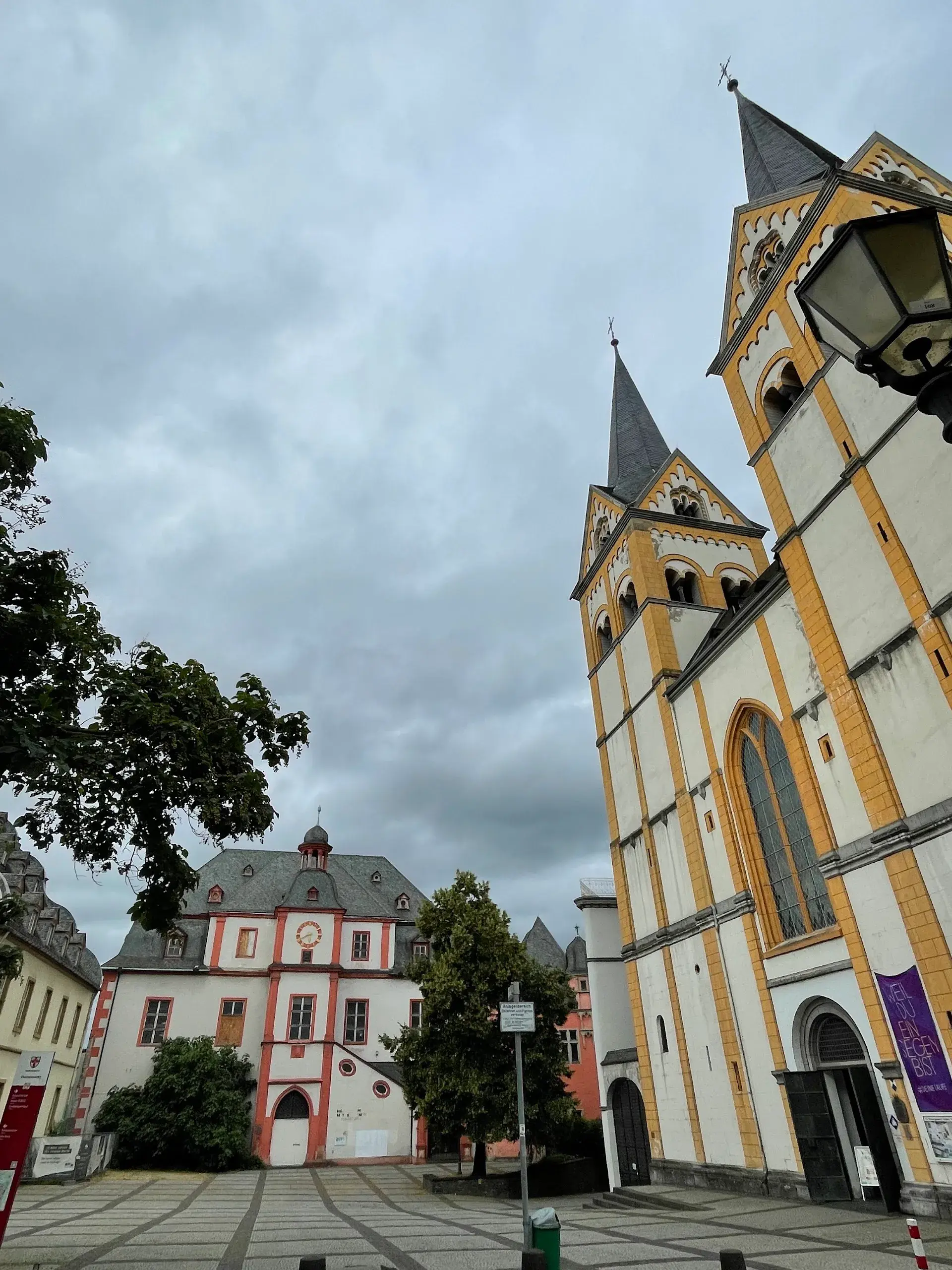
Florinsmarkt serves as a historic central square within the Old Town of Koblenz. During the Middle Ages and early modern period, it functioned as the primary political, judicial, and mercantile center of the city. The pedestrian plaza is defined by a compact cluster of four major buildings: the Romanesque Florinskirche, the Gothic and Baroque Altes Kaufhaus, the late-Gothic Schöffenhaus, and the Baroque Bürresheimer Hof. Together, they illustrate the historical interplay of church administration, civic governance, and Moselle river commerce.
The Evolution of Florinskirche
Founded around 1100 under Provost Bruno von Lauffen, the Florinskirche is characterized by heavy Romanesque stone masonry and twin towers. The building underwent a dramatic shift in 1802 when occupying French troops secularized the church. In 1807, Emperor Napoleon Bonaparte signed a decree to convert the building into a municipal slaughterhouse and meat market. This plan was aborted when the Prussian administration took over in 1815.
Prussian King Frederick William III transferred the building to the Protestant congregation, and in 1820, it became the first Protestant parish church in Koblenz. Today, the Florinskirche operates as an active church and cultural concert venue. A unique feature from the church's turbulent past remains visible inside: a 17th-century French cannonball from the 1688 siege is embedded in the ceiling vault directly above the baptismal font, deliberately placed there during 1708 repairs as a reminder of wartime destruction.
Civic Governance at the Square
Adjacent to the church, the Altes Kaufhaus was built between 1419 and 1425 as a municipal trade and assembly hall. The upper floor served as the Koblenz Town Hall from 1674 to 1794. After sustaining heavy damage during the 1688 French bombardment, the structure was rebuilt in 1724 with Baroque features.
Nearby stands the Schöffenhaus, erected in 1530 as the seat for city court lay judges who regulated trade and punishment. The municipal pillory stood in front of the Schöffenhaus until the 18th century, serving as a site for public punishment.
The Augenroller
When the Altes Kaufhaus was rebuilt in 1724, a clock tower was installed featuring the "Augenroller" (Eye-Roller). This mechanical human face is mounted on the white-and-red facade beneath the clock. Its painted eyes shift continuously side to side with the swing of the pendulum, and a red tongue darts forward during quarter, half, and full-hour strikes. Local tradition claims the mask depicts the 16th-century robber knight Johann Lutter von Kobern. According to legend, he defiantly rolled his eyes and stuck his tongue out at the executioner right before he was beheaded in 1536.
FAQ
Why is there a cannonball in the ceiling of the Florinskirche?
A 17th-century French cannonball from the 1688 siege of Koblenz is embedded in the ceiling vault above the baptismal font. It was deliberately placed there during repairs in 1708 to serve as a lasting reminder of wartime destruction.
What is the Augenroller in Koblenz?
The Augenroller is a mechanical human face mounted on the clock tower of the Altes Kaufhaus in Florinsmarkt. Its eyes move continuously with the clock's pendulum, and a red tongue sticks out when the bell tolls on the quarter, half, and full hours.
Who does the Augenroller face represent?
Local tradition holds that the face depicts Johann Lutter von Kobern, a 16th-century robber knight who supposedly rolled his eyes and stuck his tongue out at his executioner before being beheaded in 1536.
Did Napoleon plan to turn the Florinskirche into a slaughterhouse?
Yes. In 1807, Emperor Napoleon Bonaparte signed a decree to convert the secularized Florinskirche into a municipal slaughterhouse and meat market. The plan was abandoned when the Prussian administration took over the city in 1815.
Discover Koblenz like never before
Dive into Koblenz hidden stories and secret spots with Ciceru interactive tours.
Explore tour
Audioguide
Quizzes
Maps
Solo
Couples
Groups & families

© Photo by Lennert Claeys via Google Maps · Google Places