Deutsches Eck: Koblenz's Historic River Monument
Stand at the literal convergence of two great rivers, the exact geographical feature that gave the city of Koblenz its name. Evolving from the Roman settlement "Castellum apud Confluentes" (fort at the confluence), the city owes its existence to this sharp, artificial headland. From the tip of the stone prow, the heavy river breeze carries the mechanical hum of passing barges, while the slower, darker waters of the Moselle visibly mix with the faster, lighter current of the Rhine.
A Monument to Empire
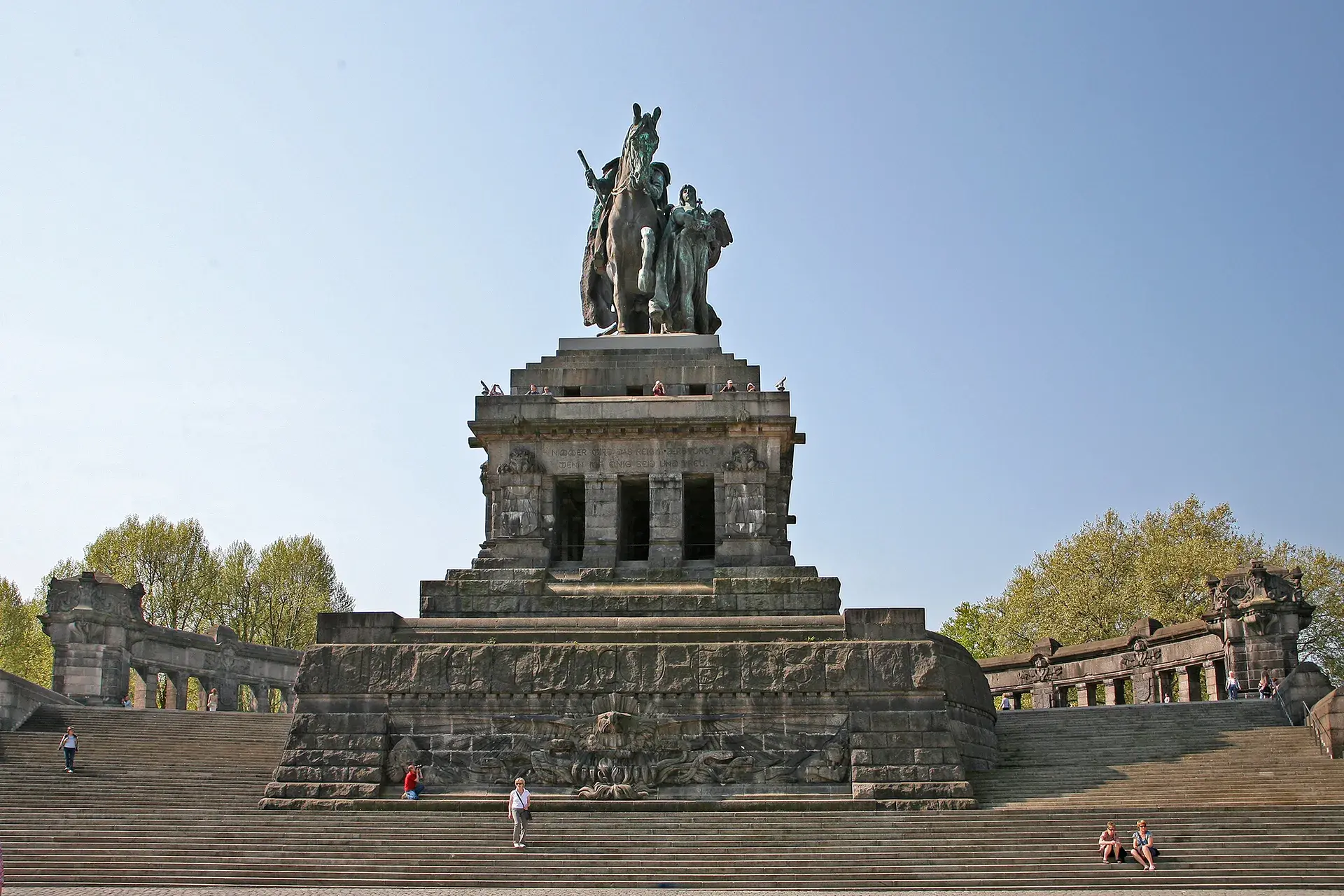
Dominating the headland is a towering 37-meter monument topped by a 14-meter equestrian statue of Kaiser Wilhelm I, accompanied by a winged female genius holding a laurel wreath and imperial crown. The site was chosen in 1891 by Kaiser Wilhelm II to serve as a national memorial honoring his grandfather's role in the 1871 unification of Germany. Architect Bruno Schmitz designed the monument, which was officially inaugurated on August 31, 1897, after an emergency harbor was filled in to extend the point.
Destruction and Rebirth
The original 1897 monument did not survive the 20th century intact. In March 1945, near the end of World War II, the copper equestrian statue was severely damaged by US artillery fire and subsequently dismantled. For decades, the plinth remained empty. In 1953, West German President Theodor Heuss rededicated the riderless pedestal as a memorial to German reunification.
Following the actual reunification of Germany, a controversial bronze replica of the Wilhelm I statue was created by sculptor Raymond Kittl, financed through private donations from local publishers Werner and Anneliese Theisen. The reconstructed statue was hoisted onto its pedestal on September 2, 1993, specifically chosen as the historical anniversary of the Battle of Sedan. Surprisingly, the battered copper head of the original 1897 statue survived the war and is currently preserved inside the Mittelrhein-Museum in Koblenz.
Symbols of Unity
The site's name translates to "German Corner" and traces its roots back to 1216, when Archbishop Theoderich von Wied granted land to the Teutonic Knights. They established a commandery that led to the area being called "Deutscher Ordt" and later "Deutsches Eck."
Today, the site is rich with symbols of modern unity. In June 1990, three original concrete segments of the Berlin Wall were installed next to the monument to memorialize the victims of Germany's division. The surrounding terrace continuously flies the flags of all 16 modern German federal states, the federal flag, the European Union flag, and the US flag, which was raised in solidarity following the September 11, 2001 attacks.
Deutsches Eck Today
Situated within the "Upper Middle Rhine Valley" UNESCO World Heritage Site, Deutsches Eck is one of the Rhineland's most prominent destinations, attracting over two million visitors annually. The wide stone platform and surrounding promenades serve as outdoor gathering spaces for concerts and regional festivities, including the popular "Rhein in Flammen" (Rhine in Flames) event.
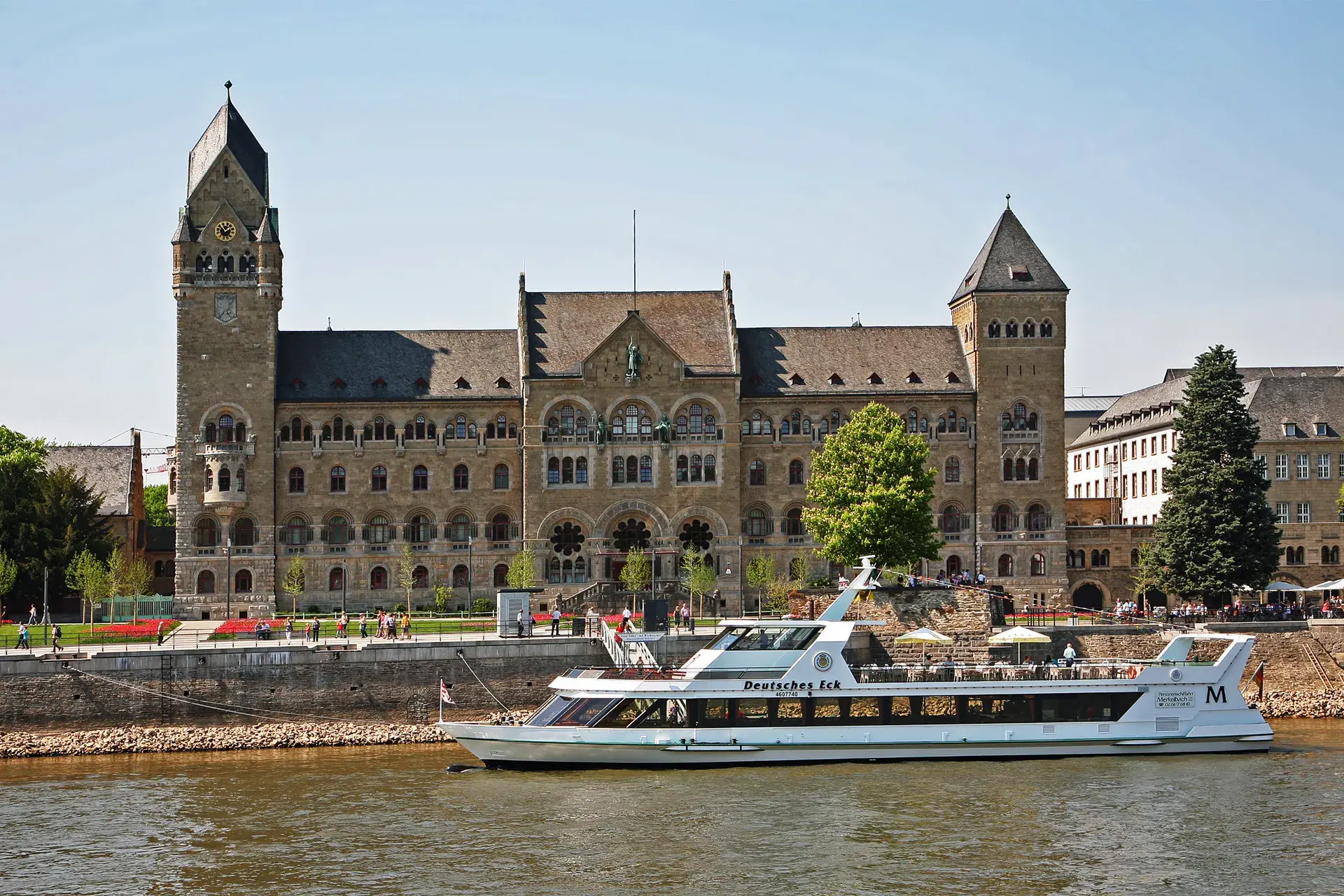
The point also acts as a vital transit hub. It is positioned directly beside riverboat docking points and near the base station of the Koblenz Cable Car, which transports passengers across the Rhine to the Ehrenbreitstein Fortress.
FAQ
Why is it called Deutsches Eck?
The name translates to "German Corner" and originates from the Teutonic Knights (Deutscher Orden). In 1216, they were granted land at the site and established a commandery, leading to the area being called "Deutscher Ordt" and eventually "Deutsches Eck."
Is the statue at Deutsches Eck the original one?
No, the current statue is a 1993 bronze replica. The original 1897 copper statue was destroyed by US artillery fire in 1945. However, the original statue's copper head survived and is on display at the Mittelrhein-Museum in Koblenz.
Why are there pieces of the Berlin Wall at Deutsches Eck?
Three original segments of the Berlin Wall were installed next to the monument in June 1990 to serve as a memorial dedicated to the victims of the division of Germany.