Filellinon Square: Nafplio's Historic Harbor Hub
A massive iron chain once stretched across the waters of the Argolic Gulf every night, physically locking Nafplio's harbor away from the outside world. Today, Filellinon Square stands at this historic threshold, linking the narrow alleyways of Nafplio's historic core to its open maritime front. The square overlooks the harbor where wooden ferry skiffs chug across the water and the sea laps constantly against the stone quayside.
Monuments of the Square
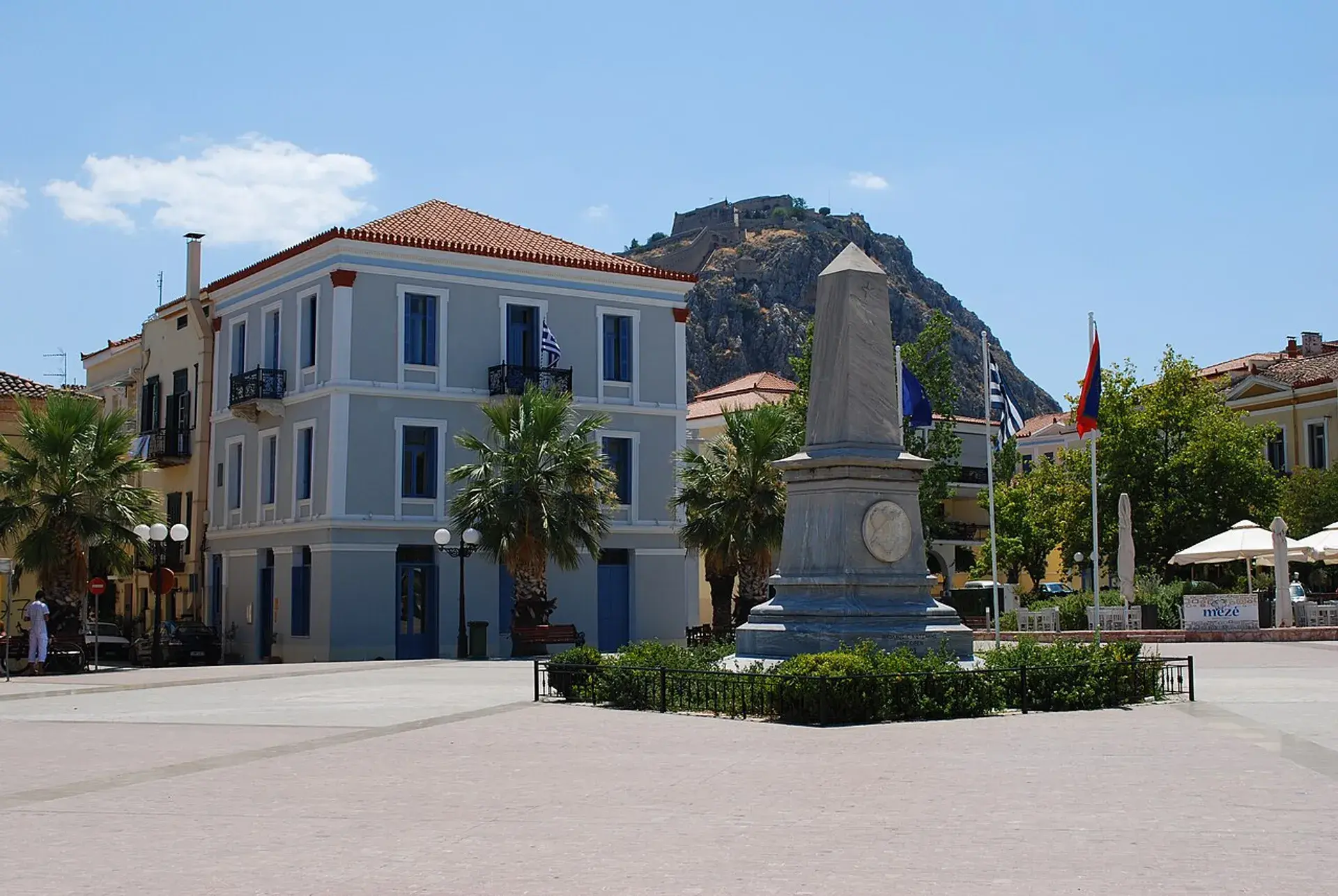
At the center of Filellinon Square sits a grey marble obelisk erected in 1903. Designed in Paris and carved in Athens, the monument honors foreign allies, specifically French Philhellenes like Marshal Maison, General Fabvier, and Admiral de Rigny, who fought in the Greek War of Independence. The base features white marble reliefs personifying Greece as Athena and France as Liberty.
The surrounding plaza holds other historical landmarks, including a bust dedicated to War of Independence heroine Mando Mavrogenous. Nearby stands a 19th-century neoclassical mansion that previously served as the Town Hall. It now houses the European branch of Harvard University's Center for Hellenic Studies.
The Port of the Chain
The open pedestrian hub was built over the demolished footprint of the Venetian bastion of Santa Teresa, which guarded the waterfront until 1866. During Venetian rule, the harbor was known as Porto Cadena, or the Port of the Chain. To seal the navigable channel against hostile warships and pirates, a massive iron chain was hauled each night from the mainland bastion to the offshore fortress of Bourtzi.
The Legacy of Bourtzi Castle
Located roughly 400 meters offshore, Bourtzi Castle frames the square's panoramic views. The low-slung stone fortress was constructed by the Venetians between 1471 and 1473 under architect Antonio Gambello and engineer Niccolò Brancaleone. Though officially recorded as Castel Pasqualigo during Venetian rule, its current name derives from the Ottoman Turkish word 'burç', meaning tower.
The islet fortress played a critical role in the Greek War of Independence. Greek forces captured Bourtzi on June 18, 1822, using its artillery batteries to bombard Ottoman fortifications and blockade the port. In 1826, the interim Greek government briefly sought refuge inside during civil disputes.
In later years, the fortress took on surprising new roles. After King George I disarmed the site in 1865, it served as an isolated residence for state executioners. Highly ostracized by local townspeople, these executioners were only permitted to set foot on the Nafplio mainland under armed police guard when carrying out their duties. Decades later, between the 1930s and 1970, the former defensive fortress and executioners' quarters were transformed into a 14-room luxury boutique hotel.
A Modern Waterfront Hub
Today, Filellinon Square serves as a lively waterfront destination. It acts as the primary departure dock for small passenger boats making the short crossing to Bourtzi Castle, which reopened to the public in 2023 as a cultural site and exhibition space following major conservation upgrades. The square's harbor edge also serves as the terminal for Nafplio's red tourist street trains, offering a starting point for exploring the historic port city.
FAQ
How is Bourtzi Castle accessed from Nafplio?
Small passenger boats depart regularly from Filellinon Square, making a short crossing of five to ten minutes to the islet fortress.
What is the monument in the center of Filellinon Square?
The square features a 1903 grey marble obelisk honoring French Philhellenes who fought alongside Greek forces in the Greek War of Independence.
What was Bourtzi Castle used for historically?
Originally built as a Venetian maritime fortress in the 1470s, Bourtzi later served as an artillery battery, a refuge for the Greek government, an isolated residence for state executioners, and a 20th-century luxury boutique hotel.
Why was Nafplio's harbor called the Port of the Chain?
During Venetian rule, a massive iron chain was stretched nightly across the water between Bourtzi Castle and the mainland to block hostile warships from entering the harbor.