Trianon Old Mosque: Nafplion's Historic Landmark
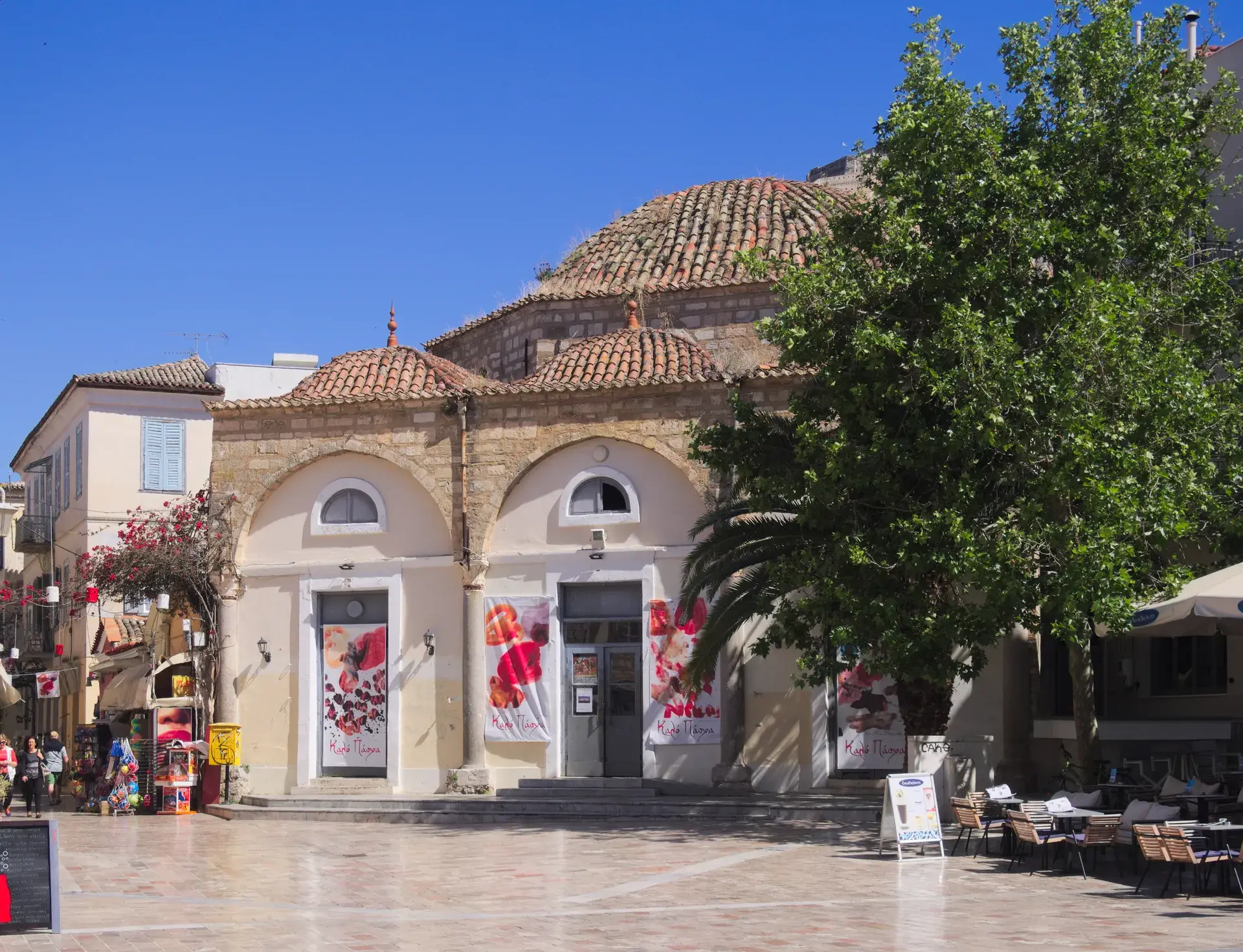
Observe the striking facade of the Trianon Old Mosque standing quietly on Syntagma Square as a testament to the city's layered Ottoman past. Anchoring the eastern end of the square, the building remains an essential historic landmark and is recognized as the oldest surviving Ottoman-era structure in Nafplion.
Architectural Origins and Alterations
Constructed during the first Ottoman occupation period in the late 16th century, the Trianon was originally built as a Friday mosque. The structure features a simple rectangular ground plan formed from brick and stone, topped with an octagonal drum and a central dome. Originally, the entrance boasted an arched, colonnaded portico capped by three small domes, and a stone minaret stood alongside it.
Over the centuries, the building's exterior has visually evolved. The original front colonnade arches were walled in to expand the interior space. Additionally, rising ground levels in the city center have buried part of the structure's original stone base beneath the modern pavement. The original stone minaret has not survived to the modern day.
A History of Transformation
The Trianon has experienced numerous functional shifts reflecting the rapid changes in power within Nafplion. In 1687, Venetian forces seized the city, and General Francesco Morosini handed the building over to the Franciscan order. It was consecrated as a Catholic church dedicated to Saint Anthony of Padua. Following the Ottoman reconquest in 1715, it reverted to a mosque.
During the Greek War of Independence around 1823, the building ceased its religious functions entirely to house the Charitable Society of Nafplion, providing aid to the poor and war orphans. Shortly after, between 1828 and 1833, it served as a Monitorial Boys' School, utilizing an early educational system where advanced students tutored younger pupils.
The Mosque That Became a Cinema
In the late 19th and early 20th centuries, the space was repurposed as a conservatory and performance venue. By 1915, the interior was fully remodeled into an entertainment hall and cinema. During this era of French cultural popularity in Greece, the venue adopted the secular name "Trianon." Despite the building's unmistakable Ottoman domed silhouette, this colloquial French name is still used today.
Current Use and City Context
Today, the building functions as the Municipal Theatre of Nafplion. It serves as a municipal cultural space hosting civic events, exhibitions, and theatrical productions, including collaborations with the University of the Peloponnese Department of Theatre Studies.
The Trianon also offers a unique architectural perspective within the city. Situated roughly 100 meters across Syntagma Square from the Vouleftiko—another major Ottoman building—it provides a direct visual comparison between simple, early provincial Ottoman construction and the grander styles of 18th-century Ottoman architecture.
FAQ
Why is the Old Mosque of Nafplion called the Trianon?
The building acquired the French secular name "Trianon" when its former prayer hall was converted into a municipal cinema and entertainment hall in 1915.
What was the Trianon Old Mosque used for throughout history?
Originally an Ottoman mosque from the late 16th century, it later served as a Catholic church dedicated to Saint Anthony of Padua, the headquarters for a local Charitable Society, a monitorial boys' school, and a cinema.
Are there other Ottoman buildings near the Trianon?
Yes, the Vouleftiko, another prominent Ottoman building, is located roughly 100 meters across Syntagma Square. This proximity allows for a direct visual comparison between the Trianon's early provincial Ottoman style and the Vouleftiko's grander 18th-century architecture.