Vouleftiko: Greece's First Parliament in Nafplion
Originally built for Ottoman worship, this heavy stone hall was rapidly transformed in 1825 to host the first parliament of a newly independent Greece. Standing at the southwestern edge of Syntagma Square in Nafplion, Vouleftiko represents the architectural and political transition of the early Greek state.
From Ottoman Mosque to Greek Parliament
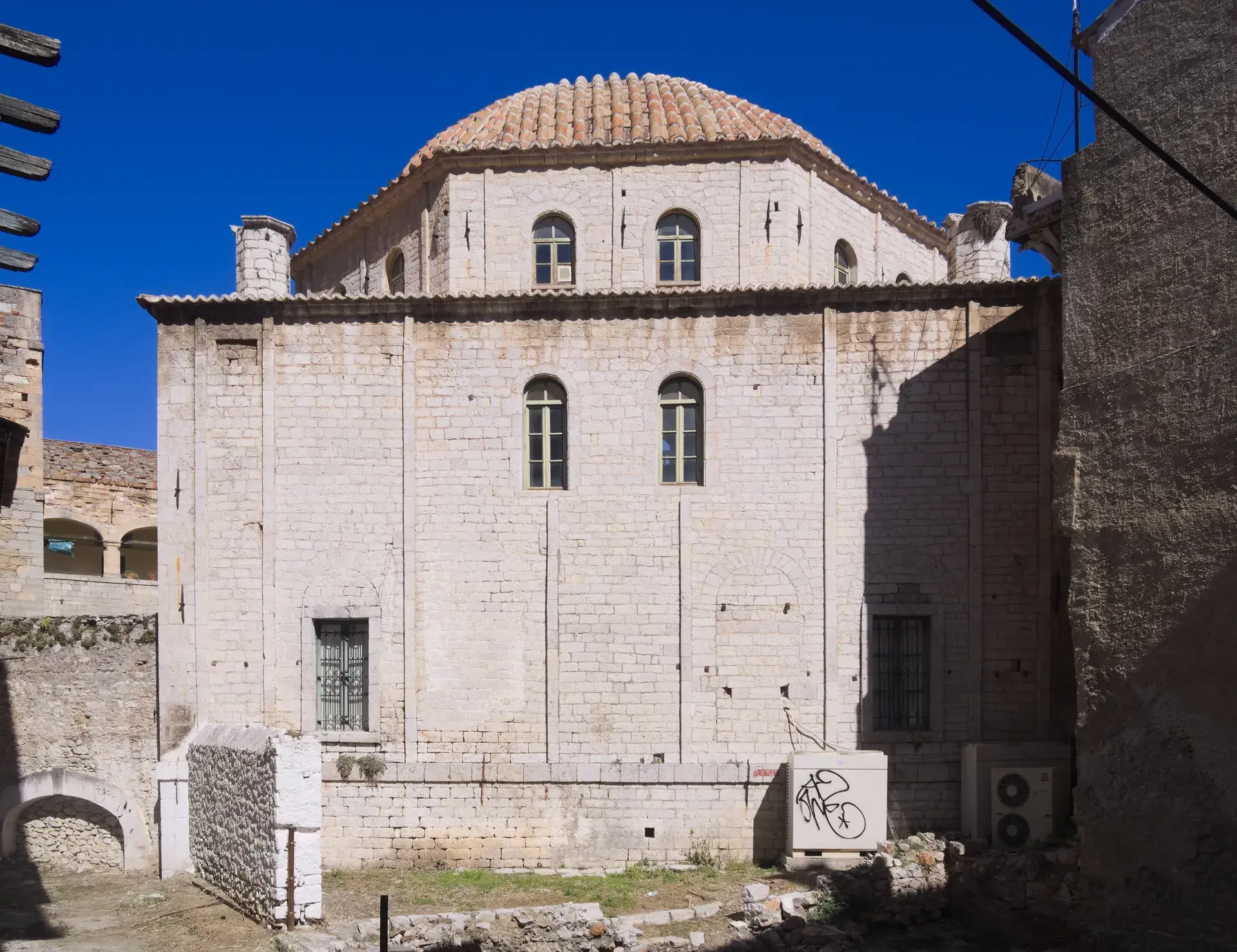
Erected around 1730 during the Second Ottoman period, the building was originally known as the Aga Pasha or Ragıb Pasha Mosque. The structure was built in a mature Ottoman style, utilizing dressed grey limestone ashlar blocks to form a tall, square hall covered by a massive central masonry dome.
Following the liberation of Nafplion, the provisional Greek revolutionary government commissioned military engineer Theodoros Vallianos to remodel the mosque into an assembly hall. Opening on September 21, 1825, the interior was adapted to seat approximately 40 delegates, complete with tiered galleries for public spectators. It housed the Hellenic Parliament (Vouli) from 1825 to 1826, with later sessions continuing through 1828.
Architecture and Local Legends
The interior of Vouleftiko features a vaulted chamber rising toward a high ceiling dome. This design created open acoustics that naturally amplified spoken sermons during its time as a mosque, and later served to carry the voices of politicians during parliamentary debates. Notably, a domed portico and arcade once stood on the western facade, but this collapsed during an early 20th-century earthquake.
Local folklore surrounds the building's origins. One legend claims the mosque was built by a wealthy Ottoman agha as an act of penance after he murdered two Venetian brothers to steal their buried treasure. Another tradition suggests that parts of the building's stone masonry were salvaged from ancient Mycenaean ruins in the surrounding Argolid region.
A Site of Trials and Imprisonment
Beyond its parliamentary role, Vouleftiko served several other civic functions. In 1831, Governor Ioannis Kapodistrias briefly designated the upper hall for a "Hellenic School," though the acoustic space proved unsuited for classrooms.
In 1834, during the Regency of King Otto, the hall was repurposed as a makeshift high court for the treason trial of revolutionary war heroes Theodoros Kolokotronis and Dimitrios Plapoutas. During this trial, judges Anastasios Polyzoidis and Georgios Tertsetis famously refused to sign the death sentence, successfully resisting physical coercion by the Bavarian regency's minister of justice. From 1834 onward, the ground level and adjacent theological school cells were converted into a municipal and military jail.
Vouleftiko Today
Fully restored by the Hellenic Ministry of Culture, Vouleftiko continues to be an active civic space. The main upper hall serves as a prestigious venue for municipal ceremonies, conferences, and musical events. The ground-floor vaults, which once held prison cells, now house the Municipal Art Gallery of Nafplion.
Situated alongside the former Venetian naval arsenal and the Trianon, Vouleftiko anchors the historic fabric of Syntagma Square, standing as a monument to Nafplion's transition from Ottoman rule to Greek independence.
FAQ
What was the original purpose of Vouleftiko?
Vouleftiko was originally constructed around 1730 as an Ottoman place of worship, known as the Aga Pasha or Ragıb Pasha Mosque.
When did Vouleftiko serve as Greece's first parliament?
The building housed the Hellenic Parliament, or Vouli, from 1825 to 1826, with parliamentary sessions continuing in the space through 1828.
What famous trial took place at Vouleftiko?
In 1834, the building served as a makeshift high court for the treason trial of Greek revolutionary war heroes Theodoros Kolokotronis and Dimitrios Plapoutas.
What is Vouleftiko used for today?
Today, the fully restored main upper hall is used for municipal ceremonies, conferences, and musical events, while the ground-floor vaults house the Municipal Art Gallery of Nafplion.