Antico Lavatoio Bergamo: Historic Public Washhouse
Located on Via Mario Lupo in Bergamo’s Città Alta, the Antico Lavatoio (also known as the Lavatoio di Piazza Angelini) stands as an evocative relic of late 19th-century civic engineering. Positioned just behind the Torre del Gombito near the ancient Roman intersection of the cardo and decumanus, this covered public facility provided running water and sanitation to the Upper Town at a pivotal moment in its civic history.
An Emergency Public Health Response
The construction of the washhouse was prompted by severe public health crises. Throughout the 19th century, Città Alta relied on an aging water network dating to the medieval and Visconti eras. Contaminated supplies culminated in severe outbreaks of cholera and typhoid in 1884, prompting the Municipality of Bergamo to overhaul its urban infrastructure.
Following the completion of the modern Bondo Petello aqueduct in 1889, municipal authorities commissioned public washhouses to deliver clean water to homes without private plumbing. When the Via Mario Lupo washhouse opened in 1891, it transformed everyday domestic life. Previously, local washerwomen (lavandaie) and domestic workers had to carry heavy loads of textiles beyond the Venetian walls to wash them in rural irrigation ditches (rogge). The new facility centralized this labor within the historic center, serving as a vital gathering space for neighborhood news and domestic work.
During peak periods in the early 20th century, the facility operated under strict organization. Archival photographs from the 1930s reveal that metal boundary partitions were once installed to enforce shifts and manage overcrowding before neighboring medieval tenements were cleared to create modern Piazzetta Luigi Angelini.
Bergamo walking tour with audio and quizzes: the walled Città Alta
2 hours11 stopsAudio guideStart any day, at your own paceTicket on your phone · 30-day refundArchitecture and Hydraulic Design
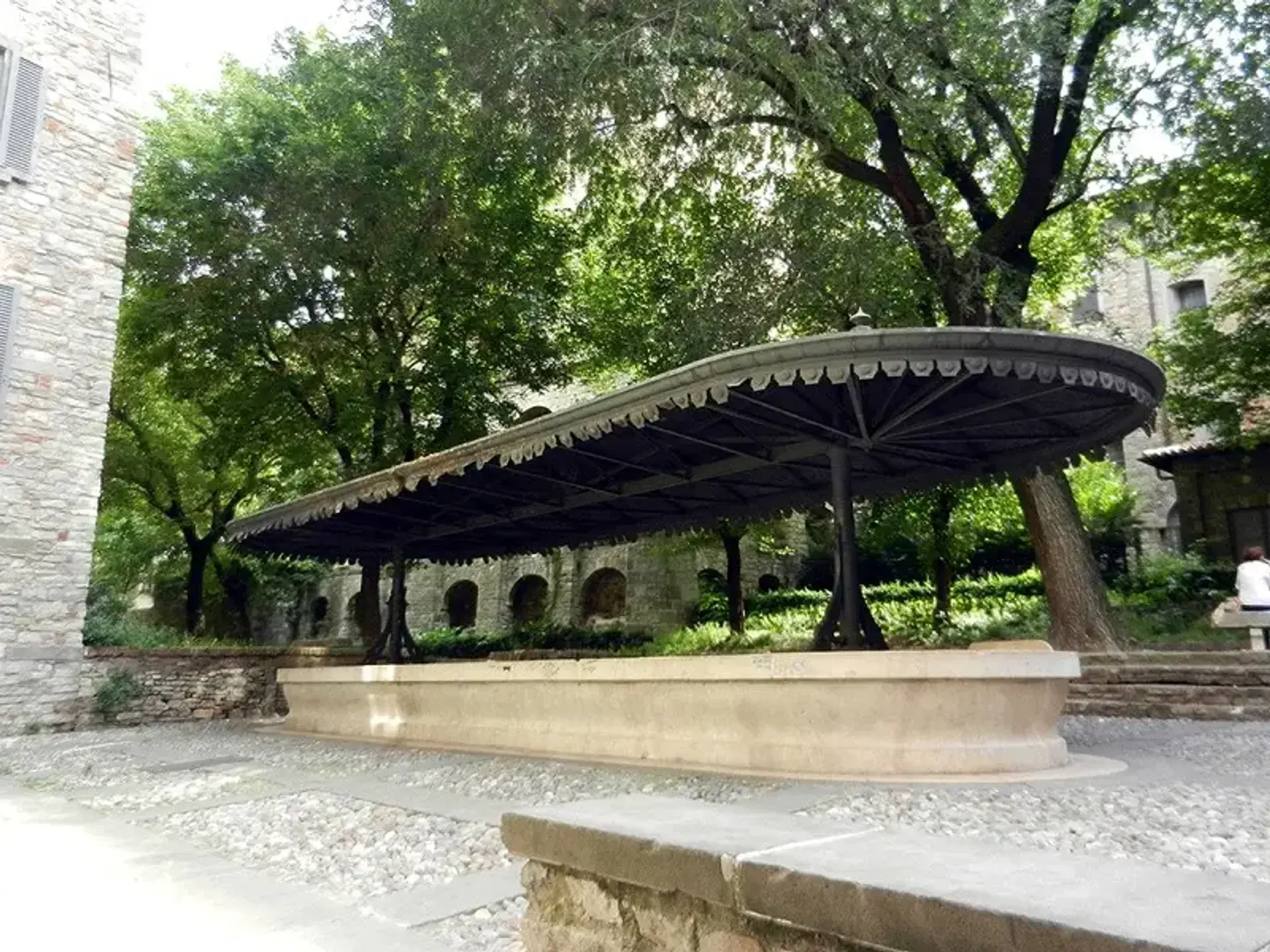
The Antico Lavatoio combines utility with late 19th-century industrial artistry. Its centerpiece is an elongated elliptical basin carved from white Zandobbio marble—the same stone featured on the city’s Porta San Giacomo. The basin is partitioned into 18 individual washing stations, each designed with outward-inclined stone rims engineered to ease the physical strain of manual laundering.
A pitched, open-sided canopy protects the installation, supported by an ornate cast-iron framework and covered with corrugated sheet metal. The roofline is decorated with Liberty-style valances (mantovana), and a preserved municipal coat of arms bearing the facility's official 1891 inauguration date remains integrated into the iron trusswork.
Beneath its historic exterior, the washhouse incorporated advanced hydraulic design. Driven entirely by gravity, water from the aqueduct entered the basin through dedicated intake channels, while splash-guard gutters, overflow outlets, and discharge pipes continuously drained dirty water away to maintain sanitary conditions.
Protection and Modern Restoration
The introduction of domestic washing appliances in the mid-20th century phased out the need for communal washhouses, and the site ceased active municipal service in the 1950s. By 1972, city planners proposed demolishing the structure, but the intervention of the Soprintendenza ai Beni Culturali halted the plans and placed the site under formal historical preservation.
In August 2020, the Municipality of Bergamo completed a 160,000-euro restoration of the washhouse. Work included deep cleaning the Zandobbio marble, repainting the cast-iron framework, adding architectural lighting, and installing an internal water-recirculation system. Civic leaders noted the poignant parallel that this restoration occurred during the COVID-19 pandemic, echoing the washhouse's original purpose as an emergency civic barrier against infectious disease.
Today, the site serves as a peaceful waypoint connecting Piazza Vecchia and Piazza Mercato delle Scarpe. The gentle trickle of circulating water still fills the marble compartments, and the open-air landmark periodically accommodates temporary art projects and exhibitions during events such as the Bergamo Landscape Festival.
FAQ
Why was the Antico Lavatoio built in Città Alta?
The washhouse was commissioned by the Municipality of Bergamo after obsolete medieval water supplies contributed to deadly cholera and typhoid outbreaks in 1884. Opening in 1891, it provided clean, running aqueduct water for residents without domestic plumbing.
What materials make up the Antico Lavatoio?
The washhouse features an 18-compartment elliptical basin carved from white Zandobbio marble, sheltered beneath an open-sided cast-iron canopy with corrugated sheet metal and Liberty-style decorative trim.
How was the washhouse saved from demolition?
After falling out of regular service in the 1950s, the facility was scheduled for municipal demolition in 1972. It was preserved when Italy's Soprintendenza ai Beni Culturali placed it under official heritage protection.