Cappella Colleoni: Renaissance Mausoleum in Bergamo
A Mercenary Captain's Monumental Legacy
The Cappella Colleoni is an early Renaissance mausoleum and funerary chapel situated on Piazza del Duomo in the historic core of Bergamo's Città Alta. Commissioned by Bartolomeo Colleoni, a celebrated mercenary commander (condottiero) and captain-general of the Republic of Venice, the monument stands as an architectural testament to the military power exercised along Venice's Lombard frontier during the late 15th century. Designed and sculpted by Giovanni Antonio Amadeo, the chapel was constructed between 1472 and 1476 and dedicated to Saints Bartholomew, Mark, and John the Baptist.
Bergamo walking tour with audio and quizzes: the walled Città Alta
2 hours11 stopsAudio guideStart any day, at your own paceTicket on your phone · 30-day refundA Forceful Foundation on Piazza del Duomo
Colleoni intended to secure a resting place of supreme prestige directly abutting the Basilica di Santa Maria Maggiore. When the basilica's governing canons refused to concede church land for the private mausoleum, Colleoni bypassed civic and ecclesiastical approval. In 1472, he deployed his soldiers to forcibly demolish the basilica's existing sacristy and portico, clearing the site manu militari.
Colleoni died in November 1475 before the chapel's decorative program was complete. Construction of the primary building concluded around 1476, while subsequent sculptural elements and decorations continued to be added over the following centuries.
Lombard Renaissance Architecture and Facade Iconography
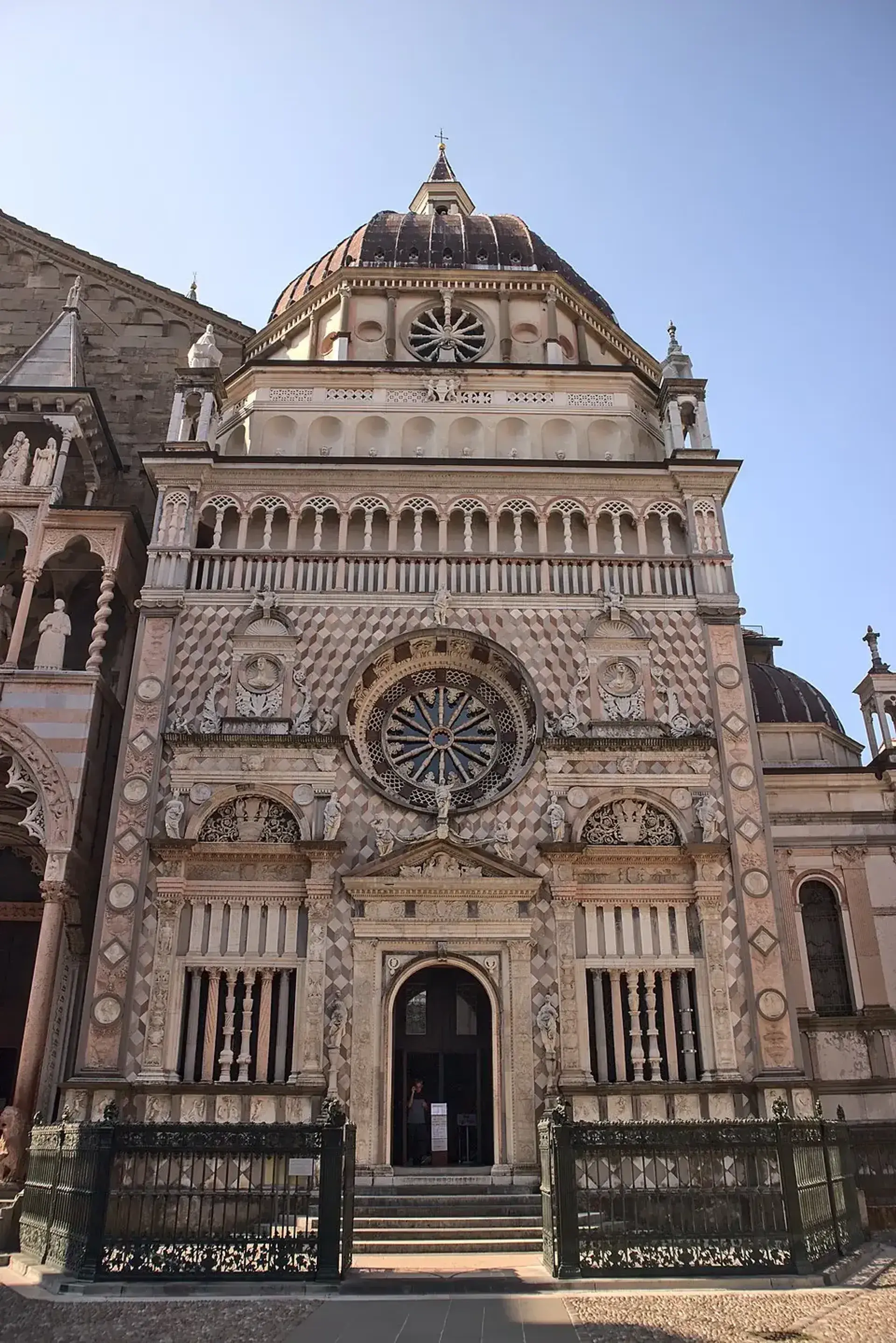
The exterior of Cappella Colleoni is renowned for its Lombard Renaissance styling, presenting a sharp visual contrast to the adjacent medieval stone basilica. The facade features polychrome marble inlays arranged in white, red, and black lozenge patterns, an octagonal lantern dome, and a grand central rose window.
Amadeo’s decorative scheme incorporates classical antiquity alongside Christian scripture. Framing the entrance and lower registers, four bas-relief panels depicting the Labors of Hercules appear directly beside nine scenes from the biblical Book of Genesis. Surrounding the central rose window are sculpted portrait medallions of Roman emperors Julius Caesar and Trajan, explicitly linking Colleoni's martial authority to the imperial heritage of ancient Rome.
Interior Masterpieces and Monuments
Inside the chapel, the focal point is Colleoni’s tiered marble funerary monument, topped by a gilded wooden equestrian statue completed in 1501 by Nuremberg woodcarvers Sisto and Leonardo. Nearby stands the delicate marble tomb of Colleoni's daughter Medea, who died in 1470; also sculpted by Amadeo, this monument was transferred to the chapel in 1892 from Urgnano.
In 1732 and 1733, Venetian painter Giambattista Tiepolo was commissioned to paint frescoes across the ceiling vaults and lunettes. These works depict episodes from the lives of Saint John the Baptist, Saint Mark, and Saint Bartholomew, complementing the chapel’s 15th-century sculptural core with late Baroque color and composition.
The Secret of the Condottiero's Tomb
For nearly five centuries, the true whereabouts of Colleoni's remains were a subject of local speculation. Because the upper visible sarcophagus appeared empty, historians and residents debated whether the captain had ever been interred on the site.
The mystery was resolved on November 21, 1969, during an official archaeological investigation. Excavators breached a plaster seal within the lower sarcophagus and discovered a wooden coffin containing Colleoni’s skeleton alongside his personal funerary artifacts.
Heraldry, Folklore, and Gate Traditions
The exterior wrought-iron entrance gate displays the Colleoni family coat of arms. The emblem is a canting, or punning, crest showing three testicles—a phonetic play on the surname and the Italian word coglioni, adopted as a symbol of virility and martial valor. Although persistent local folklore claimed that Colleoni had polyorchidism, archival documentation confirms that the three-testicle motif was already in standard use by the family before his birth.
A longstanding local tradition holds that rubbing the bronze coat of arms brings good fortune, historically performed at midnight. Centuries of visitor touch have left the family crest worn smooth and polished to a bright shine compared to the weathered ironwork surrounding it.
Visiting the Chapel
The Cappella Colleoni functions as an active cultural site and is administered independently from both the neighboring Basilica di Santa Maria Maggiore and the Bergamo Cathedral. The chapel is open to the public from Tuesday through Sunday, closing on Mondays and during a midday recess. Standard operating hours are 9:30 AM to 12:30 PM, reopening from 2:00 PM to 4:30 PM from November to February, and until 6:30 PM from March to October. General admission is free, with voluntary donations accepted to support ongoing preservation.
FAQ
Who was Bartolomeo Colleoni?
Bartolomeo Colleoni was a renowned 15th-century mercenary captain (condottiero) and captain-general of the Republic of Venice who commissioned the chapel as his personal mausoleum.
Is Bartolomeo Colleoni buried inside the chapel?
Yes. An archaeological excavation on November 21, 1969, located his skeleton and funerary artifacts inside a concealed wooden coffin beneath a plaster seal in the lower sarcophagus.
Why does the Colleoni coat of arms feature three testicles?
The emblem is a canting crest featuring a phonetic pun on the family name and the Italian word coglioni, adopted to signify virility and martial valor. Archival records confirm the crest was used by the family before Bartolomeo Colleoni was born.
What are the opening hours and admission fees?
Admission is free, with voluntary donations accepted. The chapel is open Tuesday through Sunday from 9:30 AM to 12:30 PM and 2:00 PM to 4:30 PM (November to February) or 6:30 PM (March to October). It is closed on Mondays.