Cattedrale di Sant'Alessandro: Duomo di Bergamo
The Spiritual Center of Bergamo
The Cattedrale di Sant'Alessandro Martire, commonly known as the Duomo di Bergamo, is the mother church and episcopal seat of the Roman Catholic Diocese of Bergamo. Situated in the Città Alta, it anchors the historic religious quarter of Piazza del Duomo alongside the Basilica of Santa Maria Maggiore, the Colleoni Chapel, and an octagonal Gothic baptistery. Directly behind the cathedral square, the open ground-floor arcades of the Palazzo della Ragione mark the threshold dividing Bergamo's civic core at Piazza Vecchia from its ecclesiastical center.
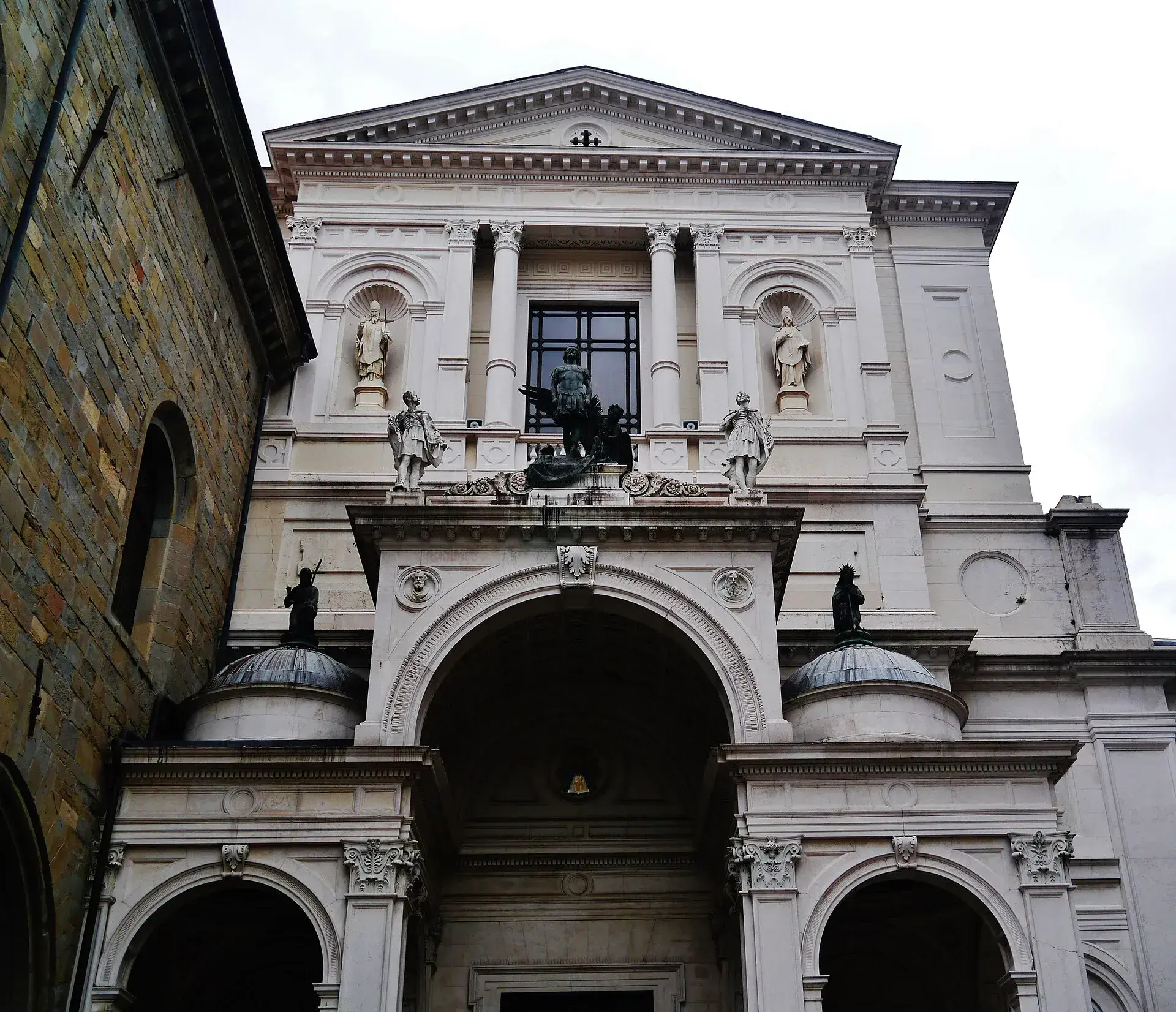
Dedicated to Saint Alexander, the city's patron saint, the cathedral combines a neoclassical exterior with an expansive Baroque interior. A statue of the saint in gilded bronze crowns the high dome, while the main entrance features a white Botticino marble portico set atop pink granite steps.
Bergamo walking tour with audio and quizzes: the walled Città Alta
2 hours11 stopsAudio guideStart any day, at your own paceTicket on your phone · 30-day refundThe Tale of Two Cathedrals
Archaeological investigations have confirmed that the site has been used for religious purposes since antiquity, revealing ancient Roman residential structures and a fifth-century paleochristian basilica. By the eighth century, the church was dedicated to Saint Vincent.
For centuries, medieval Bergamo operated under an unusual ecclesiastical arrangement: it maintained two competing cathedrals. San Vincenzo stood inside the walled city, while the Basilica di Sant'Alessandro stood outside the walls over the purported burial place of Saint Alexander. This division ended abruptly in 1561 when the Republic of Venice fortified Bergamo Alta. Venetian military engineers demolished the outer Basilica di Sant'Alessandro to secure defensive sightlines for their new ramparts. Following the demolition, the saint's dedication and chapter were merged with San Vincenzo, elevating the inner church to become the city's primary cathedral.
Centuries of Architectural Evolution
The building seen today is the result of multiple architectural campaigns spanning more than four centuries. In 1459, Renaissance architect and sculptor Filarete designed a major expansion for the site. Construction stalled and resumed in 1611 under the guidance of Vincenzo Scamozzi. Between 1689 and 1693, Roman architect Carlo Fontana carried out extensive modifications, redesigning the dome and apse. The transformation concluded in 1889 with the completion of the neoclassical façade designed by Angelo Bonicelli.
Inside, the Latin cross layout opens into a luminous environment of white plaster and gold leaf ornamentation, filled with the faint scent of beeswax and incense and occasionally accompanied by organ reverberations. The cathedral houses significant sacred art, including Giambattista Tiepolo's painting Martyrdom of Bishop Saint John of Bergamo, alongside canvases by Giovan Battista Moroni and Andrea Previtali, and wood and marble carvings by Andrea Fantoni.
Relics and the Papal Tiara of John XXIII
Beneath the high altar lie the remains of Saint Alexander. According to local religious tradition, Alexander was a Roman soldier of the Theban Legion who escaped imprisonment twice before being beheaded in Bergamo around 300 AD for refusing to sacrifice to Roman gods.
The cathedral treasury also preserves the gold papal tiara of Pope John XXIII (Angelo Giuseppe Roncalli), who was born in the province of Bergamo. Created by local artisan Attilio Nani, the ceremonial crown is adorned with diamonds, pearls, rubies, and emeralds.
Subterranean Ruins and the Piazza Baptistery
Directly underneath the cathedral floor, the Museo e Tesoro della Cattedrale allows visitors to access excavated subterranean levels. The archaeological area displays layers of Bergamo's urban fabric, including Roman street paving, medieval foundations, and an early Christian crypt.
Directly outside the cathedral's entrance stands a fourteenth-century octagonal Gothic baptistery. Built in 1340, the structure originally stood inside the neighboring Basilica of Santa Maria Maggiore. It was dismantled in the seventeenth century, moved to multiple locations, and finally reassembled in Piazza del Duomo between 1898 and 1900.
Worship and Visitor Access
Cattedrale di Sant'Alessandro remains an active place of Catholic worship, holding daily liturgies and episcopal services. The cathedral is open daily with free general admission to the main nave, while the subterranean museum provides access to the archaeological layers below. Every year on August 26, the cathedral serves as the primary setting for the citywide patronal feast of Saint Alexander.
FAQ
Why was the original Basilica di Sant'Alessandro demolished?
In 1561, the Republic of Venice demolished the outer Basilica di Sant'Alessandro to clear defensive sightlines for the construction of Bergamo Alta's Venetian walls. Its chapter and patron dedication were subsequently merged into the cathedral within the city.
What precious item belonging to Pope John XXIII is housed in the cathedral?
The cathedral holds the gold papal tiara of Pope John XXIII, who was born in the province of Bergamo. Crafted by local goldsmith Attilio Nani, it is decorated with diamonds, pearls, rubies, and emeralds.
What can be seen in the cathedral's archaeological area?
The underground Museo e Tesoro della Cattedrale preserves excavated Roman roadways, medieval building foundations, and an early Christian crypt located directly beneath the cathedral floor.
What is the origin of the baptistery outside the cathedral?
The fourteenth-century octagonal Gothic baptistery was originally erected in 1340 inside the neighboring Basilica of Santa Maria Maggiore. It was dismantled in the seventeenth century and relocated multiple times before its reassembly in Piazza Duomo around 1898–1900.