Palazzo della Ragione: Bergamo's Medieval Civic Hall
The Historic Core of Bergamo Alta
Standing as the architectural threshold between secular governance and ecclesiastical authority, the Palazzo della Ragione occupies the central pivot of Bergamo Alta. Historically documented in 1198 as the Palatium Comunis Pergami, it was constructed between 1183 and 1198 in the wake of the Peace of Constance, which secured civic liberties for northern Italian communes from Holy Roman Emperor Frederick I Barbarossa. Today, it ranks as the oldest surviving communal palace in Lombardy and stands among the earliest civic halls in Italy.
In the urban fabric of the upper city, the structure functions as both a division and a link between Piazza Vecchia, Bergamo's civic forum, and Piazza del Duomo, the historic religious precinct. Its distinctive open ground floor allows pedestrian traffic to move seamlessly between the two public squares.
Bergamo walking tour with audio and quizzes: the walled Città Alta
2 hours11 stopsAudio guideStart any day, at your own paceTicket on your phone · 30-day refundVenetian Reorientation and Renaissance Reconstruction
The palace was initially designed for communal assembly meetings and originally oriented south, facing the Basilica of Santa Maria Maggiore. Following Bergamo's integration into the Republic of Venice, the civic administration reshaped the building. Between 1462 and 1463, the palace's primary orientation was rotated north toward Piazza Vecchia, accompanied by the installation of a prominent exterior covered staircase.
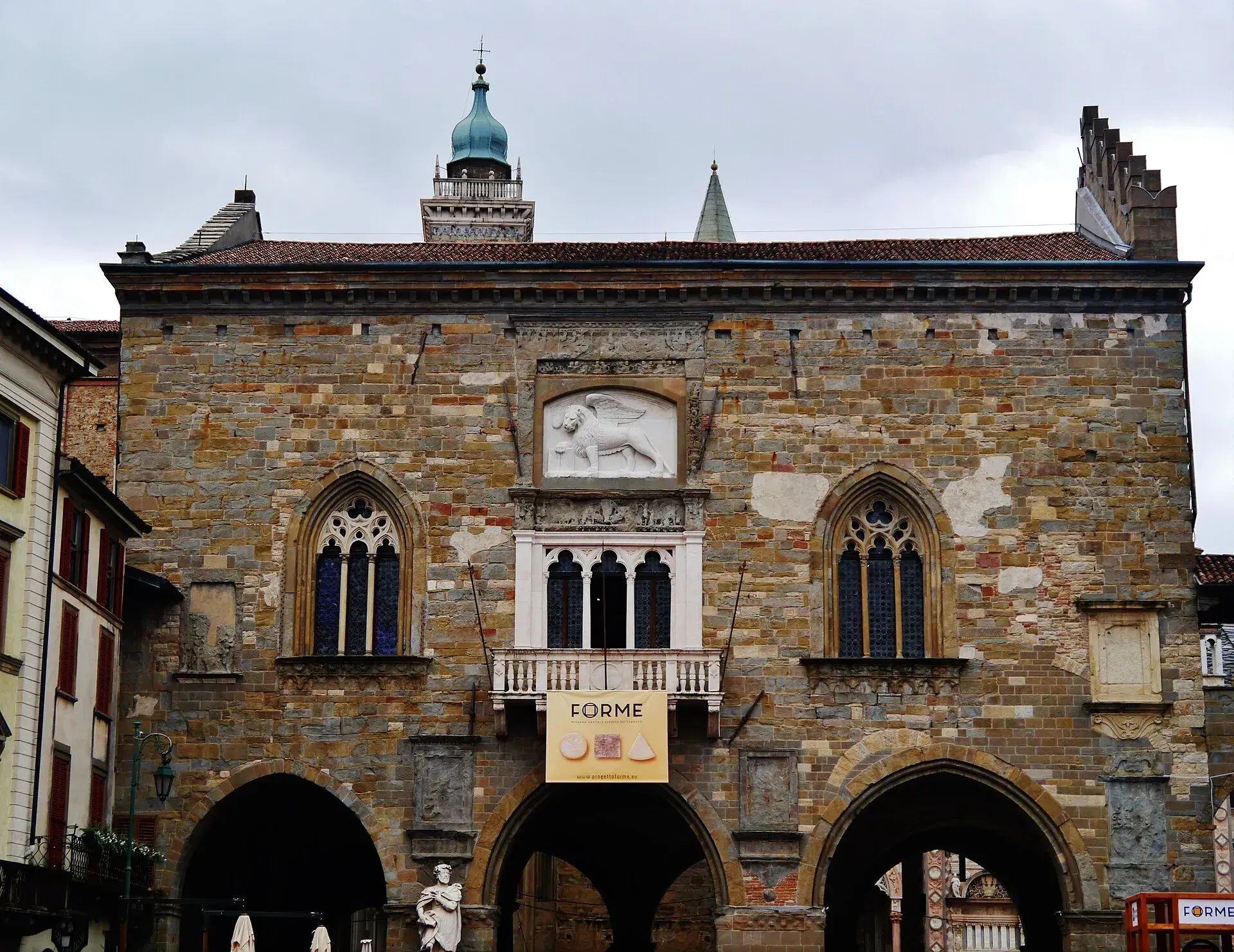
During this Venetian era, municipal council assemblies moved, and the building became the seat of the judicial courts. It acquired the name Palazzo della Ragione because magistrates convened within its halls to administer legal right or reason (ragione). A catastrophic fire damaged the hall in 1513, prompting a Renaissance reconstruction overseen between 1538 and 1554 by architect Pietro Isabello and his son Leonardo. The northern facade overlooking Piazza Vecchia remains distinguished by three-light Gothic windows (trifore) and a central 15th-century marble relief depicting the Venetian Lion of Saint Mark. Judicial operations continued here until the fall of the Venetian Republic to Napoleonic forces in 1797.
The Ground-Floor Loggia and the 1798 Solar Meridian
The ground-floor loggia features pointed stone arches supported by central columns and perimeter pillars crowned with late 12th-century Romanesque capitals. These carvings depict a variety of medieval motifs, including grotesque human heads, lions, eagles, and monkeys. The transition from the open, sunlit expanse of Piazza Vecchia to the shaded vaulting of the portico creates an abrupt shift in temperature, acoustics, and light, with the stone arches framing the marble facade of Santa Maria Maggiore and the Colleoni Chapel.
Over the centuries, the loggia served various public functions. In earlier eras, defendants stood trial here while seated on an official stone bench, while crowds also gathered under the vaults for open-air puppet shows satirizing civic officials.
Inlaid directly into the pavement beneath the vaulted ceiling is an analemmatic solar meridian (meridiana), designed in 1798 by the astronomer and mathematician Giovanni Albrici. The instrument functions via a small aperture pierced in a metal plate set high within an adjacent archway. Sunlight passing through this gnomon casts a focused disc of light onto a calibrated marble strip on the floor, marking the exact moment of local solar noon along with the calendar date and corresponding astrological zodiac sign.
Sala delle Capriate and the Museo dell'Affresco
The upper level of the palace contains the monumental Sala delle Capriate (Hall of the Trusses), named for its exposed timber roof structure. Reached via the external covered staircase—flanked by decorative stone beasts originally salvaged from a dismantled funerary monument in a former local Franciscan convent—the hall is illuminated by expansive multi-mullioned Gothic windows.
Today, the hall operates as an exhibition venue and houses the Museo dell'Affresco. The museum preserves detached historic wall paintings (strappi d'affresco) salvaged from various buildings across Bergamo. Among its most notable holdings are surviving fragments of Donato Bramante's 1477 Seven Sages of Antiquity series, painted originally for the facade of the neighboring Palazzo del Podestà, as well as works by Alessandro Allori and temporary modern exhibitions.
FAQ
When was the Palazzo della Ragione built?
The palace was constructed between 1183 and 1198 following the Peace of Constance, making it the oldest surviving communal palace in Lombardy.
Why is the building called the Palazzo della Ragione?
During Venetian rule, the structure became the city's judicial tribunal where magistrates met to administer justice and evaluate legal right or reason (ragione).
How does the sundial on the portico floor work?
Designed in 1798 by astronomer Giovanni Albrici, the meridian line uses sunlight passing through a high aperture in an archway to cast a light beam onto an inlaid floor track, indicating solar noon, the calendar date, and the zodiac sign.
What artworks are displayed inside the upper hall?
The Sala delle Capriate houses the Museo dell'Affresco, featuring detached historic frescoes including fragments of Donato Bramante's 1477 Seven Sages of Antiquity and works by Alessandro Allori.