Torre del Gombito: Bergamo's Medieval Fortress
Ancient Crossroads and Medieval Origins
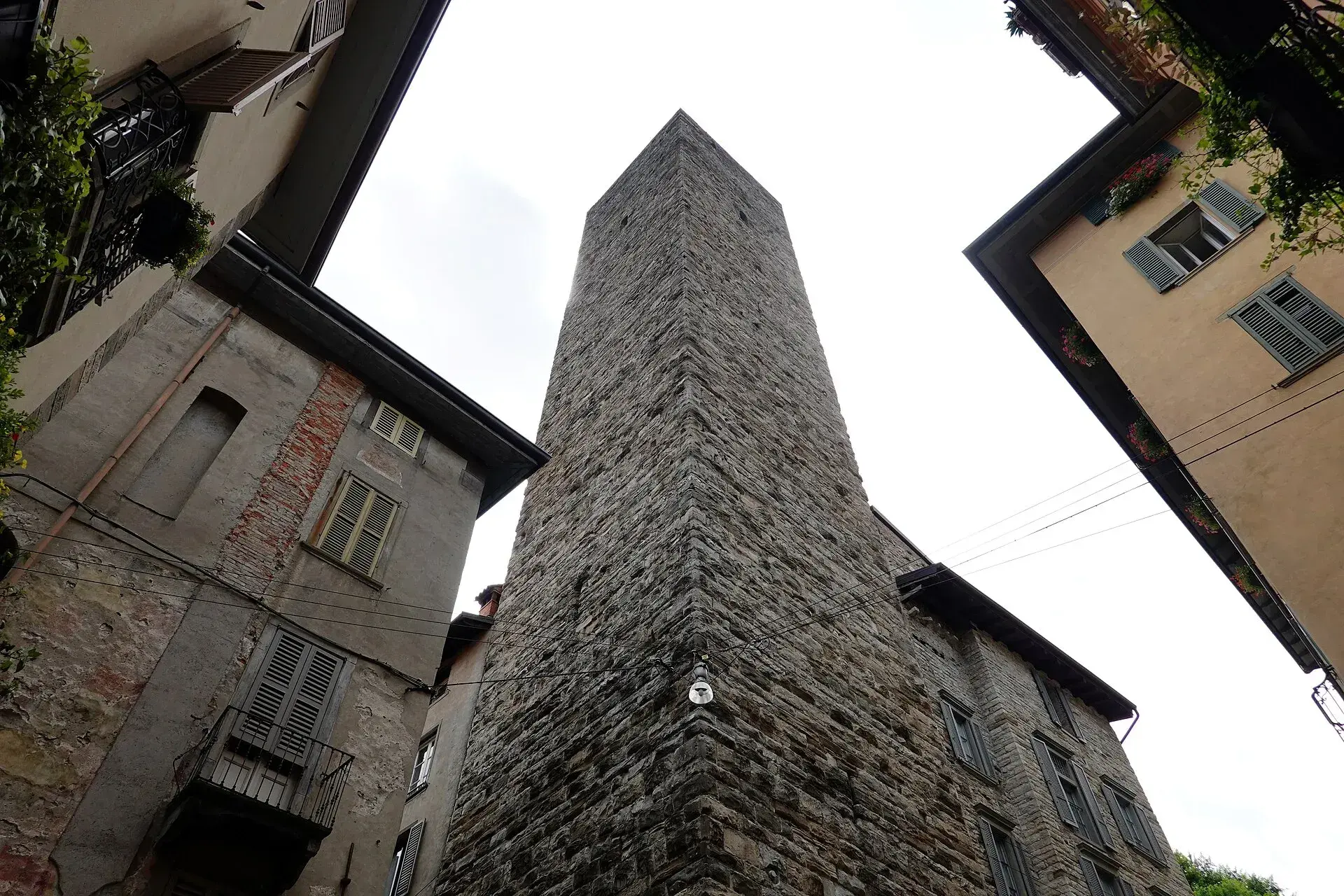
Rising above the primary thoroughfare of Bergamo Alta, the Torre del Gombito stands at an intersection of deep historical significance. The tower marks the precise junction of Roman Bergomum's primary street axes: the decumanus maximus (modern Via Gombito) and the cardo (Via San Lorenzo and Via Mario Lupo). Built around 1200 as a private defensive tower house for the Del Zoppo family, the structure was constructed from 6,827 square ashlar blocks of grey Sarnico sandstone (pietra di Sarnico) laid in regular horizontal courses.
The tower's name originates from the Latin term compitum, meaning "crossroads." Over centuries, local dialect shifted the word to gòmbito, meaning "elbow." This linguistic evolution gave rise to a enduring local misconception that the tower was named after a sharp curve in the street rather than its Roman intersection.
Bergamo walking tour with audio and quizzes: the walled Città Alta
2 hours11 stopsAudio guideStart any day, at your own paceTicket on your phone · 30-day refundA Stronghold in Communal Warfare
During the communal era, noble families in Bergamo built competing towers as fortified redoubts and symbols of clan power. The Torre del Gombito became directly embroiled in the intense Guelph and Ghibelline factional fighting that defined the period. Historical records indicate that the tower was set on fire in 1206 during urban warfare between the rival Rivola and Suardi families.
During the High Middle Ages, Bergamo Alta contained more than 30 fortified towers. Most were later dismantled or heavily altered, making the Torre del Gombito the best-preserved private medieval tower to survive largely intact. In height, it is rivalled within the upper city only by the municipal Torre Civica on Piazza Vecchia.
Defensive Architecture and Modifications
Unlike many medieval towers retrofitted over the centuries with residential windows, the Torre del Gombito retains its severe military exterior. Up to a height of approximately 42 metres, the sandstone shaft remains almost completely blind and unbroken, pierced only by four small apertures near the upper levels.
Originally reaching roughly 64 metres in height, the structure was reduced to approximately 52 metres during the 19th century, though surviving municipal archives lack conclusive documentation regarding the specific structural concerns that prompted the dismantling. In 1877, private owners donated the tower to the Municipality of Bergamo. A steep wooden staircase was installed in the interior in 1892, supplementing steps carved directly into the thick perimeter walls, with narrow arrow-slit openings providing minimal daylight.
Transition to Public Landmark
Beginning in the 16th century, the tower transitioned away from military functions. Ground-level spaces were adapted for commercial use, including an inn documented in 1596 as the hostaria del Gombedo. Following an extensive municipal restoration and structural consolidation project carried out between 2001 and 2009, the monument reopened to the public in 2010.
Today, the ground floor houses the official tourist office for Bergamo Alta (Infopoint Bergamo Città Alta). The rooftop terrace functions as a panoramic viewpoint accessible via 263 interior steps on select dates by advance reservation. Due to the confined nature of the historical staircase, ascents are restricted to small groups of 6 to 10 visitors at a time, offering 360-degree vistas across the historic rooftops, Venetian walls, the surrounding Po Valley plain, and the Pre-Alps.
FAQ
Why was the Torre del Gombito built?
The tower was erected around 1200 as a fortified private residence and stronghold for the Del Zoppo family during a period of intense factional conflict in Bergamo.
What does the name Gombito mean?
The name derives from the Latin word compitum, meaning 'crossroads', referencing the tower's position at the intersection of Roman Bergamo's decumanus maximus and cardo.
Can the public visit the top of the tower?
Yes. The rooftop terrace is accessible on select dates by prior reservation through the municipal tourist office located on the ground floor, with group sizes limited to 6 to 10 people.