Castello Ursino: Catania's Medieval Lava Fortress
An Imperial Stronghold on the Sicilian Coast
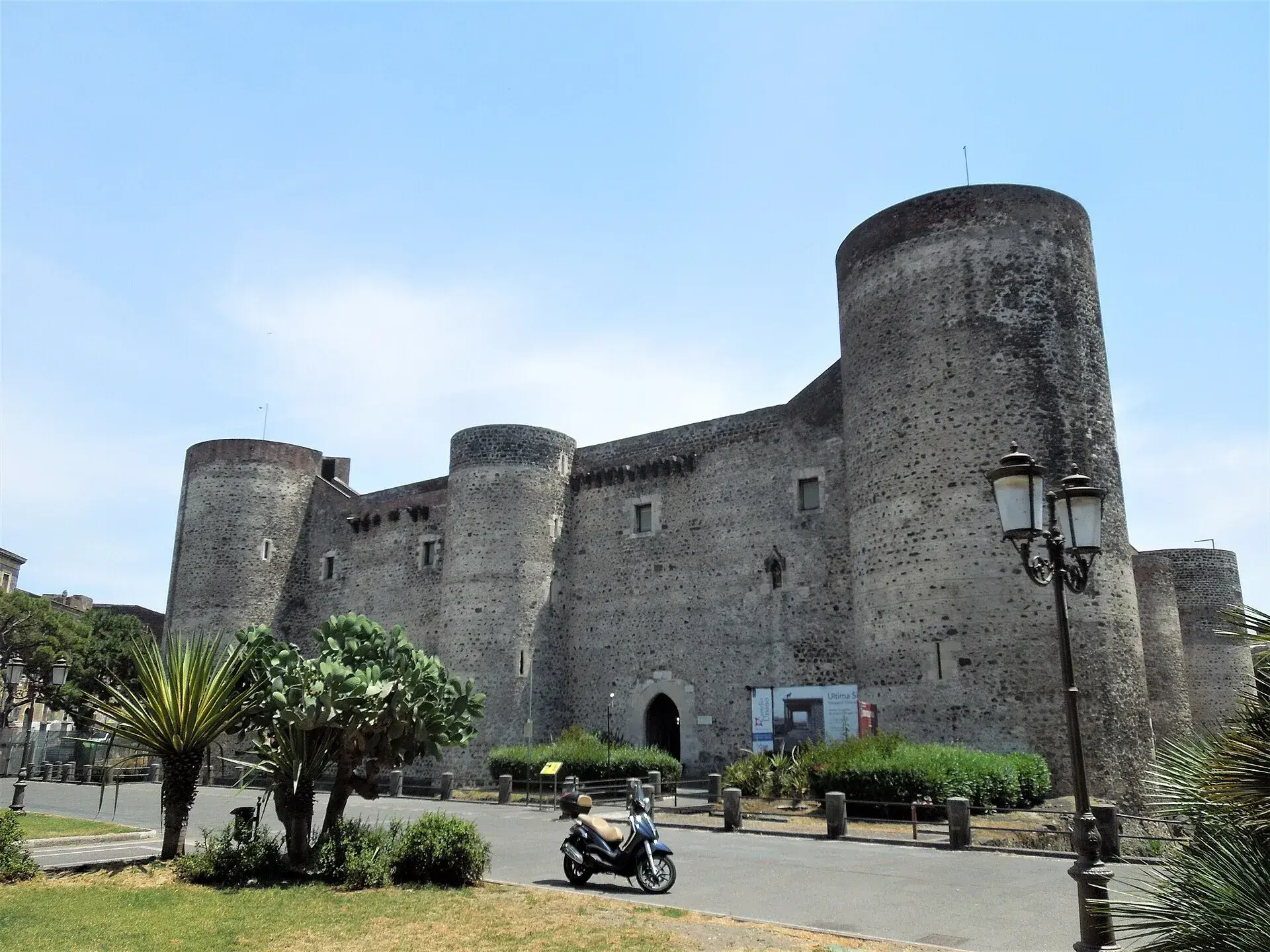
Commissioned between 1239 and 1250 by Holy Roman Emperor Frederick II of Swabia, Castello Ursino was conceived as an imperial stronghold to assert royal control over Catania and protect Sicily's eastern seaboard. Designed by the military architect Riccardo da Lentini, the fortress stands in Piazza Federico di Svevia, anchoring the historic fabric just south of Piazza del Duomo.
The structure exemplifies Swabian military engineering, characterized by a strictly geometric, square plan measuring roughly 50 by 50 meters around an open central courtyard. Built from dark volcanic basalt and limestone masonry, it was originally fortified with four large cylindrical corner towers and four semicircular curtain wall towers. Today, the core fortress and two of the intermediate wall towers remain standing. Within its walls, heavy stone vaults create cool, sheltered halls that contrast sharply with the sunlit central yard.
Catania walking tour with audio and quizzes: Elephant and Roman ruins
2 hours8 stopsAudio guideStart any day, at your own paceTicket on your phone · 30-day refundFrom Royal Residence to Spanish Gaol
Beyond its defensive role, Castello Ursino served as a focal point for Sicilian political life. Under Aragonese rule, it functioned as a royal residence. In 1295, the Sicilian Parliament gathered within its vaulted halls to depose James II and declare Frederick III the King of Sicily.
By the 16th century, developments in artillery lessened the fortress's tactical significance. Spanish viceregal authorities adapted the castle for use as a military garrison and a prison. The ground-floor chambers retain poignant traces of this era, with dates, symbols, and inscriptions carved into the stone walls and window embrasures by former inmates.
Surviving Lava and Earthquakes
Castello Ursino originally stood on a rocky sea cliff where Mediterranean waves broke against its fortifications. Linguistic tradition suggests the name Ursino derives from Castrum Sinus, meaning "castle of the bay," describing its initial coastal setting.
This geography changed drastically in 1669 when an eruption of Mount Etna directed streams of molten lava toward Catania. The volcanic flow surrounded the castle, filled its defensive moat, and pushed the shoreline approximately 500 meters to the east. As a result, the maritime fortress became permanently landlocked. In 1693, the catastrophic Val di Noto earthquake flattened most of Catania, but Castello Ursino's robust medieval core endured. It remains one of the city's few surviving medieval landmarks, standing in stark contrast to the late-Baroque architecture that defines modern Catania.
Catania's Museo Civico
In 1932, the Municipality of Catania acquired Castello Ursino. Following a restoration process that cleared away post-medieval alterations to highlight the fortress's original architectural lines, the castle reopened in 1934 as the city's Museo Civico.
The museum displays civic archaeological and art collections covering Greek, Hellenistic, Roman, medieval, and modern periods. Significant holdings include the 18th-century antiquities assembled by Ignazio Paternò Castello, Prince of Biscari, alongside historical treasures from the Benedictine Monastery of San Nicolò l'Arena. The collection features Roman sculptures, mosaics, bronzes, and Sicilian paintings from the 15th through 19th centuries, while the open central courtyard and ground-floor halls continue to host temporary exhibitions, civic gatherings, and lectures.
FAQ
Why is Castello Ursino located inland instead of on the coast?
Although built directly onto a sea cliff, the 1669 eruption of Mount Etna engulfed the castle's moat in molten lava and pushed the coastline 500 meters eastward, leaving the fortress landlocked.
Who designed and commissioned Castello Ursino?
Holy Roman Emperor Frederick II of Swabia commissioned the castle between 1239 and 1250, and it was designed by military architect Riccardo da Lentini.
What is Castello Ursino used for today?
The castle serves as Catania's Museo Civico, displaying archaeological artifacts and artwork ranging from the Greek and Roman periods to modern Sicilian paintings, including collections from the Prince of Biscari and the Monastery of San Nicolò l'Arena.
Where does the name Ursino come from?
Linguistic traditions suggest the name stems from Castrum Sinus, meaning 'castle of the bay,' which referred to its original position along the shoreline before volcanic lava altered the coast.