Roman Theatre and Odeon: Catania's Volcanic Ruins
Ancient Architecture of Volcanic Stone
The Roman Theatre and Odeon form a dual ancient performance complex set into the southern slope of the Montevergine hill in Catania. Situated along Via Vittorio Emanuele II, between Piazza del Duomo and Piazza San Francesco, the site illustrates the physical layering of Catania's ancient history beneath its post-1693 Baroque urban center. This monument is distinct from the city's Roman Amphitheatre, which is located nearby in Piazza Stesicoro.
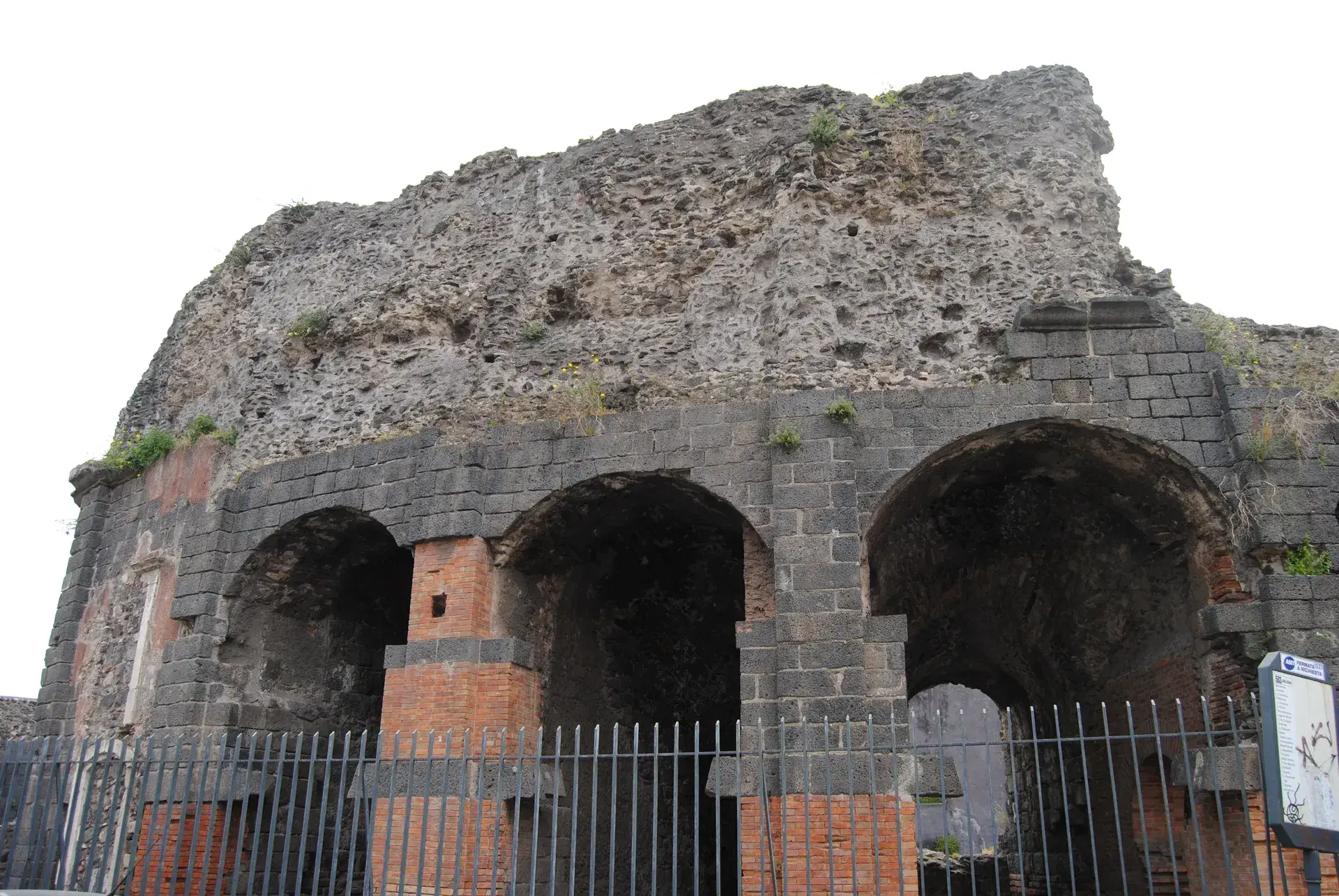
The main Roman Theatre features a semicircular cavea measuring between 80 and 98 meters across. Built to accommodate roughly 7,000 spectators, its 21 rows of tiered seating were engineered primarily from dark Mount Etna volcanic basalt, integrated with limestone and brickwork. In antiquity, these rough volcanic tiers were dressed in polished decorative marble. Adjacent to the main theatre stands the smaller Odeon, an approximately 1,500-seat structure designed with radiating walls that enclose vaulted, wedge-shaped rooms.
Catania walking tour with audio and quizzes: Elephant and Roman ruins
2 hours8 stopsAudio guideStart any day, at your own paceTicket on your phone · 30-day refundFrom Greek Foundations to Medieval Spoliation
The visible Roman complex dates to the 1st and 2nd centuries AD, but archaeological excavations confirm it rests directly above earlier Greek structural foundations dating from the 5th and 4th centuries BC. According to local tradition, this underlying Greek theatre was the location where Athenian general Alcibiades addressed the citizens of Katane in 415 BC to secure an alliance during the Peloponnesian War, though this event remains tied to historical tradition rather than definitive archaeological proof.
Following late antiquity, the civic complex fell out of use. In 1098, Norman Count Roger ordered the site stripped of its surviving marble facing and stone cladding to supply building material for the Cathedral of Sant'Agata. Over the subsequent centuries, residential buildings and tenements expanded directly over and inside the ancient cavea and vaulted galleries, gradually hiding the monument within the evolving city fabric.
The Submerged Orchestra of the Amenano River
One of the most unusual characteristics of the Roman Theatre is the constant presence of water across the performance area. Mount Etna's catastrophic eruption in 1669 diverted and buried the Amenano River underground. Today, the river's subterranean course surfaces directly through the lower levels of the complex, where clear water continuously bubbles up into the orchestra pit.
This continuous flow leaves the lower basalt tiers damp and the orchestra floor shallowly submerged year-round. Because of this permanent water level, modern stage productions cannot utilize the main theatre's orchestra floor.
Rediscovery, Urban Fabric, and Modern Access
Formal recovery of the complex began in 1770 under Prince Ignazio Paternò di Biscari, who initiated the clearing of residential structures built over the ruins. Substantial archaeological and expropriation efforts continued under archaeologist Paolo Orsi in the late 19th century and progressed through the 20th century.
Despite ongoing excavation, the complex maintains a close physical connection to surrounding domestic life. The upper rim of the cavea remains structurally integrated into historic residential buildings, leaving windows, balconies, and clotheslines sitting directly atop the ancient seating tiers. From Via Vittorio Emanuele II, the street entrance resembles an ordinary residential doorway that opens outward into the sunken volcanic bowl.
Today, the site operates as an archaeological park managed by the Parco archeologico e paesaggistico di Catania e della Valle dell'Aci. Open daily to ticketed visitors, the park incorporates historic domestic properties spared during excavation. Notably, the restored Casa Liberti serves as an antiquarium displaying recovered architectural fragments, while the adjacent Odeon occasionally hosts summer concerts and performances.
FAQ
Why is the orchestra of the Roman Theatre flooded?
The orchestra floor is submerged by the subterranean course of the Amenano River, which was buried underground by Mount Etna's 1669 lava flow and now emerges directly into the theatre.
What materials were used to construct the theatre complex?
The structures were built primarily using dark volcanic basalt from Mount Etna, integrated with limestone and brickwork, and originally faced with decorative marble.
How is the Roman Theatre different from Catania's Amphitheatre?
The Roman Theatre and Odeon complex sits on the southern slope of the Montevergine hill along Via Vittorio Emanuele II, whereas Catania's Roman Amphitheatre is an entirely separate monument located in Piazza Stesicoro.
What happened to the complex's original marble?
In 1098, Norman Count Roger ordered the theatre stripped of its decorative marble and stone cladding to construct the Cathedral of Sant'Agata.