Via Crociferi: Catania's Historic Baroque Street
History and Post-Earthquake Reconstruction
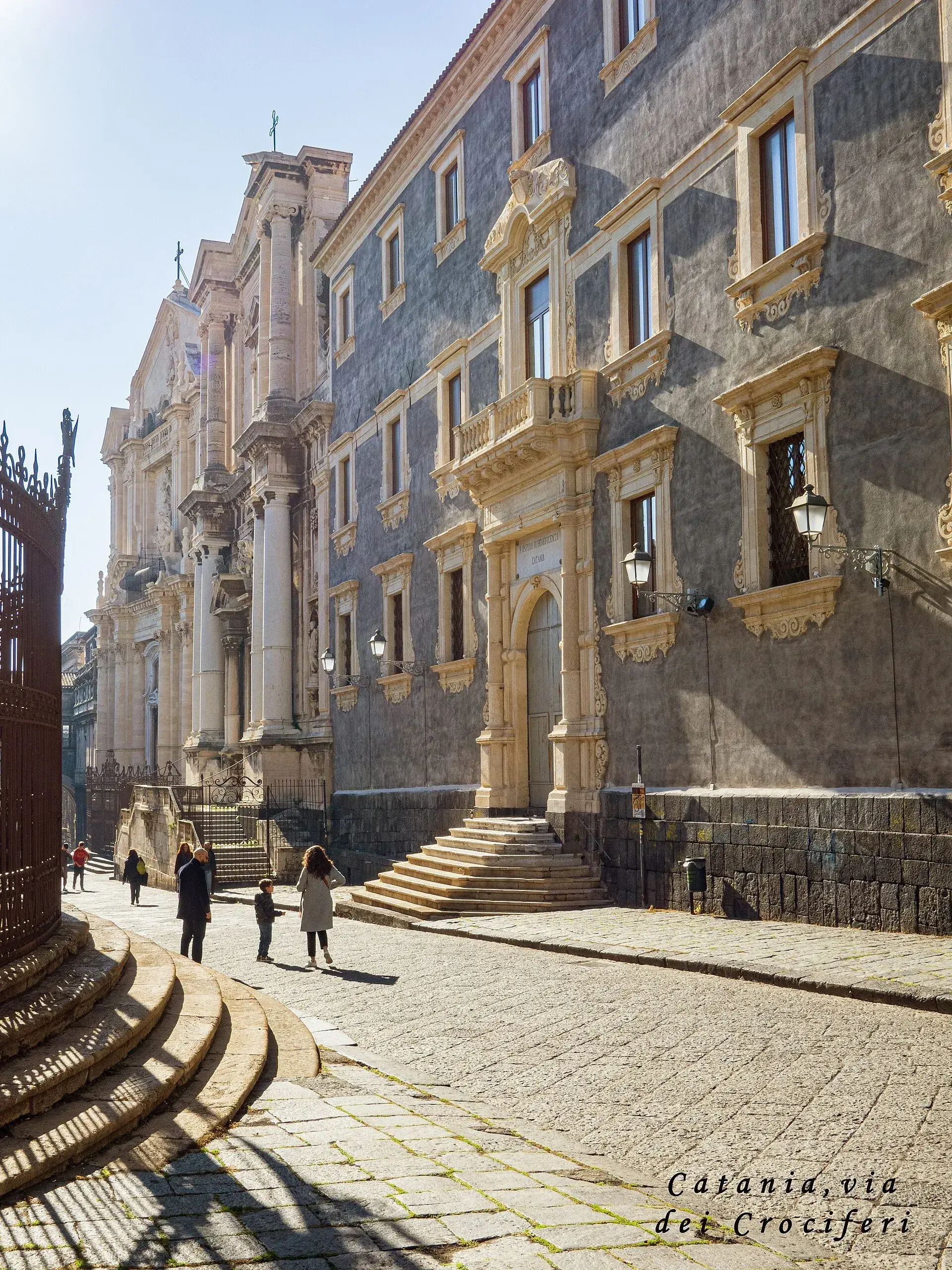
Via Crociferi is a monumental street spanning roughly 200 to 400 meters through the historic center of Catania. Extending northward from Piazza San Francesco d’Assisi to Villa Cerami, it forms an urban corridor connecting the lower civic center with the university quarter on Monte Vergine near Piazza del Duomo.
The street acquired its present form following the earthquake of January 11, 1693, which leveled Catania. During the subsequent rebuilding program, urban planners established a straightened axis reserved primarily for prominent religious communities, including the Benedictines, the Jesuits, and the Padri Crociferi (Camillians), after whom the street is named. In 2002, the dense cluster of 18th-century architecture along the street was inscribed as part of the UNESCO World Heritage Site "Late Baroque Towns of the Val di Noto (South-Eastern Sicily)".
Catania walking tour with audio and quizzes: Elephant and Roman ruins
2 hours8 stopsAudio guideStart any day, at your own paceTicket on your phone · 30-day refundArchitectural Highlights and Notable Churches
The street's visual coherence is largely credited to master architects such as Giovanni Battista Vaccarini. The architectural composition relies on light-colored limestone façades and ornate carvings set against dark basalt volcanic stone paving and accents.
Four prominent churches define the street's built environment:
- Chiesa di San Benedetto: Connected to the Benedictine Badia Grande, this church is entered via the marble Scalinata dell’Angelo. The complex encompasses the historical site of the monastery, contemporary exhibitions, and Roman archaeological remains, while remaining home to a cloistered community.
- Chiesa di San Francesco Borgia: Located adjacent to the former Jesuit College (Collegio dei Gesuiti).
- Chiesa di San Giuliano: A Baroque sanctuary featuring an octagonal plan and convex-concave curves, designed by Giovanni Battista Vaccarini.
- Chiesa di San Camillo de' Lellis: Situated along the upper section of the street, this church adjoins the convent of the Padri Crociferi.
At the northern terminus of the street stands Villa Cerami, an 18th-century aristocratic residence that serves as the Department of Law for the University of Catania.
The Arco di San Benedetto and Local Lore
Spanning the southern end of the street is the Arco di San Benedetto, an ornamental Baroque arch built in 1704. It was designed to link the Badia Grande with the Badia Piccola, allowing cloistered Benedictine nuns to cross between convent wings above the street without violating their seclusion vows. According to local lore, the arch was erected in a single night to circumvent an official municipal construction ban.
The arch is also central to an 18th-century legend involving a supposed "headless horse" (cavallo senza testa). The tale suggests local nobles circulated rumors of a midnight phantom horse roaming Via Crociferi to prevent onlookers from witnessing illicit nighttime meetings. A local youth, accepting a dare to prove the story false, walked the street at midnight and drove a stake into the masonry beneath the arch as evidence. However, he accidentally pinned his own cloak and died of fright, believing the apparition had seized him.
Modern Status, Traditions, and Cinema
Via Crociferi functions as an active pedestrian zone (Area Pedonale Crociferi) protected by automated electronic camera gates that enforce limited-traffic regulations (ZTL).
Religious traditions continue on the street, most notably during the annual Festa di Sant'Agata in February. As the procession passes, crowds gather in complete silence to listen to the Canto delle monache (or Canto delle Clarisse/Benedettine), a solemn Latin hymn sung by cloistered nuns through church grates.
Because of its intact 18th-century streetscape, Via Crociferi has served as an open-air film set. Prominent productions filmed here include Mauro Bolognini’s Il bell'Antonio (1960), Franco Zeffirelli’s Storia di una capinera (1993), and Roberto Faenza’s I Vicerè (2007).
FAQ
Why is the street named Via Crociferi?
It is named after the Padri Crociferi (the Order of Saint Camillus de Lellis, or Camillians), who built their convent and the Church of San Camillo de' Lellis along the upper part of the street.
What was the purpose of the Arco di San Benedetto?
Erected in 1704, the arch connected the Badia Grande and Badia Piccola, allowing cloistered Benedictine nuns to cross above the street without breaching their seclusion vows.
Which movies have been filmed on Via Crociferi?
Due to its unified 18th-century Baroque architecture, the street was used as a backdrop for Mauro Bolognini’s 'Il bell'Antonio', Franco Zeffirelli’s 'Storia di una capinera', and Roberto Faenza’s 'I Vicerè'.
What happens on Via Crociferi during the Festa di Sant'Agata?
Every February, crowds assemble along the street in silence to hear cloistered nuns perform the 'Canto delle monache', a Latin hymn sung from behind church grates as the patron saint's procession passes.