Basilica di San Fedele: Como's Romanesque Church
Roman Roots and Early Christian Origins
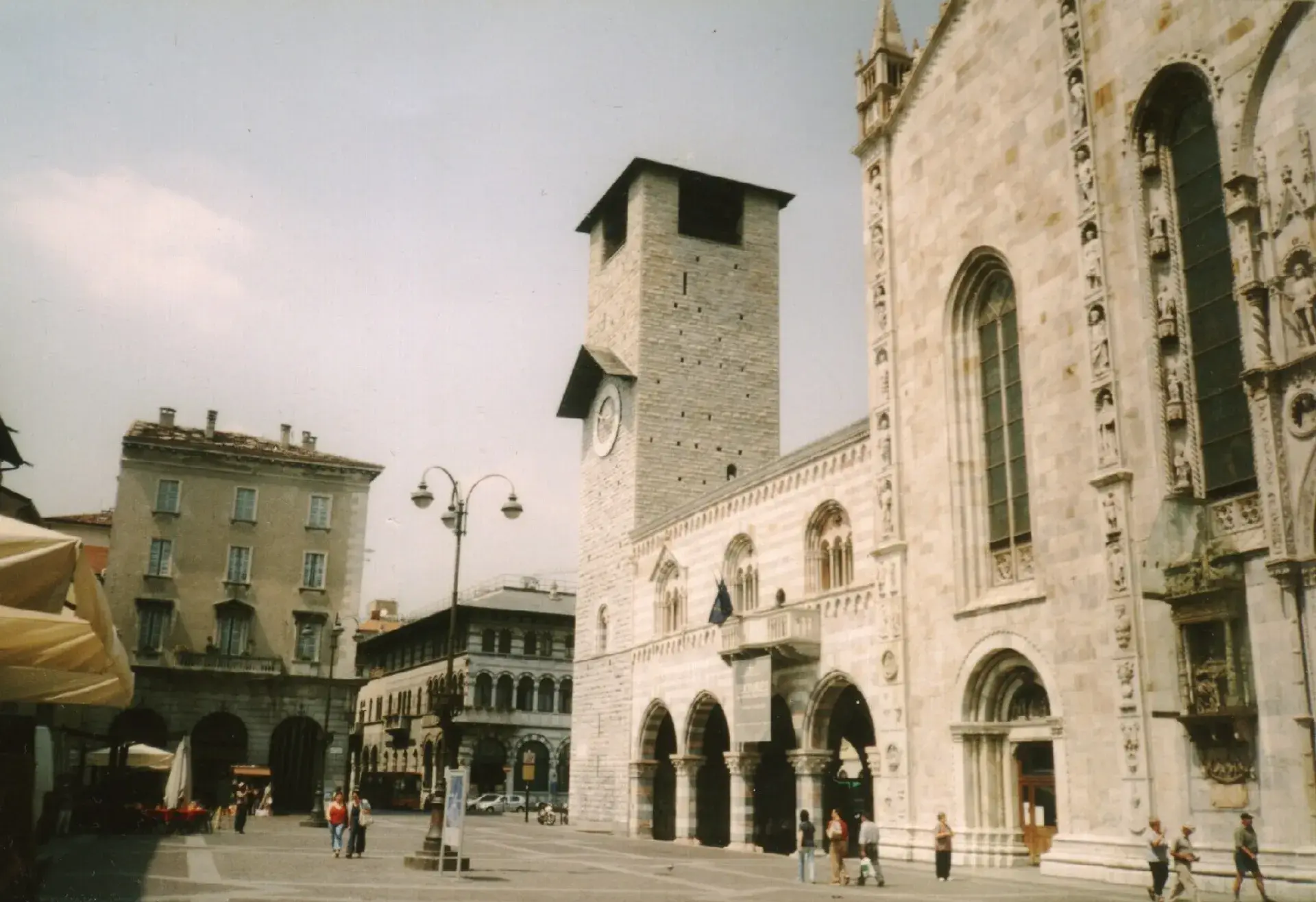
The Basilica di San Fedele stands in Piazza San Fedele within the walled old town (Città Murata) of Como. Anchoring the central crossroads of the city's Roman orthogonal street plan, the site originally formed the forum and commercial center of ancient Novum Comum. Archaeological evidence indicates that a paleochristian foundation was established here between the 5th and 7th centuries, initially dedicated to Santa Eufemia.
Between the 5th and 10th centuries, this early church served as Como's episcopal seat, flanked by the baptistery of San Giovanni in Atrio. According to tradition, the relics of Saint Fidelis—an early Christian soldier-martyr executed along northern Lake Como—were transferred to the church from Samolaco in 964. This prompted a rededication to San Fedele, though the cathedral seat later moved toward the lakeside to Santa Maria Maggiore. Throughout the Middle Ages and into the modern era, the adjacent square evolved into Como's principal grain and wheat market, remembered as the Piazza del Grano.
Lombard Romanesque Architecture and the Dragon Portal
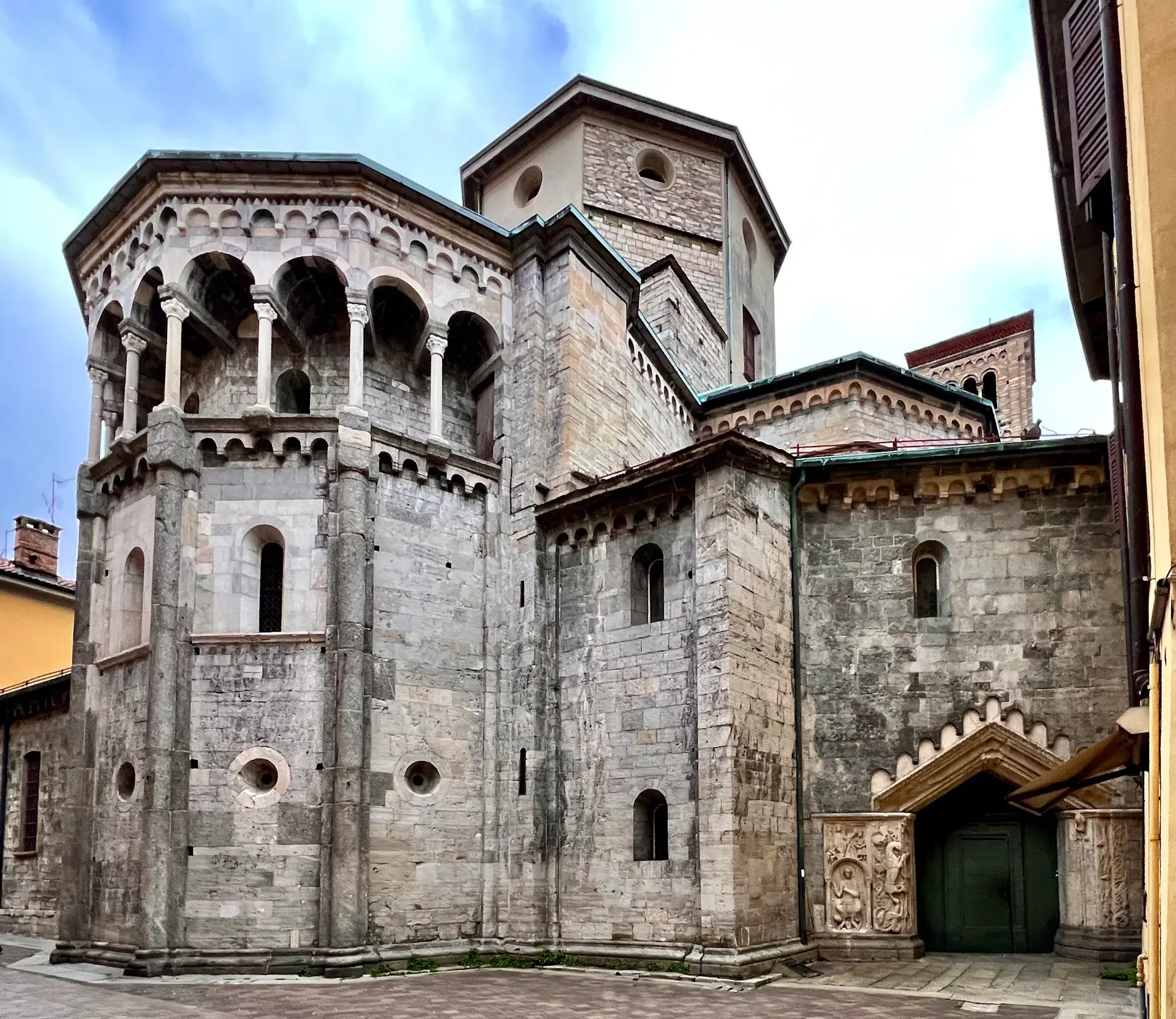
Construction of the present Lombard Romanesque collegiate church began around 1120. San Fedele represents one of the premier achievements of the Maestri Comacini, the regional guild of stonecutters and builders who shaped medieval architecture across northern Italy. The building features an Ottonian-Rhenish inspired eastern choir layout with a trefoil cloverleaf ambulatory and upper women's galleries (matronei). Recycled Roman spolia, including classical columns and capitals, are built directly into the exterior stonework and apsidal loggia.
On the northern exterior wall facing Via Vittorio Emanuele II is the Romanesque Dragon Portal (Portale del Drago). Carved from local Moltrasio limestone, the portal exhibits detailed low-relief sculptures by the Maestri Comacini depicting Daniel in the lions' den, the prophet Habakkuk held by an angel, competing dragons, a hunting dog chasing a hare, a griffin, and a monkey. The western facade is a neo-Romanesque design rebuilt in 1914 by architect Antonio Giussani, incorporating an earlier Renaissance rose window. Beside it, the bell tower was dismantled in 1905 due to structural tilting and reconstructed between 1905 and 1907.
Interior Art and Historical Curiosities
The transition from the bustling open square into the dim stone interior reveals a barrel-vaulted nave known for its resonant acoustics. Beneath the high altar lies a 14th-century marble sarcophagus containing the relics of Saint Fidelis. Near the entrance, two medieval stone stylophore lions have been adapted for use as holy water fonts. Side chapels display Baroque frescoes painted in 1623 by Isidoro Bianchi.
The church preserves notable historical connections, including the 1611 baptismal record of Como native Benedetto Odescalchi, who later became Pope Innocent XI; he is honored in an interior chapel completed in 1807. While some accounts mistakenly reference a historic marble ambo inside the basilica, official parish documentation confirms that the church pulpit is an early 19th-century carved walnut structure. Regional 12th-century marble ambo fragments are located instead in nearby Bellagio and Como's Paolo Giovio Archaeological Museum.
Piazza San Fedele and Surrounding Heritage
Facing the basilica across Piazza San Fedele are rare surviving examples of 15th- and 16th-century timber-framed residential architecture. These historical structures feature cantilevered upper stories supported by exposed wooden beams and masonry filled with bricks laid in a herringbone (spina di pesce) pattern.
Today, the Basilica di San Fedele operates as an active parish church within the Roman Catholic Diocese of Como, holding regular masses and religious services. Its resonant hall also hosts sacred music performances and recitals utilizing its restored Mascioni pipe organ, while the surrounding pedestrian square accommodates open-air café terraces, independent shops, and seasonal artisan markets.
FAQ
What was Piazza San Fedele used for in the past?
The square originally formed the forum of the Roman city of Novum Comum and later served through the Middle Ages and early modern period as Como's primary wheat and grain market, known as Piazza del Grano.
What is the Dragon Portal on the basilica's exterior?
The Dragon Portal (Portale del Drago) is a 12th-century Romanesque doorway on the north flank of the church, sculpted by the Maestri Comacini with reliefs of Daniel in the lions' den, the prophet Habakkuk, and mythical beasts.
Does the Basilica di San Fedele have an ancient marble ambo?
No. Parish records confirm that the interior pulpit is a 19th-century carved walnut structure. Notable 12th-century marble ambo fragments from the region are instead kept in Bellagio and Como's Museo Archeologico Civico Paolo Giovio.
Discover Como like never before
Dive into Como hidden stories and secret spots with Ciceru interactive tours.
Explore tour
Audioguide
Quizzes
Maps
Solo
Couples
Groups & families

© Photo by Stephan Fink via Google Maps · Google Places