Porta Torre: Como's Medieval Fortress Gate
Origins of Como's Southern Fortress
Porta Torre stands as the primary southern entrance to Como's historic walled center, the Città Murata. Historically known by several names—including Porta di Milano, Porta delle Meraviglie, and Torre di Porta Vittoria—the fortification was erected in 1192 under the direction of the city's podestà, Uberto de' Olevano.
The construction was part of a broader defensive campaign necessitated by the Ten Years' War (1118–1127), during which Milanese forces captured and leveled Como's Roman-era fortifications. In 1154, Como forged an alliance with Holy Roman Emperor Frederick I Barbarossa to counter Milanese dominance, initiating the reconstruction of the city's defensive perimeter. To reinforce the vulnerable southern frontier facing Milan, Uberto de' Olevano anchored the curtain wall with three key fortifications: Porta Torre in the center, Torre di San Vitale to the east, and Torre di Porta Nuova (later known as Torre Gattoni) to the west.
Architectural Ingenuity and Defensive Strategy
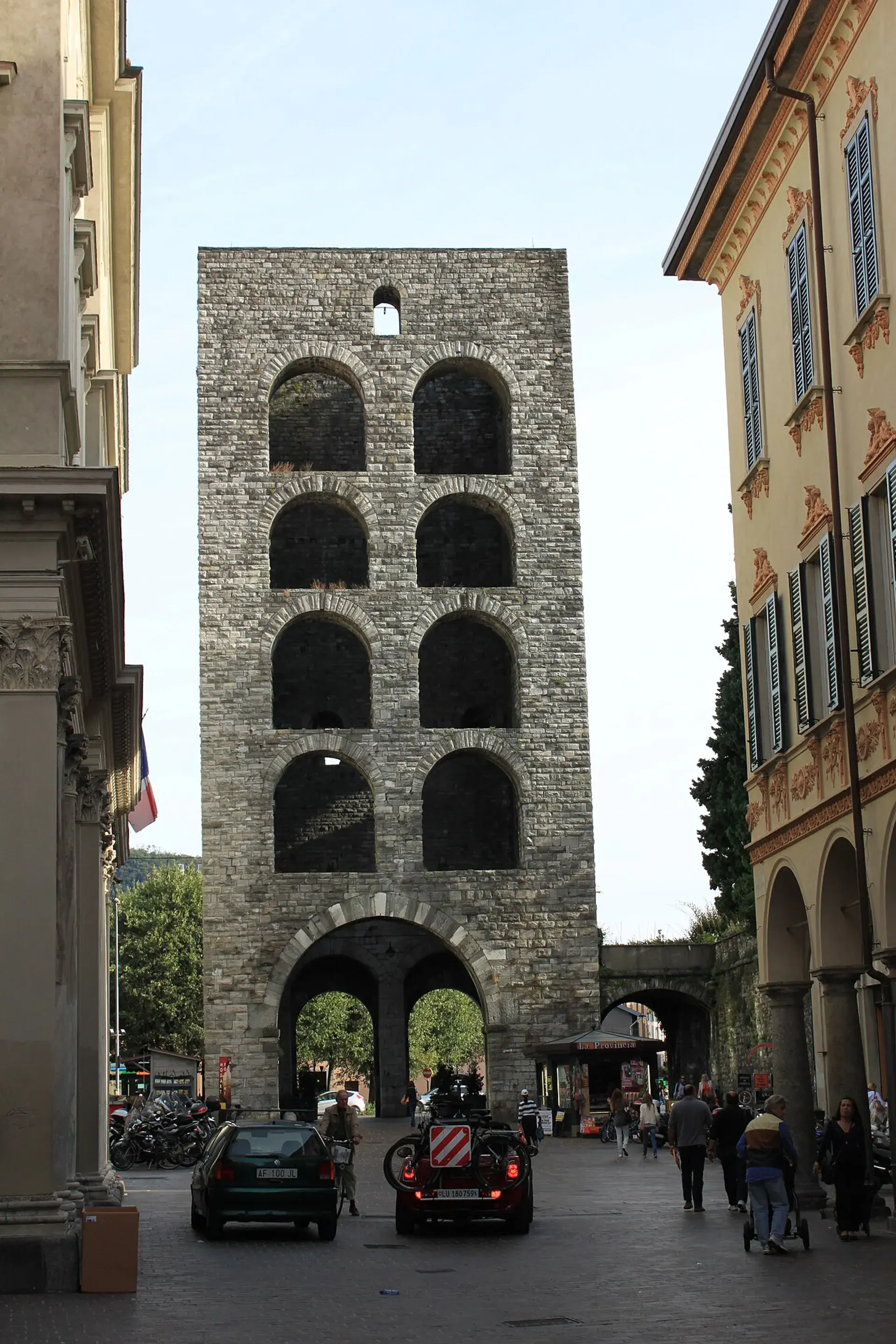
Built in the Romanesque style, Porta Torre is constructed from squared ashlar masonry set upon foundational wooden pilings (palafitte). Historical records document the tower's height as measuring between 34 and 40 meters. From the exterior facing Piazza Vittoria, the structure presents an austere, impenetrable facade pierced only by a massive ground-level gateway.
In stark contrast to its solid outer wall, the town-facing side of the tower features an entirely open design. Looking up from within the gateway reveals open sky through four tiers of paired arched window openings where intermediate wooden floors once rested. This asymmetric layout served an essential strategic purpose: if invading Milanese troops succeeded in breaching the heavy outer portal, the missing interior wall prevented them from taking cover or barricading themselves against defenders shooting arrows and projectiles from within the city. Architecturally, the four upper tiers of twin arches are noticeably misaligned with the wider single portal at street level.
Survival and Modern Urban Role
During the 14th century, the gate was further reinforced with two pentagonal lateral towers and a ravelin, followed by the addition of a semicircular bastion in the 16th century. Although these auxiliary defenses and most of Como's exterior walls were demolished during subsequent urban expansions, Porta Torre was preserved as a freestanding civic monument.
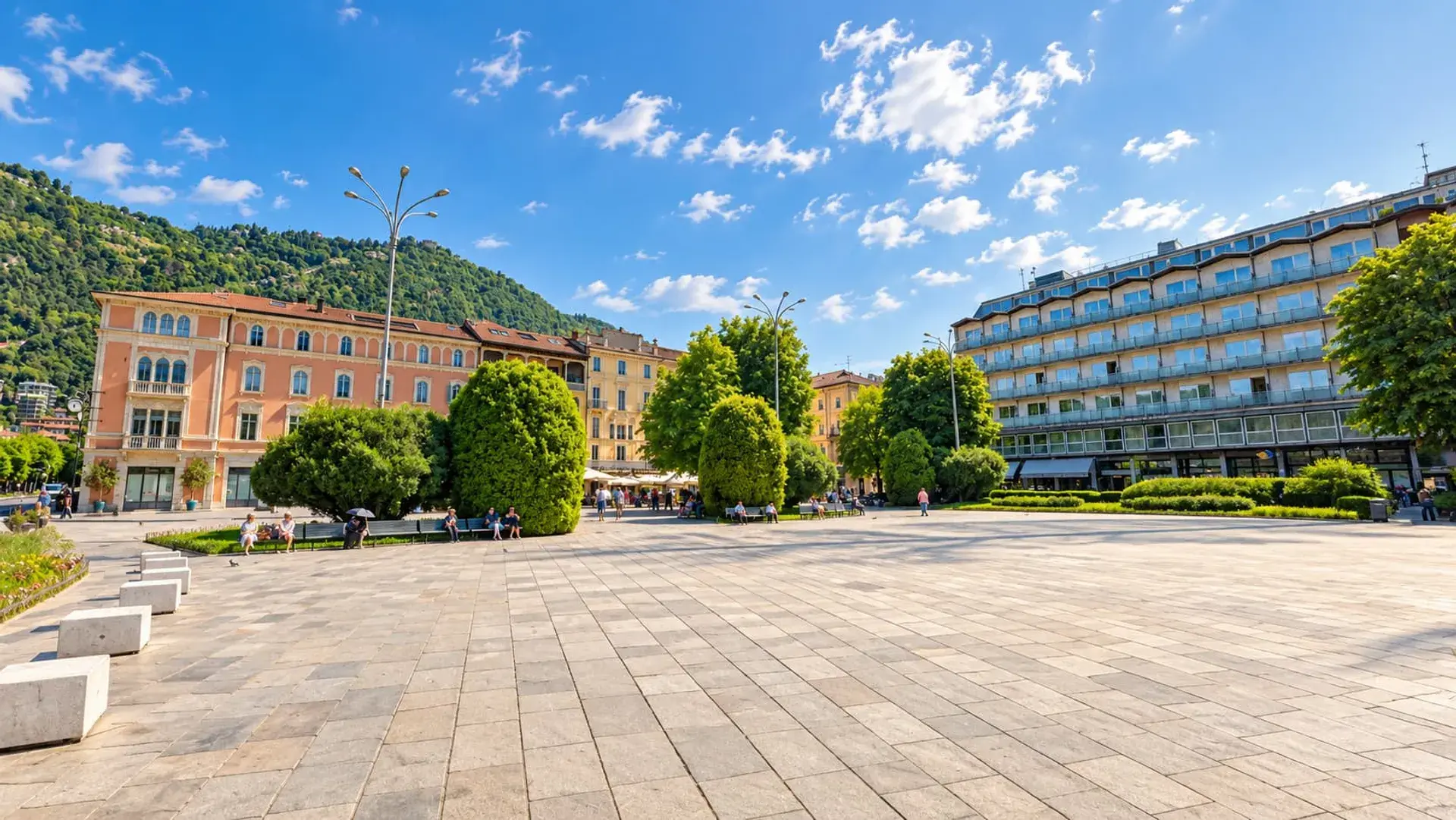
Archaeological investigations beneath modern streets and buildings near the tower have revealed the submerged remains of Como's ancient Roman entrance, traditionally referred to in local accounts as the Porta Pretoria. Today, Porta Torre marks the transition from contemporary Como into the preserved cardo-and-decumanus street plan of the old town. Piazza Vittoria, directly outside the gate, functions as a public gathering space and regularly hosts open-air street markets, while the gate itself serves as a major pedestrian thoroughfare. The upper interior floors remain closed to regular walk-in public access.
Connections to Alessandro Volta
Porta Torre is closely linked to Como's Enlightenment history. Immediately past the portal along Via Cesare Cantù sits the neoclassical building of the Liceo Classico e Scientifico Alessandro Volta (originally the Real Ginnasio), where Como-born scientist Alessandro Volta served as rector and professor of physics between 1774 and 1778.
Further west along the surviving southern perimeter stands Torre Gattoni, the matching defensive tower built concurrently with Porta Torre. In the late 18th century, Canon Giulio Cesare Gattoni converted this defensive bastion into a physics laboratory, providing the space where Volta conducted his formative experiments in electricity and electrostatics.
FAQ
Why is Porta Torre open on the side facing the city?
The gate was deliberately engineered without an interior rear wall. If invading forces breached the exterior gates, the open interior facade left them exposed with no shelter or defensive barricade against local defenders inside Como.
Can the public visit the upper levels of Porta Torre?
While the exterior and ground-level pedestrian portal are freely accessible, the upper interior chambers are not open for routine walk-in public visits.
What historical connection exists between Porta Torre and Alessandro Volta?
Porta Torre borders key locations from Volta's career, including the school on Via Cesare Cantù where he taught physics from 1774 to 1778, and the nearby Torre Gattoni, which served as his early electrostatic laboratory.
Discover Como like never before
Dive into Como hidden stories and secret spots with Ciceru interactive tours.
Explore tour
Audioguide
Quizzes
Maps
Solo
Couples
Groups & families

© photography taken by Christophe.Finot | CC BY-SA 3.0