Duomo di San Giorgio: Ferrara's Historic Cathedral
A Civic and Religious Centerpiece
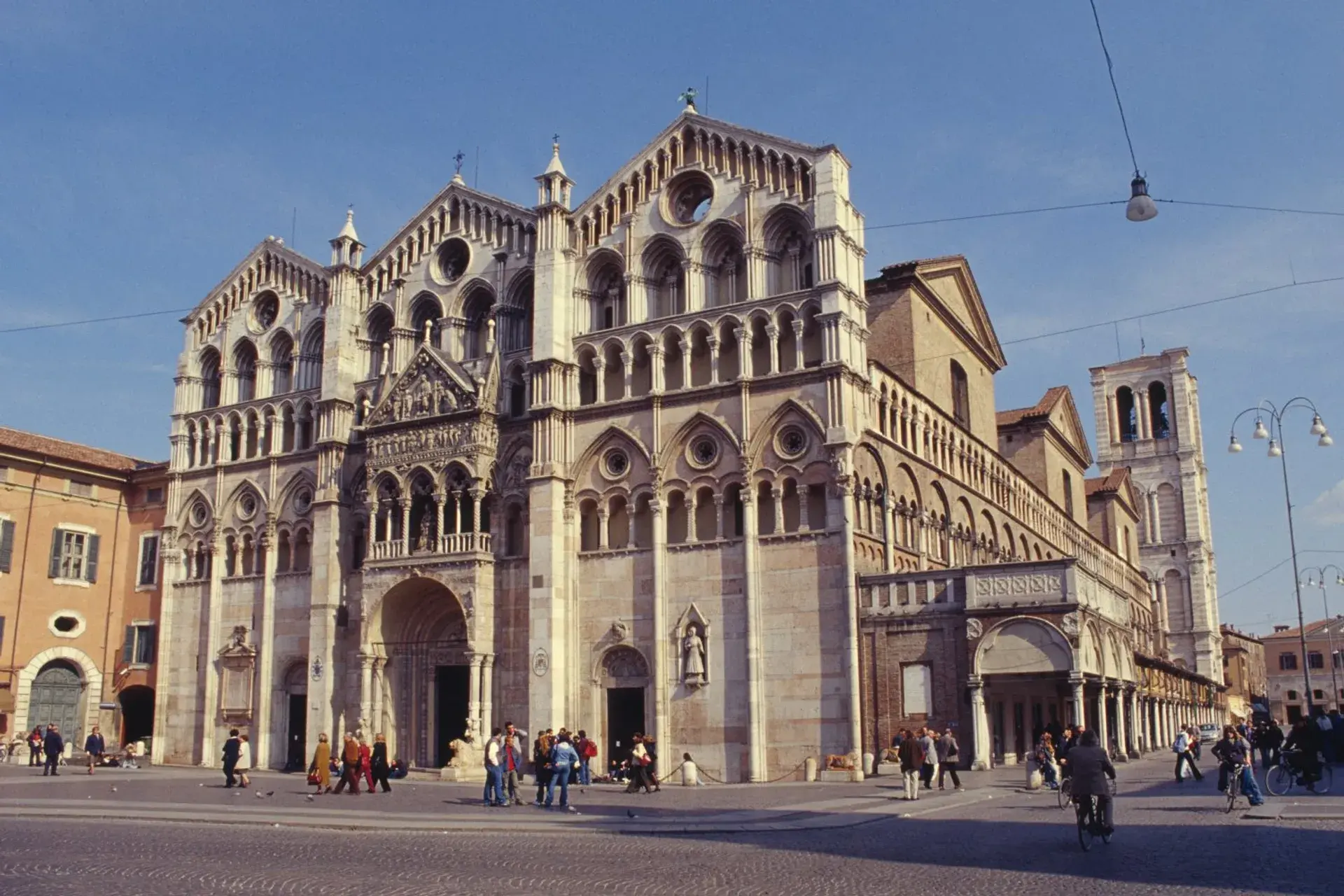
Begun in 1135 and consecrated in 1177, the Basilica Cattedrale di San Giorgio Martire anchors the UNESCO-listed historic core of Ferrara. Championed by Bishop Landolfo and financed by the nobleman Guglielmo II degli Adelardi, the building replaced an older basilica located outside the city walls. This transition established a new political and religious center for the medieval commune.
Centuries of Architectural Evolution
The cathedral’s design spans multiple centuries and styles. The lower level features Romanesque carvings by the master sculptor Nicholaus, while the upper facade displays intricate 13th-century Gothic details.
A white-and-pink marble Renaissance bell tower, begun in 1451 by Leon Battista Alberti, stands unfinished without its intended spire. The terracotta apse was designed by municipal urbanist Biagio Rossetti. Inside, the original medieval space was entirely rebuilt in the Baroque style during the 18th century.
Warnings and Laws Carved in Stone
The Duomo di San Giorgio served as a civic billboard where municipal laws and moral warnings were literally set in stone. The marble base of the cathedral bears fragments of an 1173 municipal decree engraved directly into the structure.
Above the central loggia, a 13th-century Gothic high-relief tympanum depicts the Last Judgment. This dramatic carving shows Archangel Michael weighing human souls while a demon attempts to tip the scale, with damned souls pushed into the mouth of Hell.
The Loggia dei Merciai
The southern wall facing Piazza Trento e Trieste seamlessly blends the sacred and the secular. A covered street-level shopping portico, known as the Loggia dei Merciai, is integrated directly into the cathedral's flank.
This architectural feature has maintained continuous commercial use since the Middle Ages. Today, the sounds of modern foot traffic and commerce still echo beneath the medieval arches, just as they did for medieval haberdashers.
Local Folklore and Hidden Curiosities
The exterior holds several details wrapped in local myth. A small Roman-era marble head set above a side door is traditionally known as "Madama Frara," believed by folklore to be the mythical Trojan woman who founded Ferrara.
Additionally, local tradition claims that the irregular, twisting stone colonnettes on the southern gallery were deformed out of spite by the Devil before the building was dedicated.
Historical Milestones and Modern Restoration
Over its long history, the cathedral has hosted significant events, including early sessions of the 1438–1439 Ecumenical Council of Ferrara. Pope Urban III, who died in Ferrara in 1187, is buried inside the cathedral.
The complex survived direct hits during Allied bombing in January 1944. More recently, the primary liturgical church of the Archdiocese of Ferrara-Comacchio underwent extensive structural consolidation following the 2012 Emilia earthquakes. It successfully reopened to regular worship in March 2024.
FAQ
When was the Duomo di San Giorgio built?
Construction of the cathedral began in 1135, and it was officially consecrated in 1177. It underwent various architectural additions over the centuries, including an 18th-century Baroque interior.
What is the Loggia dei Merciai?
The Loggia dei Merciai is a covered, street-level shopping portico integrated into the southern wall of the cathedral. It has hosted continuous commercial activity from medieval haberdashers to present-day retailers.
Who designed the cathedral's bell tower?
The white-and-pink marble Renaissance bell tower was designed by Leon Battista Alberti. Construction began in 1451, but the tower was left unfinished without its intended spire.
What is carved into the marble base of the cathedral?
The marble base of the cathedral is engraved with fragments of a municipal decree from 1173, turning the religious building into a civic billboard for the medieval commune.