Baluardo San Pietro: Lucca's Bastion of Peace
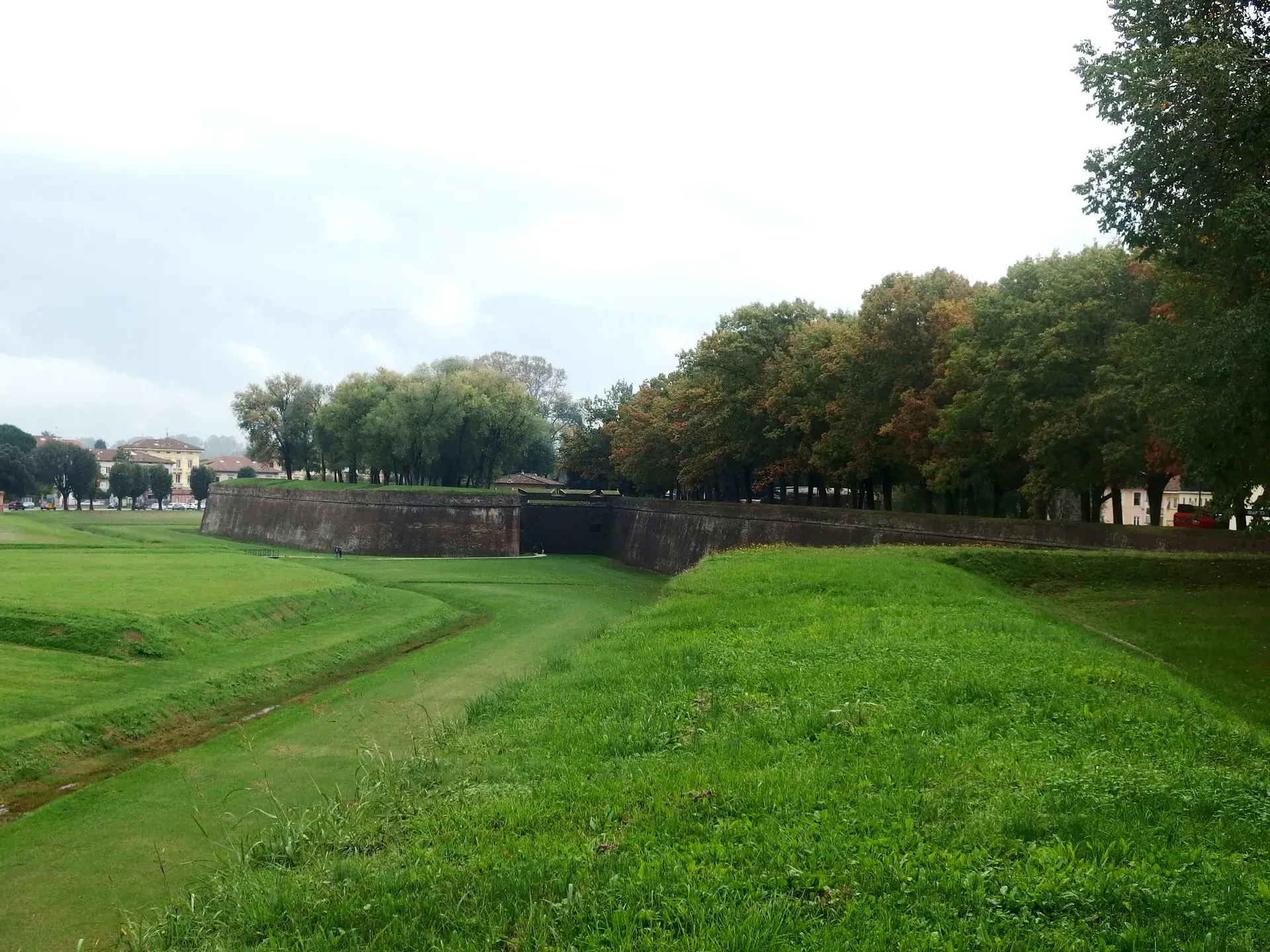
The Baluardo San Pietro, also known as Baluardo Cesare Battisti, is one of the eleven bastions forming the celebrated Renaissance walls of Lucca, Italy. Located at the northeastern tip of the defensive perimeter, this arrowhead-shaped fortification exemplifies the 'trace italienne' star fort design, engineered for defense with no blind spots. Though built for war, its history is one of peace and community service.
Renaissance Military Engineering
Constructed between 1608 and 1612, the Baluardo San Pietro was part of Lucca's third and final defensive circuit, a massive project undertaken from 1504 to 1648. The Republic of Lucca initiated this fortification in response to the expansionist ambitions of the Medici family in Florence. The design of this specific bastion, credited to architect Ginese Bresciani, features nearly symmetrical sides and distinctive rounded flanks known as 'orecchioni'. The immense earthworks were consolidated from the beginning by intentionally planting trees, a feature that defines the walls' appearance today.
A History of Unexpected Roles
Despite their formidable design, the walls of Lucca and the Baluardo San Pietro were never tested in battle. Their most dramatic defensive moment came in 1812, when they successfully held back the floodwaters of the Serchio river, saving the city from devastation. In 1866, the entire wall system was purchased by the Comune of Lucca from the state for 112,350 Lire, marking its transition from state military asset to civic property.
From Barracks to Children's House
A particularly poignant chapter in the bastion's history began in 1918. With the approval of the municipality, the American Red Cross repurposed the casermetta, or barracks, on Baluardo San Pietro. It became the 'Casa dei Bambini' (Children's House), a home for the children of soldiers fighting in World War I. This transformed a structure built for conflict into a sanctuary for its youngest victims.
The Bastion Today
Today, the Baluardo San Pietro is an integral part of the public park that encircles Lucca atop the city walls. Its wide, tree-lined top is a popular spot for locals and tourists to walk, run, and cycle. The building that once housed the 'Casa dei Bambini' is now home to the 'Villaggio del Fanciullo' (Children's Village), which became a foundation in 2014. The bastion offers expansive green spaces and serves as a scenic viewpoint over the city and the surrounding landscape.
FAQ
When was Baluardo San Pietro built?
The Baluardo San Pietro was constructed between 1608 and 1612 as part of the larger project to build Lucca's Renaissance walls.
Were the walls of Lucca ever used in a war?
No, the Renaissance walls of Lucca, including the Baluardo San Pietro, were famously never used for their intended military purpose in warfare.
What is the building on top of Baluardo San Pietro?
The building currently houses the 'Villaggio del Fanciullo' (Children's Village). It was established in 1918 by the American Red Cross as the 'Casa dei Bambini' for children of World War I soldiers.