Naumachia di Taormina: Ancient Roman Reservoir
The Grand Roman Reservoir Facade
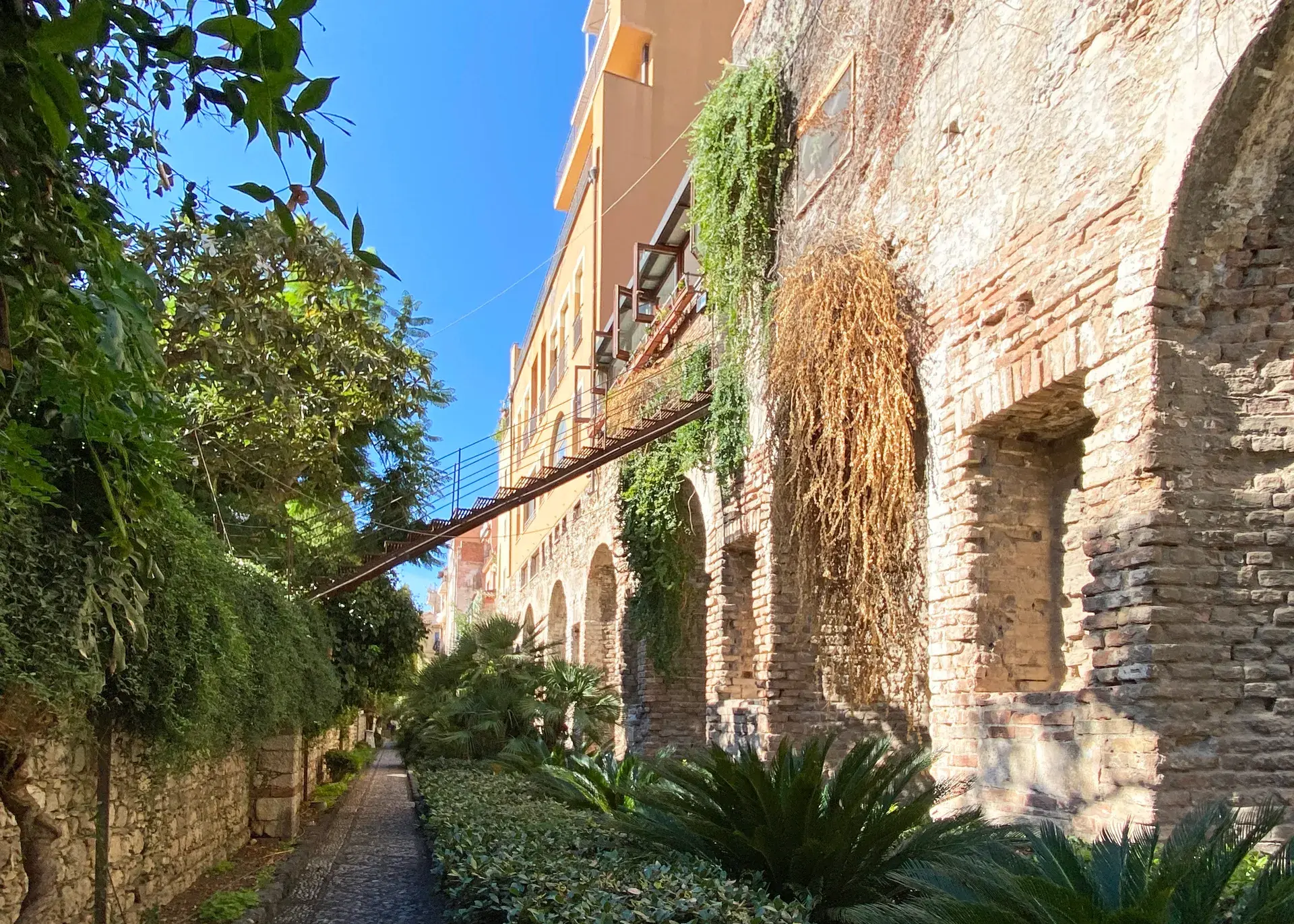
The Naumachia di Taormina is a monumental Roman Imperial retaining wall and reservoir facade located in Taormina's historic center. Measuring roughly 122 meters in length and 5 meters in height, it stands as the town's largest preserved Roman architectural work after the Ancient Theatre. Constructed primarily of red brick during the 2nd century AD—with foundation elements possibly dating to the late 1st century BC—the long facade features a rhythmic pattern of 18 large semicircular niches alternating with 18 smaller rectangular niches.
Rather than serving merely as a decorative divider, the structure functioned as an essential component of the city's ancient water infrastructure. Excavations conducted in 1943 cleared and exposed significant sections of this massive brickwork, allowing its grand architectural scale to be viewed from the street level.
Origins of the "Naumachia" Misnomer
Despite its long-standing name, the site was never used for naval spectacles. The word naumachia refers to ancient Roman mock sea battles typically held in flooded amphitheaters or specially dug lakes. The association with Taormina originated with Dutch antiquarian Jacques-Philippe D’Orville, who published the misidentification posthumously in his 1764 work Sicula after mistaking the immense water basin for an aquatic arena.
Geographic reality makes naval combat on the site impossible, as the structure is built into a steep, narrow mountain shelf. Modern archaeologists confirm that the basin was strictly functional, though D'Orville's misnomer endured in local topography and guidebooks.
Hydraulic Engineering and Layered History
The Roman brick facade was built directly against an earlier Hellenistic retaining wall composed of squared stone ashlars, which originally belonged to a Greek portico or stoa. The hollow space engineered between the older Greek stonework and the Roman brick wall served as a vast municipal cistern. This reservoir collected water channeled from nearby mountain springs to feed civic water systems and supply fountains integrated directly into the wall's large semicircular niches.
Archaeological findings indicate that the reservoir complex was linked to an adjacent public center, commonly interpreted as either a gymnasium or a monumental fountain pavilion known as a nymphaeum. The smaller rectangular niches along the facade originally displayed sculptures of civic heroes and gods. Excavations within the vicinity have unearthed several classical marble pieces, including a preserved torso of Apollo.
A Living Foundation in Modern Taormina
Located along Via Naumachie, parallel to and just below the main thoroughfare of Corso Umberto, the ancient structure physically bridges several millennia of urban occupation. It stands between Piazza IX Aprile and Piazza Vittorio Emanuele, displaying the literal stacking of Greek, Roman, and medieval construction phases.
Today, the ancient cistern wall is not an isolated archaeological ruin; it continues to serve as an active retaining wall and the structural foundation for occupied medieval and modern multi-story townhouses and businesses built directly on top of the ancient masonry. At street level, the stone-paved lane forms a cooler, shaded corridor buffered from the noise of the main commercial promenade, lined with hanging ferns, climbing plants, and residential potted greenery along the weathered Roman brickwork.
FAQ
Why is the monument named Naumachia if no naval battles occurred there?
The name stems from an 18th-century error by Dutch antiquarian Jacques-Philippe D’Orville in 1764, who misidentified the vast water reservoir as an arena for mock naval battles, despite the steep mountain topography making such events impossible.
What was the original purpose of the wall and its niches?
The wall acted as the outer facade of an enormous Roman cistern fed by mountain springs. Its 18 large semicircular niches housed public water fountains, while the 18 alternating rectangular niches displayed marble statues of deities and heroes.
How is the Naumachia used in modern times?
The site is an open-air pedestrian lane, accessible at all times without admission fees. The ancient Roman masonry continues to serve as an active retaining wall and foundation for private medieval and modern townhouses built directly on top of it.