Templo Mayor: Aztec History in Mexico City
Once the spiritual and political heart of the Aztec Empire, the Templo Mayor lay buried and forgotten for centuries beneath modern Mexico City. Its accidental rediscovery in 1978 brought the sacred center of Tenochtitlan back to light, revealing the foundations of a powerful civilization.
The Spiritual Heart of the Aztec Empire
The Templo Mayor, or Huēyi Teōcalli in the Nahuatl language, was the principal sacred structure for the Mexica people. It was considered the axis mundi—the center of the universe connecting the heavens, the earth, and the underworld. The temple was founded on the spot where the Mexica saw their prophesied sign: an eagle on a cactus with a snake in its mouth.
Symbolically, the temple represented two sacred mountains. One side was Coatepec, the mythical birthplace of the god of war and sun, Huitzilopochtli. The other was Tonacatepetl, the “Mountain of Sustenance,” associated with Tlaloc, the god of rain and agriculture. The temple was the stage for state ceremonies, coronations, and ritual human sacrifices, which were believed to maintain cosmic balance and sustain the gods.
Architecture and Expansion
Construction on the Templo Mayor began sometime after 1325 and went through at least seven major expansions, typically initiated by a new ruler. The structure was a large pyramid with a base measuring approximately 100 by 80 meters and reaching a height of up to 60 meters. Its defining feature was a double-temple design, with two separate staircases leading to two shrines at its summit.
The shrine dedicated to Huitzilopochtli was decorated in red and white, while Tlaloc's shrine was adorned in blue and white stucco and polychrome paint. Rulers such as Motecuhzoma I and Ahuitzotl oversaw significant expansions, with each new layer of construction enveloping the previous one.
Destruction and Rediscovery
In 1521, during the Spanish conquest, forces led by Hernán Cortés systematically dismantled the Templo Mayor. The temple's stones were then used as building materials for the new colonial capital, Mexico City, including its Metropolitan Cathedral. As a result, the exact location of the great temple was lost for centuries.
Its location remained a mystery until February 1978. Electrical workers digging near the city's main plaza accidentally struck a massive, carved stone monolith. The artifact depicted the dismembered body of the moon goddess Coyolxauhqui. This serendipitous discovery was the catalyst for the Templo Mayor Project, a major archaeological excavation that would unearth the temple's foundations.
Archaeological Insights
Led by archaeologist Eduardo Matos Moctezuma, the Templo Mayor Project (1978-1982) uncovered over 200 ritual deposits containing thousands of artifacts. These findings provided unprecedented insight into Mexica religion, trade, and daily life.
One of the most significant discoveries was the Hueyi Tzompantli, a massive skull rack located next to the temple complex. The discovery of this structure, which once held thousands of human skulls, confirmed historical accounts from the Spanish conquistadors that had long been doubted. As of 2020, archaeologists had identified 603 skulls from the site.
The Site Today
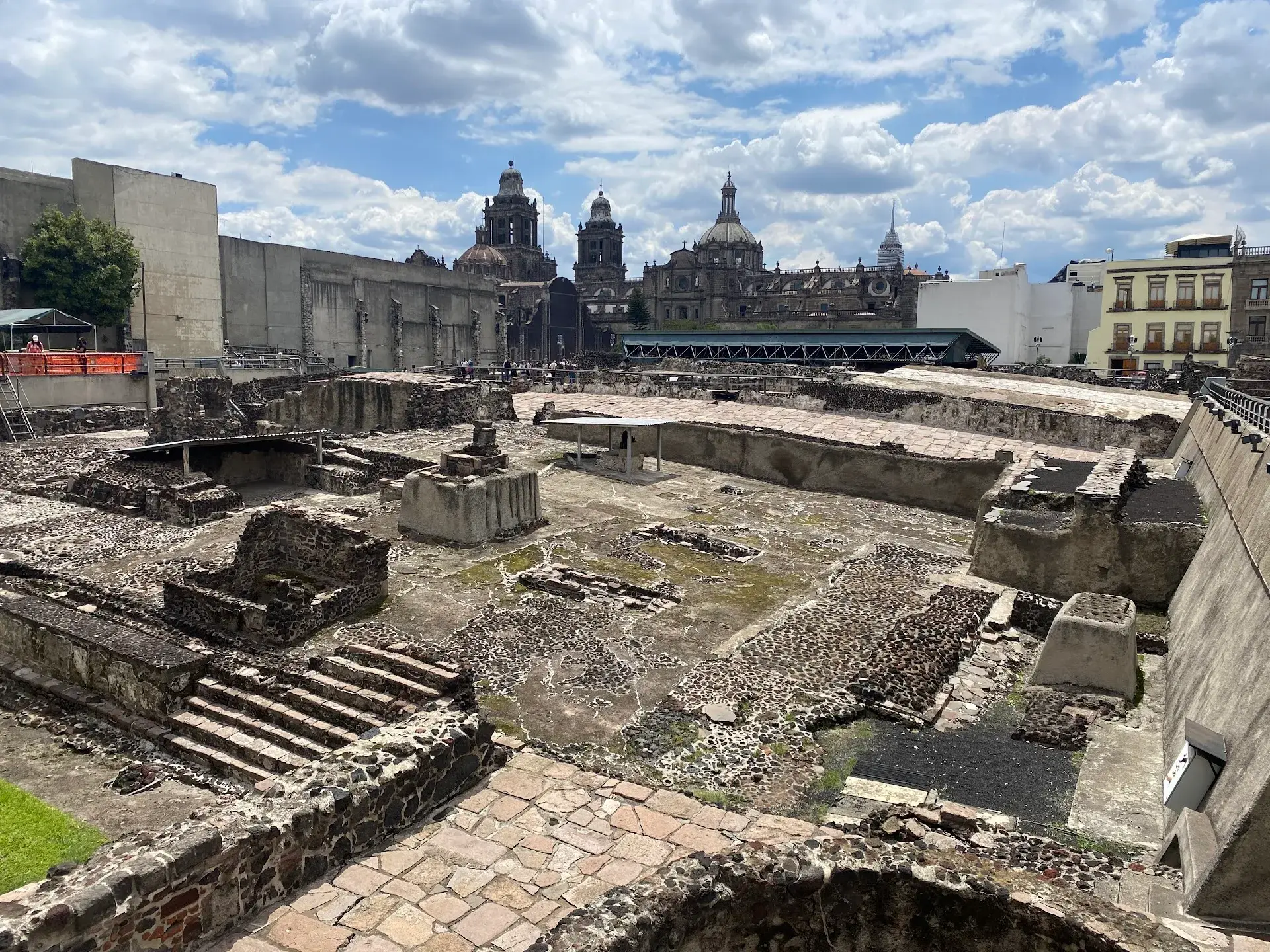
Today, the Templo Mayor is a major archaeological site and museum in the heart of Mexico City's Historic Center, which was designated a UNESCO World Heritage Site in 1987. Visitors can explore the outdoor ruins, which reveal the nested layers of the temple's successive construction phases.
The adjacent Museo del Templo Mayor houses an extensive collection of over 7,000 objects recovered during the excavations. These artifacts, from the monumental Coyolxauhqui stone to small sacrificial offerings, provide a tangible link to the pre-Hispanic empire that lies beneath the modern metropolis. Archaeological work continues at the site, with new discoveries still being made.
FAQ
What was the Templo Mayor?
The Templo Mayor was the main temple of the Mexica (Aztec) people in their capital, Tenochtitlan. It was a dual pyramid dedicated to Huitzilopochtli, the god of war and sun, and Tlaloc, the god of rain and agriculture.
Why was the Templo Mayor destroyed?
Spanish conquistadors led by Hernán Cortés destroyed the Templo Mayor in 1521 during the conquest of the Aztec Empire. Its stones were then repurposed to build the new colonial capital, which became Mexico City.
How was the Templo Mayor rediscovered?
After being buried for centuries, the Templo Mayor was accidentally rediscovered in 1978. Electrical workers digging near Mexico City's main plaza unearthed a large, carved stone monolith depicting the Aztec goddess Coyolxauhqui, which triggered a major archaeological excavation.
What can be seen at the Templo Mayor site today?
The site consists of the excavated ruins, showing the temple's multiple construction layers, and the Museo del Templo Mayor. The museum displays over 7,000 artifacts recovered from the site, including the famous Coyolxauhqui stone disk.
Discover Mexico-city like never before
Dive into Mexico-city hidden stories and secret spots with Ciceru interactive tours.
Explore tour
Audioguide
Quizzes
Maps
Solo
Couples
Groups & families

© Photo by Bjorn Stiphout via Google Maps · Google Places