Escher in the Palace: Royal Illusions in The Hague
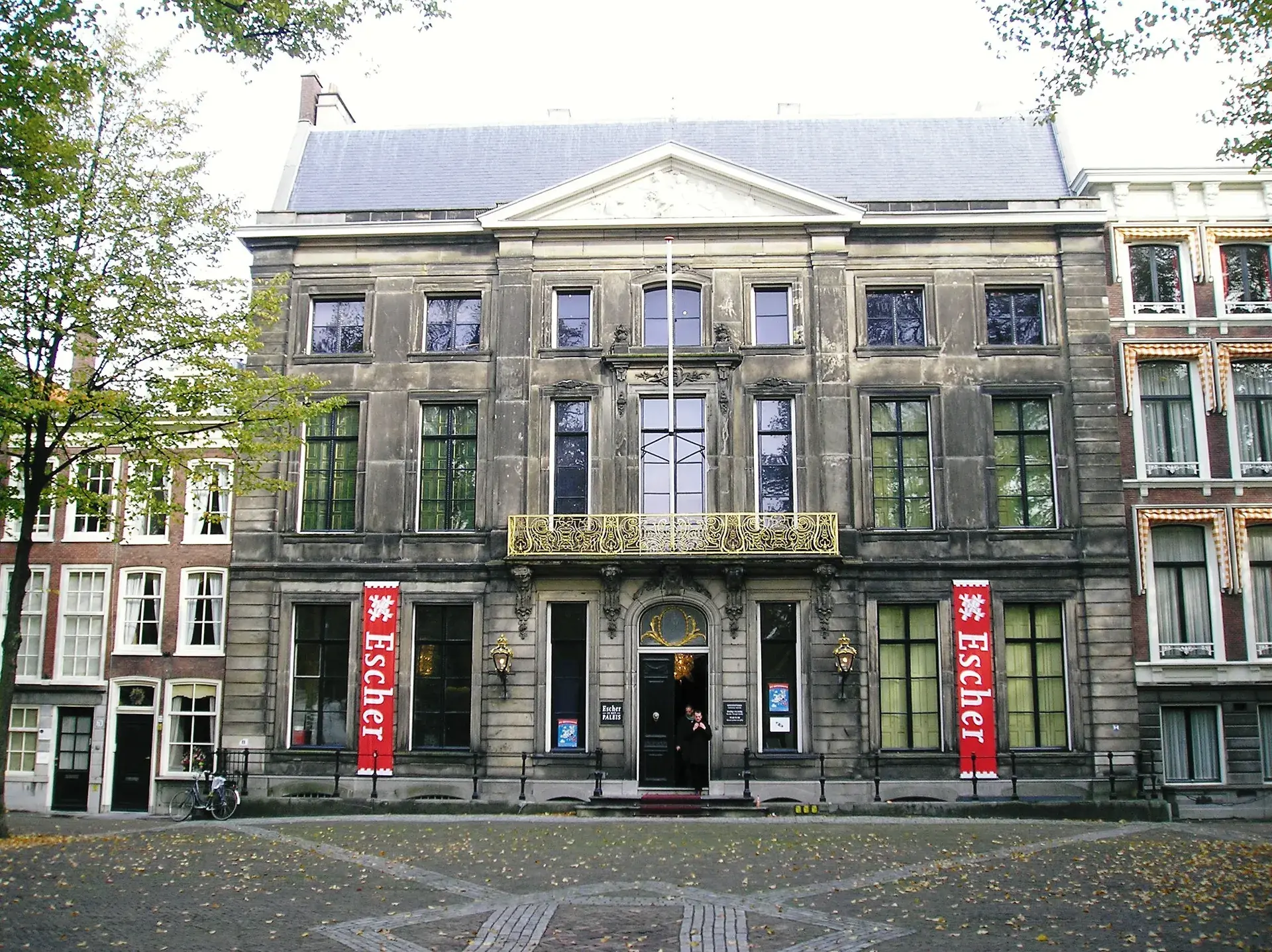
On the historic Lange Voorhout avenue in The Hague stands Escher in Het Paleis (Escher in the Palace), a former royal residence that now houses the world-renowned works of Dutch graphic artist M.C. Escher. The building itself, a blend of Dutch Neoclassicism and Rococo styles, offers a unique backdrop where royal history and artistic illusion converge.
A Palace with Royal Roots
Constructed between 1760 and 1764, the Lange Voorhout Palace was designed by architect Pieter de Swart for its first owner, Anthony Patras. Over the centuries, the palace changed hands, notably being acquired by the Hope banking family in 1796 and hosting Napoleon Bonaparte for a 14-hour stay in 1811.
A significant chapter in its history began in 1896 when Queen Emma purchased the building. She commissioned an extensive renovation, and from 1901 until her death in 1934, it served as her winter palace. Following Queen Emma, the palace was used as a working office by Dutch Queens Wilhelmina, Juliana, and Beatrix. From 1952 to 1984, its balcony was the official royal waving point during the annual Prinsjesdag (Prince's Day) procession. In 1991, Princess Juliana sold the palace to the municipality of The Hague with the stipulation that it be used for cultural activities.
The World of M.C. Escher
Since November 2002, the palace has been exclusively dedicated to the art of M.C. Escher (1898-1972), an artist celebrated for his 448 lithographs, woodcuts, and wood engravings, alongside over 2,000 drawings. The museum’s permanent exhibition features around 130 of his prints, allowing visitors to explore his fascinating transformations and impossible realities. A highlight of the collection is the seven-meter-long woodcut, 'Metamorphosis III'.
Where Art and Architecture Collide
Escher in the Palace creates a remarkable synergy between the art it displays and the building's own history. During her 1901 renovation, Queen Emma installed a grand staircase of Italian marble and copper that appears to ascend to the second floor but, in an architectural sleight of hand, only leads to the first. This built-in optical illusion provides a fitting introduction to Escher's work.
The experience continues on the second floor with interactive exhibits, including the 'Escher Room,' where distorted proportions allow visitors to become part of an illusion. Adding a modern touch to the royal ambiance are fifteen custom chandeliers by Rotterdam artist Hans van Bentem, featuring whimsical designs like a shark and a globe.
Today, Escher in the Palace is one of the few public buildings in The Hague where visitors can experience an original royal atmosphere while engaging with a world-class art collection.
FAQ
What was Escher in the Palace before it became a museum?
Before becoming a museum in 2002, it was the Lange Voorhout Palace. It served as the winter residence for Queen Emma and later as a working office for Queens Wilhelmina, Juliana, and Beatrix of the Netherlands.
Is there an optical illusion in the palace building itself?
Yes, the grand staircase installed by Queen Emma is an optical illusion. Adorned with Italian marble and copper railings, it appears to lead to the second floor but only reaches the first.
What is a major highlight of the Escher collection?
A significant piece in the collection is 'Metamorphosis III', a seven-meter-long woodcut that showcases M.C. Escher's mastery of transformation and interconnected patterns.
Who designed the modern chandeliers in the museum?
The fifteen unique chandeliers throughout the palace were designed by Rotterdam artist Hans van Bentem. They add a contemporary and playful element to the historic rooms, with designs including a shark and a globe with compasses.