Prison Gate Museum: Crime & Punishment in The Hague
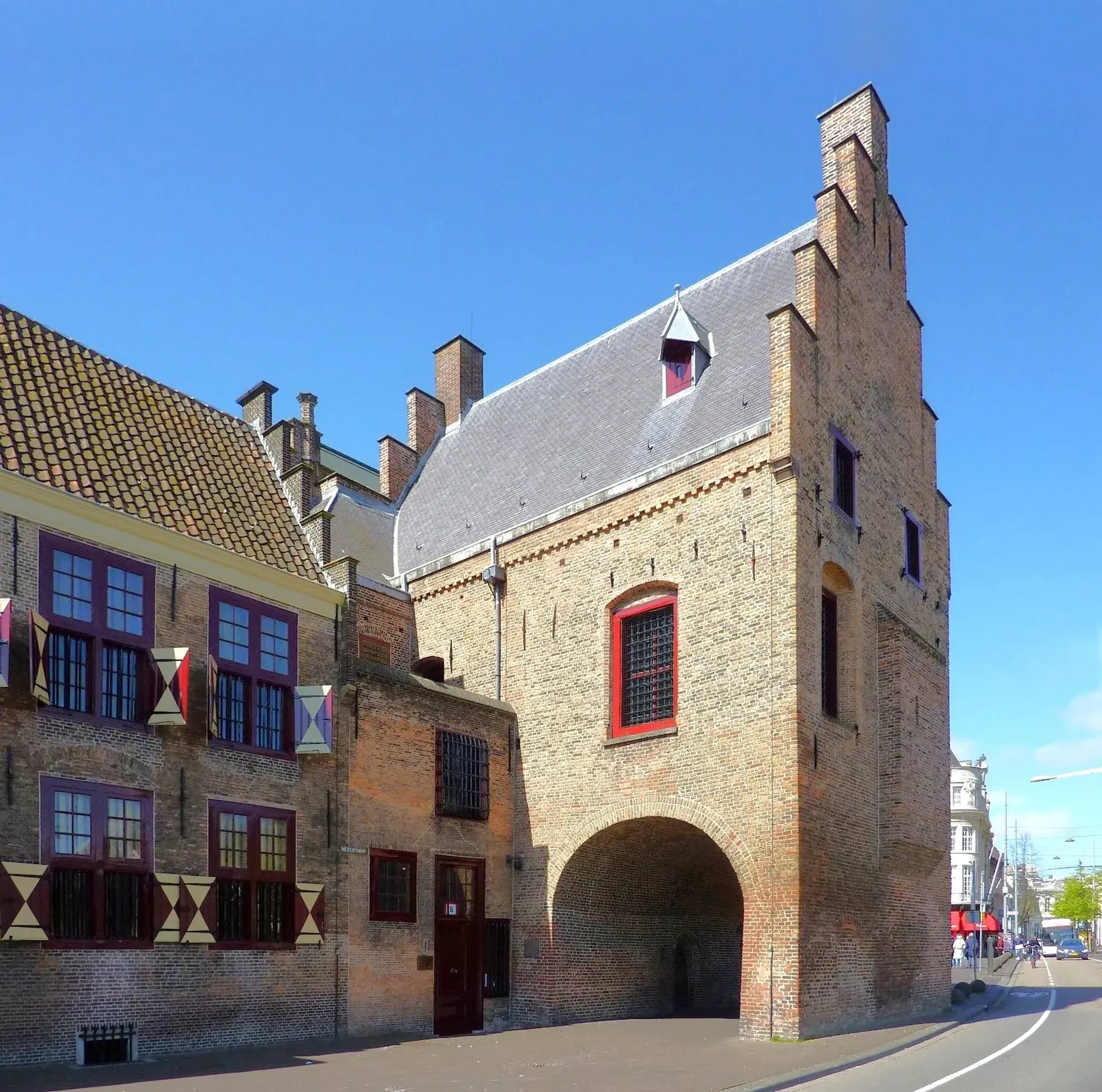
The Prison Gate Museum, or Gevangenpoort, stands as an imposing medieval gatehouse adjacent to the Binnenhof in The Hague. Originally built as a defensive entrance, its history evolved to tell a dark story of justice, incarceration, and political turmoil in the Netherlands.
From Castle Gate to Prison
Constructed around 1280, the Gevangenpoort initially served as one of the main entrance gates to the castle of the Counts of Holland. Its function dramatically shifted in 1420 when it was converted into the primary prison and courthouse for the powerful Court of Holland. For the next four centuries, it was a place where suspects awaited trial and punishment.
The building served as a prison until its closure in 1828. It was later repurposed and opened as a state museum in 1882, preserving its grim history for future generations. The structure's original function as a gate was lost in 1923 when surrounding houses were demolished for a new road.
The De Witt Lynching of 1672
A pivotal and brutal event in Dutch history occurred at the Gevangenpoort on August 20, 1672, during a period known as the 'Rampjaar' or Disaster Year. Statesman Cornelis de Witt was imprisoned and tortured on accusations of plotting against Stadtholder William III, though he never confessed.
When his brother, Grand Pensionary Johan de Witt, came to visit him, a politically-fueled mob stormed the prison. The brothers were dragged out onto the square and brutally lynched. In the aftermath, their bodies were mutilated, hung upside down, and their body parts were sold to bystanders as gruesome souvenirs.
Notable Prisoners and Grim Realities
Besides the De Witt brothers, the Gevangenpoort held other prominent figures. Statesman Johan van Oldenbarnevelt was detained here before his 1619 execution for treason. In 1567, humanist writer Dirk Volckertszoon Coornhert was confined for criticizing religious persecution, an experience that inspired his writings advocating for rehabilitation over punishment.
Contrary to the belief that it only held the elite, the prison also incarcerated a significant number of common and poor individuals. At times in the 17th century, women were prosecuted more frequently than men for crimes like begging, prostitution, and theft. Conditions were squalid; prisoners' waste from 'poop boxes' was discarded into the Hofvijver (Court Pond), the same pond from which they drew their drinking water. The execution site in front of the gate, known as 'Het Groene Zoodje' (The Green Turf), was said to be exceptionally fertile due to the blood spilled during public executions.
The Museum Today
Today, the building operates as the Rijksmuseum de Gevangenpoort, a national museum dedicated to the history of crime and punishment in the Netherlands. It houses the country's most extensive collection of historical instruments of torture and punishment. Visitors can explore former cells and a torture chamber to learn about the historical justice system.
Among the most visceral exhibits are the preserved tongue of Johan de Witt and a finger of his brother Cornelis, tangible relics of the infamous lynching. The museum is also connected via a special staircase to the Prince William V Gallery, an 18th-century art gallery.
FAQ
What is the Prison Gate Museum?
The Prison Gate Museum (Gevangenpoort) is a former medieval gatehouse and prison in The Hague, now a national museum showcasing the history of crime and punishment in the Netherlands from the 15th to the 19th century.
What is the most famous event that happened at the Gevangenpoort?
The most infamous event was the brutal lynching of statesmen Johan and Cornelis de Witt on August 20, 1672. An angry mob stormed the prison, dragged the brothers outside, and killed them on the adjacent square.
Who was imprisoned at the Gevangenpoort?
Famous prisoners included statesmen Johan van Oldenbarnevelt and the De Witt brothers. However, the prison also held many common people, including women prosecuted for offenses such as begging, prostitution, and theft.
What can be seen at the museum today?
The museum displays the Netherlands' largest collection of historical torture and punishment instruments. Visitors can explore former cells, a torture chamber, and see shocking historical relics like the preserved tongue and finger of the De Witt brothers.