Noordeinde Palace: The Dutch King's Working Palace
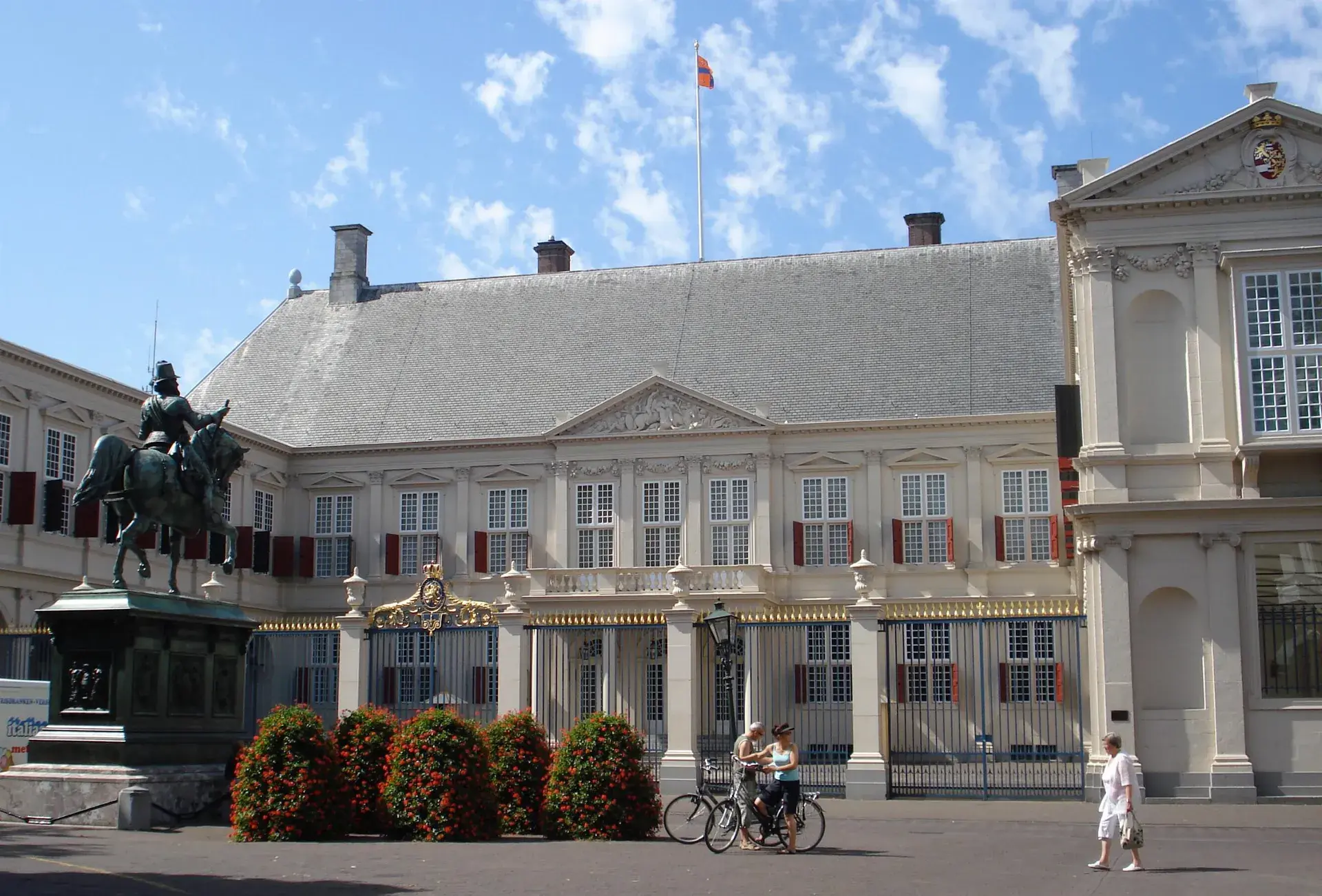
In the heart of The Hague stands Noordeinde Palace, a stately residence with a rich history that serves as the official working palace of the Dutch monarch. While its elegant Dutch Classicist facade exudes royalty, the building's origins are surprisingly humble, beginning as a simple medieval farmhouse in the 16th century.
From Farmhouse to Royal Residence
The palace's story begins in 1533 as a medieval farmhouse. Willem van de Goudt later converted it into a more spacious residence. Its connection to the Dutch royal family, the House of Orange, started in 1591 when the States of Holland acquired the property for Louise de Coligny, the widow of William the Silent, and their son, Frederick Henry.
In 1640, Prince Frederick Henry commissioned architects Pieter Post and Jacob van Campen for extensive alterations. These changes transformed the building, then known as the 'Oude Hof', into the characteristic H-shape seen today. The palace has hosted many notable figures, including the philosopher Voltaire, who stayed in an apartment there in 1740. It later became the winter home for King William I and was the birthplace of both Queen Wilhelmina in 1880 and Queen Juliana in 1909. A fire in 1948 destroyed the central part of the palace, leading to a thorough restoration that concluded with its reopening in 1984.
A Modern Working Palace
Since 1984, Noordeinde Palace has functioned as the monarch's official workplace. Today, it is the primary office for King Willem-Alexander and Queen Máxima, along with the majority of the Royal Household staff. The palace is the setting for numerous state affairs, including official receptions and audiences. It is here that foreign ambassadors present their credentials to the King.
Each year on Prinsjesdag (the State Opening of Parliament), the royal procession begins at the palace. Following the Speech from the Throne, the royal family appears on the palace balcony to greet the public. While the palace interior is generally not open to the public, the Palace Garden (Paleistuin) located behind the building is accessible to visitors daily from sunrise to sunset.
Architecture and Location
Located on the lively Noordeinde street in The Hague's city center, the palace is surrounded by art galleries, antique shops, and cafes. This integration into the urban landscape reflects the modern Dutch monarchy's active role in state affairs. The palace complex also includes the Royal Stables and the Royal Archives.
A fascinating detail of its long history is that the original cellars from its time as a 16th-century farmhouse are still visible in the palace basement. Another point of interest is the extreme precision used within its walls; for formal dinners, laser alignment tools are employed to ensure every plate and glass is perfectly positioned.
FAQ
Is Noordeinde Palace open to the public?
The interior of Noordeinde Palace is generally closed to the public, with the exception of limited periods during the summer. However, the Palace Garden (Paleistuin) behind the palace is open to the public daily from sunrise to sunset.
What is Noordeinde Palace used for today?
Noordeinde Palace is the official working palace of King Willem-Alexander. It houses his offices and those of the Royal Household staff, and is used for official receptions, audiences, and other state functions.
What is the history of Noordeinde Palace?
The palace originated as a medieval farmhouse in 1533. It became associated with the royal family in the late 16th century, was significantly enlarged in 1640, and became the monarch's official workplace in 1984 following a major restoration after a fire in 1948.
Who lives at Noordeinde Palace?
No one lives at Noordeinde Palace. It is one of the three official palaces of the Dutch Royal House but functions strictly as the monarch's workplace, not a residence.