Sandomierz Royal Castle: History, Siege, and Museum
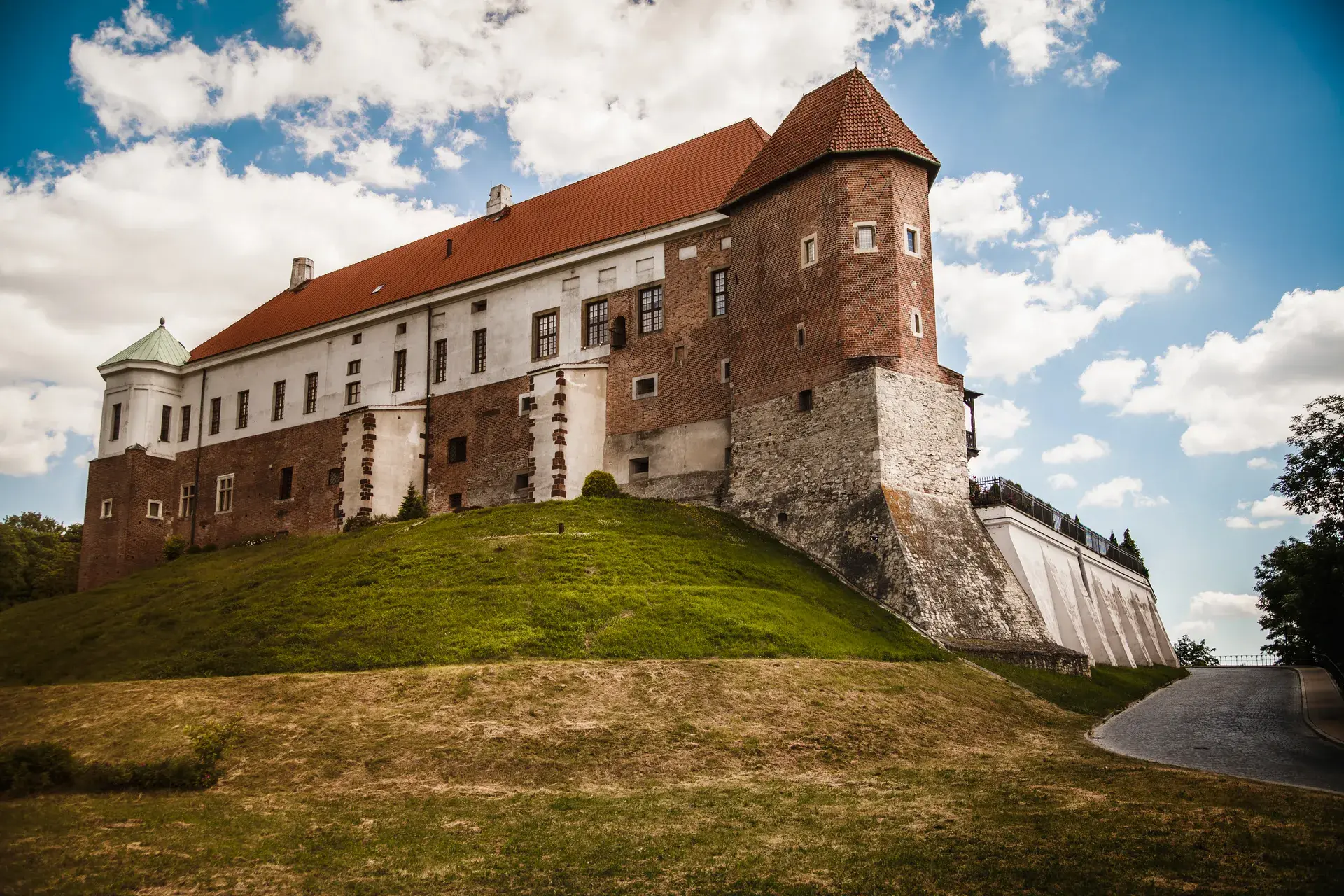
Perched on Castle Hill (Wzgórze Zamkowe) overlooking the Vistula River, the Royal Castle at ul. Zamkowa 12 stands as an enduring symbol of Sandomierz. Serving as the southern anchor of the town's historic defensive ridge opposite the Opatowska Gate, the site has occupied a strategic vantage point for over a millennium.
From Ducal Stronghold to Royal Palace
The hill was first fortified with a wooden-and-earth stronghold dating back to at least the 10th century. Following the fragmentation of Poland in 1138, Sandomierz emerged as the capital of an independent duchy and a principal seat for rulers such as Prince Henry of Sandomierz. In the 14th century, King Casimir III the Great commissioned the first masonry Gothic fortress on the promontory. Deep beneath the castle's inner courtyard, an ancient stone-lined well still preserves the stone foundations of this early medieval stronghold.
Throughout the late medieval period, the fortress hosted prominent Polish monarchs, including Queen Jadwiga, Władysław II Jagiełło, and Casimir IV Jagiellon. During the 1520s, King Sigismund I the Old commissioned royal architect Benedykt (Benedykt Sandomierzanin) and later Santi Gucci to transform the Gothic castle into a grand, four-winged Renaissance palace wrapped around an arcaded courtyard.
The Swedish Deluge and Architectural Survival
The grand Renaissance complex met catastrophe in 1656 during the Swedish Deluge. As Polish troops advanced, retreating Swedish forces under General Sincler laid powder charges and detonated the stronghold. The explosion leveled three of the four wings and destroyed the arcaded cloisters, killing entering Polish soldiers and local citizens.
Between 1680 and 1688, King John III Sobieski initiated an extensive reconstruction project to salvage what remained. Sobieski adapted the single surviving western wing into a self-contained residential building. This preserved structure is anchored on its southern corner by the 15th-century Kurza Noga ("Hen's Foot") tower, dating from around 1480.
Centuries as a State Penitentiary
Following the Third Partition of Poland in 1795, Austrian authorities repurposed the former royal residence into a criminal court and prison. For approximately 164 years, the building ceased to function as a seat of power and operated strictly as a penal facility under five successive regimes.
Its use as a prison continued through the period of Tsarist Russian control, the Second Polish Republic, the Nazi German occupation during World War II, and post-war Stalinist secret police (UB) administration. The penal facility finally ceased operations in 1959, paving the way for extensive archaeological excavations and architectural conservation.
The Castle Museum in Sandomierz
After thorough restoration, the building opened to the public in 1986 and today houses the Castle Museum in Sandomierz (Muzeum Zamkowe w Sandomierzu). Operating year-round from Tuesday to Sunday, the institution displays archaeological finds, sacred art, and Renaissance stone carvings attributed to Benedykt Sandomierzanin.
Among the museum's permanent highlights is the Sandomierz Chess set, a rare 12th- to 13th-century collection carved from red deer antler. Visitors can also view ornamental jewelry made from striped flint (krzemień pasiasty), a stone unique to the Sandomierz region, as well as a 17th-century Swedish cannon (oktawa kartauny) that was excavated from the slopes of Castle Hill during stabilization works in 1996.
FAQ
Why is only one wing of the Royal Castle standing today?
In 1656, retreating Swedish forces detonated gunpowder charges beneath the castle during the Swedish Deluge. The explosion leveled three wings, leaving only the western wing, which King John III Sobieski later rebuilt as an independent residence.
How long was the castle used as a prison?
The castle operated as a high-security prison for roughly 164 years, from 1795 under Austrian rule until its closure under post-war Polish authorities in 1959.
What unique artifacts can be seen at the Castle Museum in Sandomierz?
Notable displays include the 12th- to 13th-century Sandomierz Chess pieces carved from antler, local striped flint jewelry, Renaissance lapidarium fragments, and a 17th-century Swedish cannon recovered from the hillside in 1996.