Church of the Holy Cross: Chopin's Heart in Warsaw
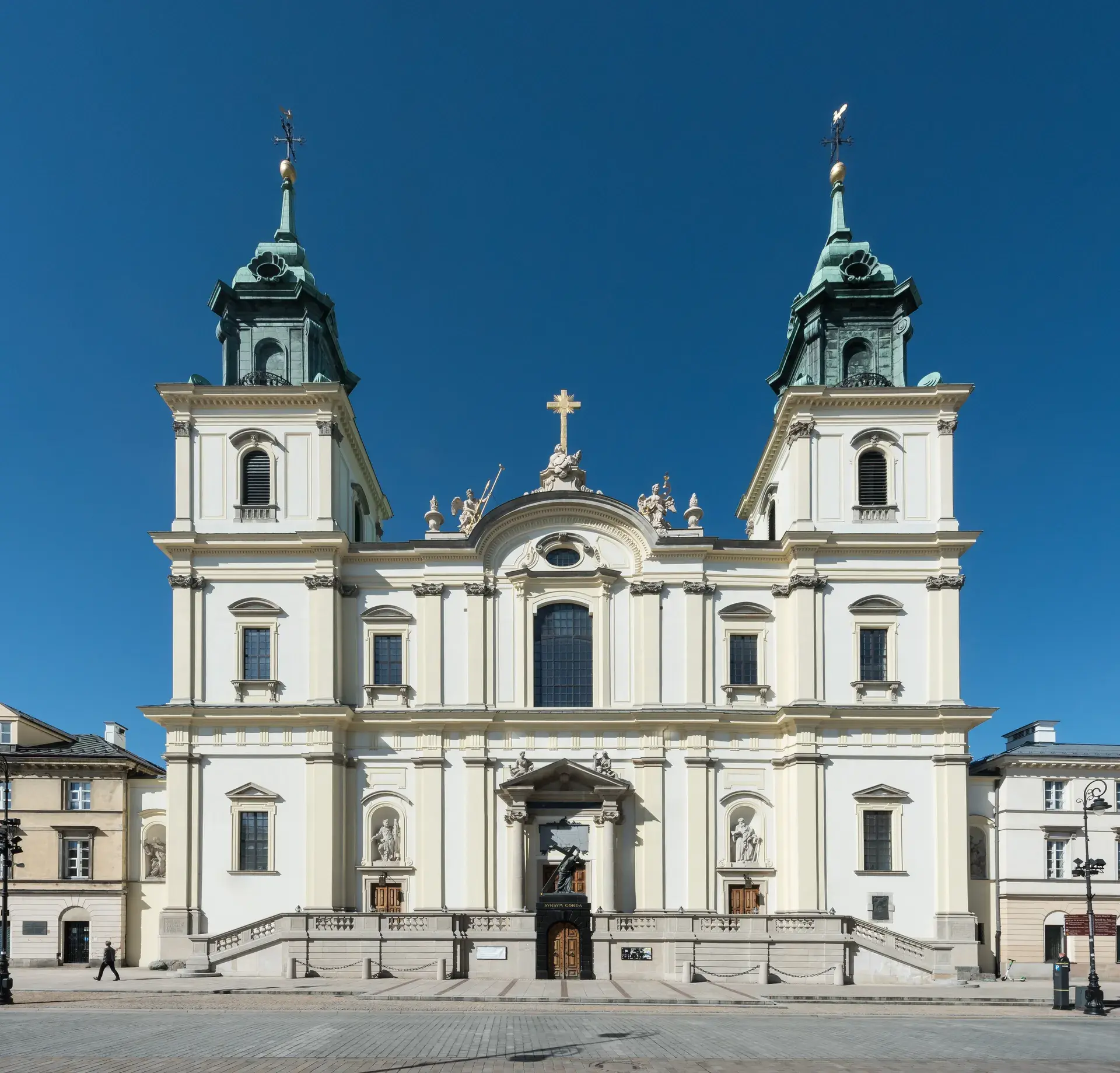
Located on Warsaw's historic Royal Route, the Church of the Holy Cross stands as a prominent Roman Catholic basilica, renowned for its magnificent Baroque facade and twin towers. More than just a place of worship, it is a profound symbol of Polish history and cultural identity, famously housing the heart of the nation's beloved composer, Frédéric Chopin.
History and Architecture
The church's origins date back to a 15th-century wooden chapel. A more substantial church was built in 1526, and in 1653, it was entrusted to the French order of Missionary Friars of Vincent de Paul. The main Baroque structure seen today was constructed between 1679 and 1696, designed by Józef Szymon Bellotti. Subsequent enhancements included late Baroque tower headpieces by Józef Fontana (1725-1737) and a refurbished facade with sculptures by Jan Jerzy Plersch, designed by Jakub Fontana in 1756. The church was consecrated in 1757.
Throughout its history, the church has mirrored the tumultuous fate of Warsaw itself. It suffered severe damage during the Kościuszko Uprising in 1794 and faced near-total annihilation during World War II. In 1944, German forces detonated mines inside, and later blew up the building in January 1945. It was rebuilt between 1945 and 1953 in a simplified architectural form, with the main altar reconstructed from 1960 to 1972.
The Hearts of Polish Icons
The church is the final resting place for the hearts of two of Poland's most revered cultural figures. Fearing being buried alive, Frédéric Chopin requested that upon his death in Paris in 1849, his heart be removed and returned to his homeland. His sister, Ludwika Jędrzejewicz, secretly transported the heart, preserved in alcohol, to Warsaw. After being kept in the family home and later the church catacombs for decades, the heart was finally immured in a pillar of the main nave in 1882.
Following this tradition, the heart of Władysław Reymont, the Nobel Prize-winning author of 'The Peasants', was also interred within the church in 1929. These acts transformed the basilica into a national sanctuary.
A Symbol of Resilience
The Church of the Holy Cross has long been a center of Polish national life. King Stanisław II Augustus established the Order of St. Stanisław here in 1765, and the Polish Diet gathered within its walls to commemorate the 3 May Constitution in 1792. A prominent sculpture of Christ Bearing His Cross by Pius Weloński stands on the external staircase, bearing the inscription 'Sursum Corda' ('Lift Up Your Hearts'). This statue became a powerful symbol of Polish endurance, especially after it was toppled by Nazi soldiers during the 1944 Warsaw Uprising.
The Church Today
Today, the Church of the Holy Cross is an active parish administered by the friars of the Congregation of the Mission of Vincent de Paul. In 2002, Pope John Paul II elevated it to the status of a Minor Basilica. It serves as both a place of worship and a site of national memory, housing numerous commemorative plaques. The church is open to visitors daily with no admission fee. Since 1980, its weekly masses have been broadcast on Polish Radio. A special tradition occurs annually on October 17th, the anniversary of Chopin's death, when a solemn mass is held featuring a performance of Mozart's Requiem, honoring the composer's own wishes.
FAQ
Why is Frédéric Chopin's heart in the Church of the Holy Cross?
Frédéric Chopin feared being buried alive and requested his heart be returned to Poland after his death. His sister smuggled his heart from Paris to Warsaw, and it was eventually enshrined in a pillar of the church in 1882.
Was the Church of the Holy Cross destroyed during WWII?
Yes, the church was severely damaged during the 1944 Warsaw Uprising and almost completely destroyed by German forces in January 1945. It was rebuilt between 1945 and 1953.
Is there an entrance fee for the Church of the Holy Cross?
No, the church is open to visitors daily without an admission fee. Visitors are asked to be respectful, especially during mass times.
Are other famous people remembered in the church?
Yes, the heart of Nobel Prize-winning author Władysław Reymont is also interred in the church. The basilica also contains numerous commemorative plaques dedicated to important figures in Polish history.