St. Alexander's Church: Warsaw's Neoclassical Landmark
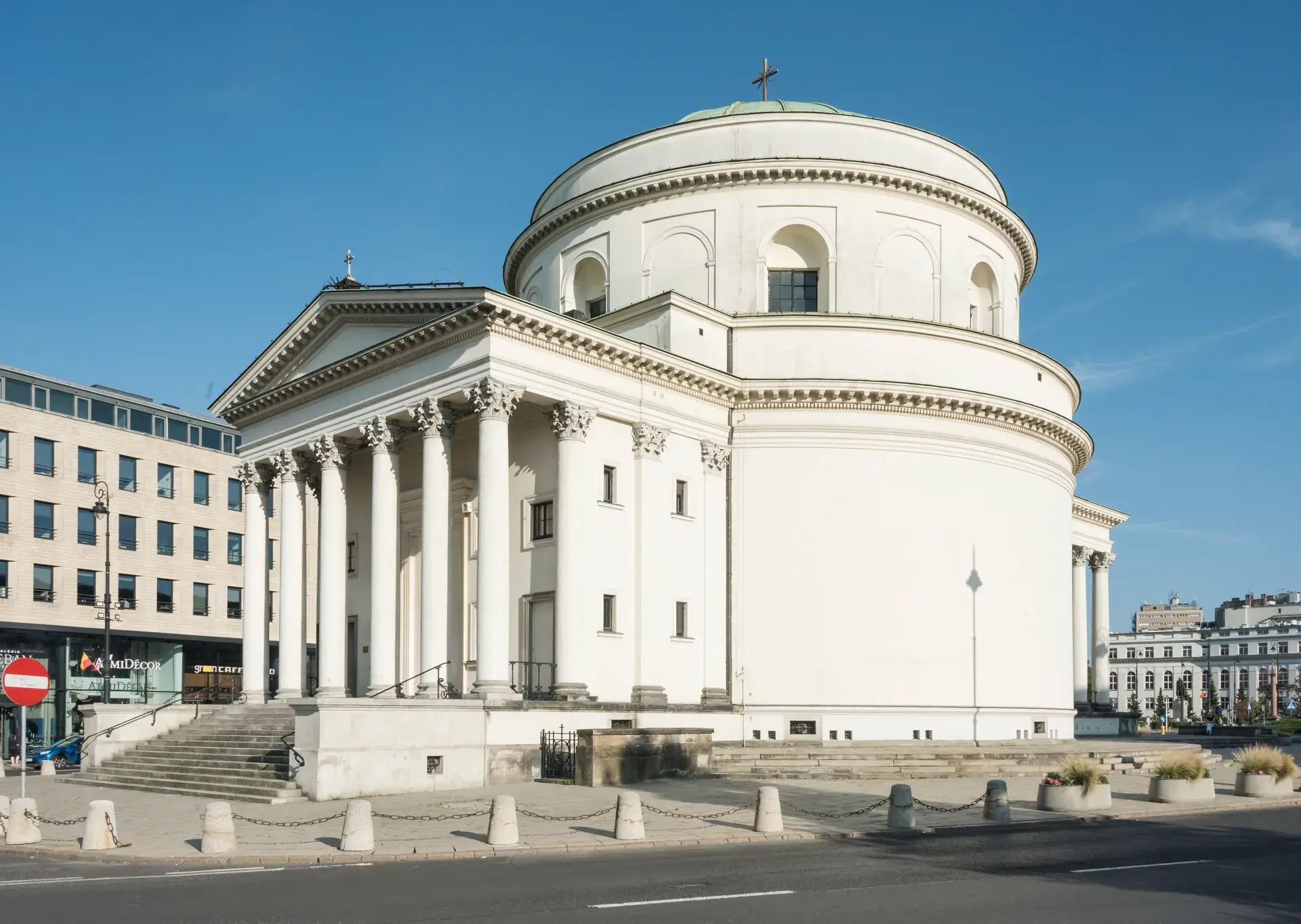
St. Alexander's Church stands as a neoclassical masterpiece on Three Crosses Square in central Warsaw. With its distinctive rounded shape and grand colonnaded portico reminiscent of the Roman Pantheon, the church is a significant landmark on the city's historic Royal Route. Its origins, however, are rooted not in a purely spiritual plan, but in a surprising political gesture.
A Surprising Imperial Origin
The creation of St. Alexander's Church stems from an unusual historical event. In 1815, the citizens of Warsaw planned to erect a triumphal arch to honor Tsar Alexander I of Russia, who had granted a constitution to the autonomous Congress Kingdom of Poland. The Tsar, however, suggested that the funds collected for the arch be redirected toward the construction of a Catholic church. Following his suggestion, the church was established in his commemoration.
A Cycle of Design, Destruction, and Rebirth
The architectural history of St. Alexander's Church mirrors the turbulent past of Warsaw itself. The original structure, built between 1818 and 1825, was a Neoclassical design by Chrystian Piotr Aigner. Aigner was well-prepared for the project, having previously created a similar Pantheon-inspired design for a church in Puławy. The foundation stone was laid on June 15, 1818, and the church was consecrated on June 18, 1826.
As the parish grew, the original building was deemed too small. Between 1886 and 1895, it underwent a significant transformation under architect Józef Pius Dziekoński. This redesign in the Neo-Renaissance style added two prominent side towers and a higher, more ornate dome inspired by St. Peter's Basilica, making it one of the largest churches in Warsaw.
The church's grand form was short-lived. During the Warsaw Uprising in September 1944, it was struck by nine bombs from the German Luftwaffe. The attack caused the collapse of its dome, main nave, and one of its towers. Following World War II, a debate arose over how to rebuild the landmark. The decision was made to restore it not to its grander, pre-war appearance, but to a form resembling its original, simpler Neoclassical design. This reconstruction, completed between 1949 and 1952, stands as a symbol of Warsaw's resilience and its commitment to restoring its historical identity.
The Church in Modern Warsaw
Today, St. Alexander's Church is an active Roman Catholic place of worship. It serves as the focal point of Three Crosses Square, a major transportation hub and a popular meeting place for locals and visitors. The church offers a peaceful ambiance amidst the bustling city, with regular masses and confession services. Inside, visitors can see a 17th-century white marble statue of the dead Christ, which was acquired for the church by Stanisław Herakliusz Lubomirski.
The Story of Three Crosses Square
The square where the church is located has its own unique history. Its name originates from two stone columns topped with crosses, erected in 1731 by architect Joachim Daniel von Jauch. A third cross, held by a stone statue of Saint John of Nepomuk placed in 1752 to commemorate the paving of Warsaw's streets, completes the trio that gives the square its name.
FAQ
Why was St. Alexander's Church built?
It was built to commemorate Tsar Alexander I of Russia. The original plan by the citizens of Warsaw was to build a triumphal arch in his honor, but the Tsar himself suggested using the funds for a Catholic church instead.
Why does St. Alexander's Church look like the Pantheon?
The original architect, Chrystian Piotr Aigner, designed the church in the Neoclassical style and drew direct inspiration from the Pantheon in Rome for its circular plan and portico.
Was St. Alexander's Church destroyed during WWII?
Yes, the church was severely damaged by German Luftwaffe bombs during the Warsaw Uprising in 1944, which caused its dome, main nave, and one of its towers to collapse. It was reconstructed between 1949 and 1952.
Why is the location called Three Crosses Square?
The square is named for three crosses: two on stone columns erected in 1731, and a third held by a statue of Saint John of Nepomuk that was added in 1752.