Staszic Palace: Warsaw's Scientific & Historical Landmark
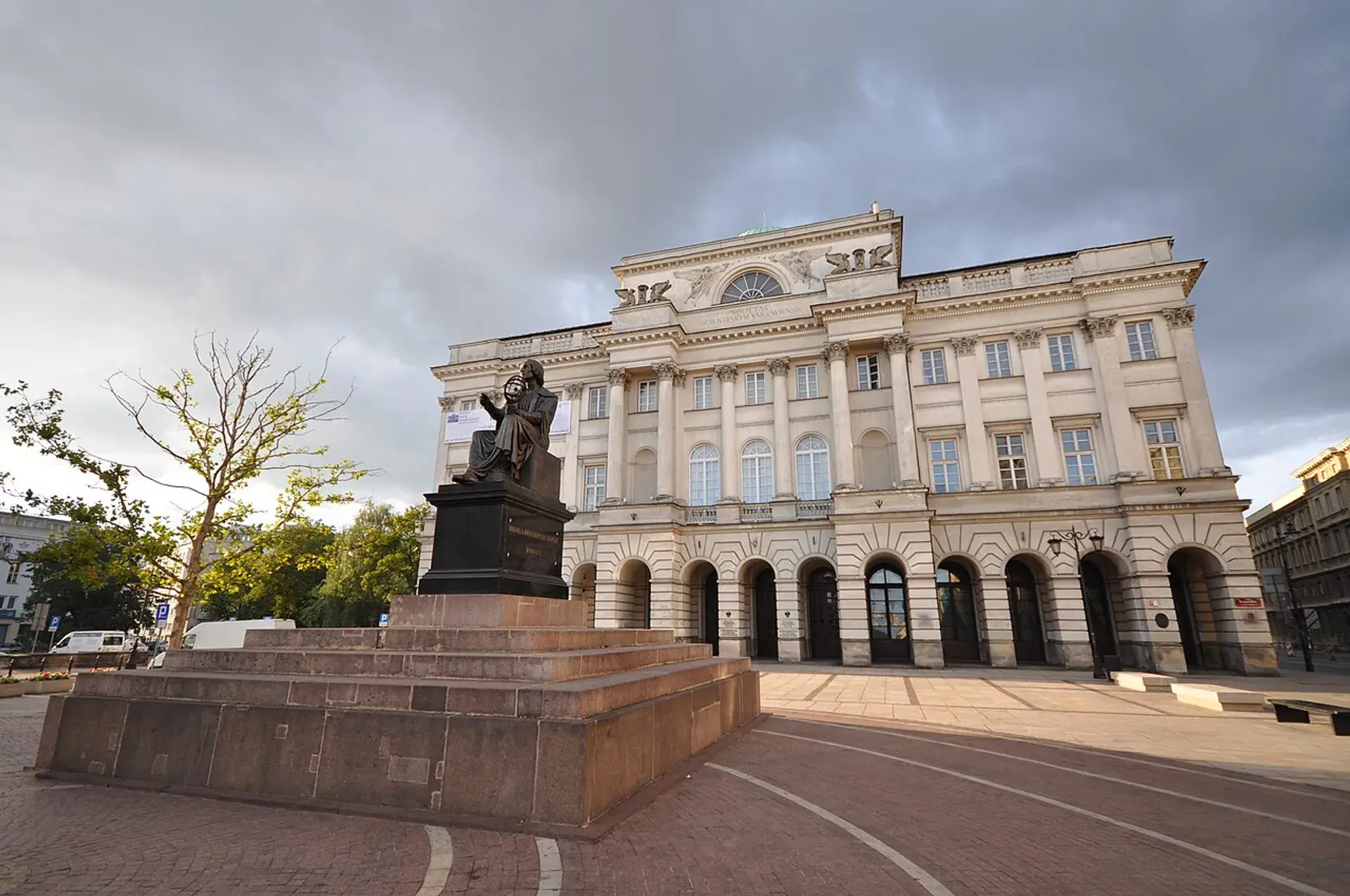
Staszic Palace is a distinguished historical landmark on Warsaw's Royal Route, a grand neoclassical building that currently houses the Polish Academy of Sciences. Its history is a powerful reflection of Warsaw's own narrative of resilience, cultural identity, and intellectual pursuit, marked by dramatic transformations, destruction, and meticulous restoration.
Architectural History and Transformations
Constructed between 1820 and 1823, the palace was originally designed by Italian architect Antonio Corazzi in the Neoclassical style. Its creation was funded by Stanisław Staszic, a leading figure of the Polish Enlightenment, to serve as the headquarters for the Warsaw Society of Friends of Science. This institution became a vital hub for the nation's intellectual and scientific activity.
In the late 19th century, the building underwent a radical change. Between 1890 and 1895, under the direction of Russian architect Wladimir Pokrowski, the palace was remodeled in a Russo-Byzantine style, complete with an onion dome, to house an Orthodox church. This transformation was a deliberate symbol of the Russification policies imposed on Poland during the period of foreign occupation.
Following Poland's regained independence, the palace was restored to its original neoclassical appearance between 1924 and 1926 by architect Marian Lalewicz. The Russian architectural additions were completely removed, re-establishing the building as a symbol of Polish national culture.
The Nicolaus Copernicus Monument
Standing prominently before the palace is the bronze Nicolaus Copernicus Monument. Designed by Danish sculptor Bertel Thorvaldsen in 1822 and unveiled in 1830, the statue depicts the astronomer holding a compass and an armillary sphere. The project was funded by Stanisław Staszic and public donations. Notably, Polish clergy refused to attend the unveiling ceremony due to the church's historical condemnation of Copernicus's heliocentric theories.
During World War II, German forces removed the monument with the intent of melting it down. The statue became a focus for the Polish underground, which engaged in acts of 'minor-sabotage,' famously removing a German plaque and leaving defiant messages. The monument was recovered after the war and restored to its rightful place.
Destruction and Post-War Rebirth
The palace suffered greatly during World War II. It was severely damaged during the 1939 siege of Warsaw and was nearly razed to the ground during the 1944 Warsaw Uprising. In the aftermath of the war, the building was meticulously rebuilt between 1946 and 1950 by architect Piotr Biegański, mirroring the city-wide effort to resurrect Warsaw from its ruins.
Staszic Palace Today
Today, Staszic Palace serves as the headquarters of the Polish Academy of Sciences, functioning as a prominent center for academic research and scholarly collaboration. While primarily used for academic purposes, the palace's interiors are often accessible to the public during cultural events like Science Picnics and Museum Nights. The building also features a café named 'Kopernik' on the ground floor and a collection of sculptures of prominent Polish scientists on the second floor.
FAQ
What is the Staszic Palace used for today?
It serves as the headquarters for the Polish Academy of Sciences, housing various scientific institutes. It also participates in Warsaw's cultural life by hosting public events like open lectures, Museum Nights, and Science Picnics.
Why was the Staszic Palace's architecture changed so drastically?
In the late 19th century, as a symbol of forced Russification, Russian authorities remodeled the neoclassical palace into a Russo-Byzantine style church with an onion dome. It was restored to its original design after Poland regained independence.
What is the statue in front of the Staszic Palace?
The statue is the Nicolaus Copernicus Monument, a bronze sculpture designed by Bertel Thorvaldsen and unveiled in 1830. It depicts the famous astronomer holding a compass and an armillary sphere.
Was the Staszic Palace destroyed during WWII?
Yes, the palace was severely damaged during the 1939 siege of Warsaw and almost completely destroyed during the 1944 Warsaw Uprising. It was meticulously rebuilt between 1946 and 1950.