Palácio Nacional de Sintra: The Twin Chimneys
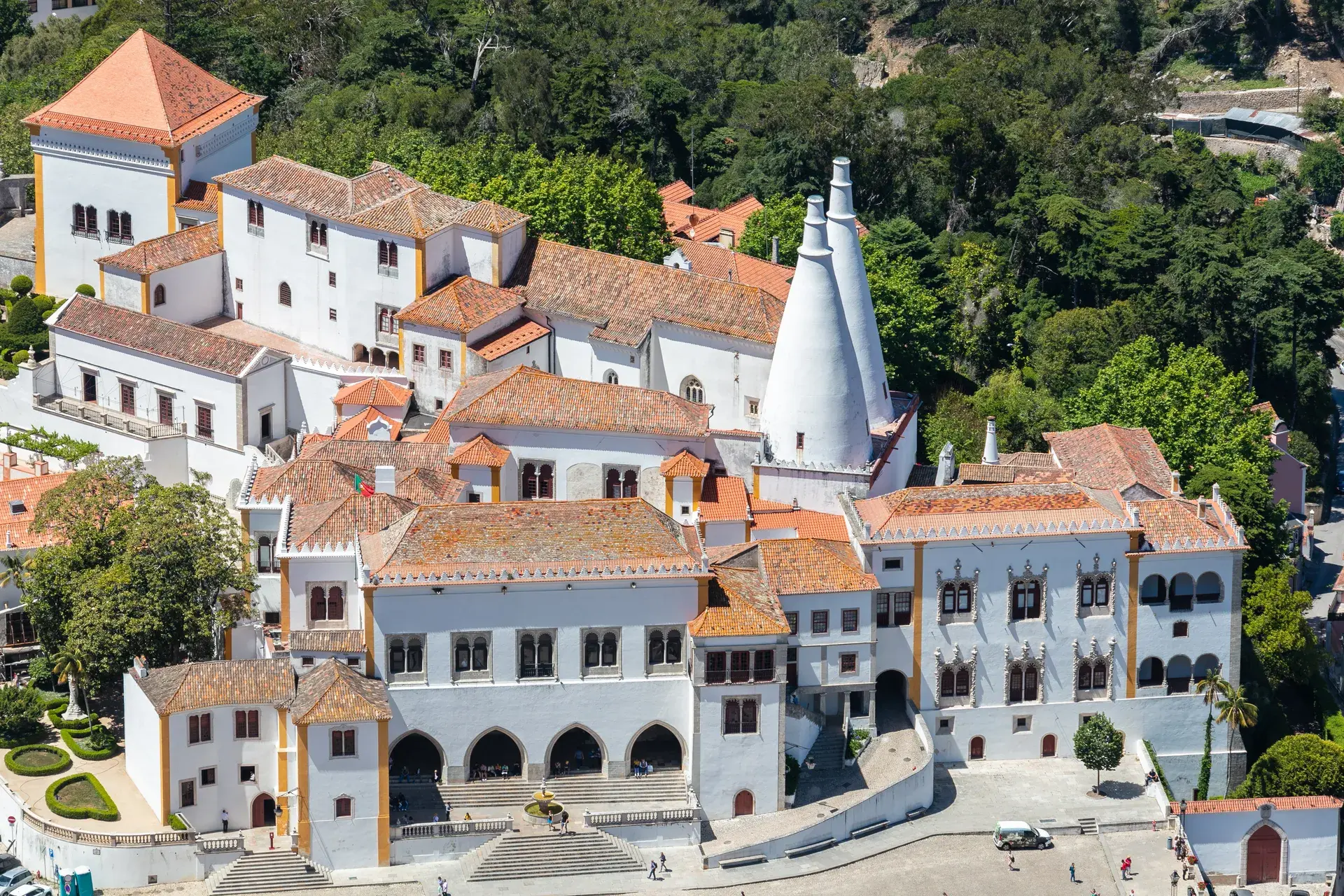
Beneath two massive, 33-metre-tall white chimneys lies Portugal's best-preserved medieval royal residence, anchoring the very center of Sintra. Unlike the high-altitude Pena Palace or Castle of the Moors, the National Palace of Sintra sits in the central valley square, Praça da República. Inscribed as a UNESCO World Heritage site in 1995, it stands as a testament to centuries of Portuguese royal history.
A Tapestry of Architectural Styles
The palace is a unique blend of Gothic, Manueline, Mudéjar, and Renaissance architectural styles. Its interiors are characterized by extensive collections of early Hispano-Moorish ceramic tiles, known as azulejos. Rich geometric Mudéjar relief tiles line the interior halls, while wooden octagonal coffered domes feature gilded trim. The palace also preserves running water features in its interior courtyards, such as the fountain located in the Arab Room.
Centuries of Royal History
The site's origins trace back to the 10th or 11th century under Islamic rule. It officially became property of the Portuguese crown in 1147 following the capture of Lisbon by King Afonso Henriques. Over the centuries, Portuguese monarchs frequently used the palace as a summer retreat to escape the heat and as a safe haven during outbreaks of the plague in Lisbon.
Massive reconstructions began in the early 15th century under King João I, who added the monumental kitchen, the Swan Room, and the Magpie Room. In the early 16th century, King Manuel I further expanded the complex, introducing Manueline decorative flourishes and the grand Room of the Coats of Arms.
Secrets of the Royal Chambers
The palace holds numerous historical curiosities within its walls. The Magpie Room gets its name from a ceiling painted with 136 magpies holding banners that read "Por bem" ("For good" or "In honor"). According to tradition, King João I commissioned the painting to silence court gossip after Queen Philippa of Lancaster caught him offering a rose and a kiss to a lady-in-waiting.
In the Room of the Coats of Arms, the wooden gilded dome displays the heraldic shields of Portugal's 72 most powerful 16th-century noble families. However, one shield space was deliberately scraped clean by royal decree. This erasure occurred in the 18th century after the Távora family was executed and disgraced for an alleged assassination attempt on King José I.
Beneath the palace's signature 33-metre-tall bottle-shaped chimneys lies the monumental kitchen. This massive culinary space was specifically designed to roast whole game, including wild boar and deer, over open hearths to feed several hundred court members during banquets.
From Royal Prison to Modern Museum
The palace was not only a place of leisure but also one of confinement. King Afonso VI, after being deposed by his brother, was kept imprisoned in a small, guarded chamber within the palace for the last nine years of his life until his death in 1683.
The complex remained an active royal residence until the Portuguese monarchy was abolished in 1910. Today, the National Palace of Sintra is managed by Parques de Sintra - Monte da Lua. It operates as a public historic house museum, displaying medieval and Renaissance royal apartments, tapestries, and decorative arts. The estate undergoes regular conservation work, which includes the specialized exterior plastering and whitewashing of its iconic monumental chimneys.
FAQ
Why does the National Palace of Sintra have two massive chimneys?
The 33-metre-tall conical white chimneys sit directly above the monumental royal kitchens. They were specifically designed to ventilate the open hearths used to roast whole game, such as wild boar and deer, to feed hundreds of court members.
What is the story behind the Magpie Room?
The Magpie Room features a ceiling painted with 136 magpies holding banners with King João I’s motto, "Por bem." Tradition dictates that the king commissioned this ceiling to silence court gossip after he was caught offering a rose and a kiss to a lady-in-waiting.
Why is one shield erased in the Room of the Coats of Arms?
The room's ceiling displays the heraldic shields of Portugal's 72 most powerful 16th-century noble families. One shield, belonging to the Távora family, was scraped clean by royal decree in the 18th century after the family was disgraced and executed for an alleged assassination attempt on King José I.