Black Eagle Palace: Oradea's Secessionist Masterpiece
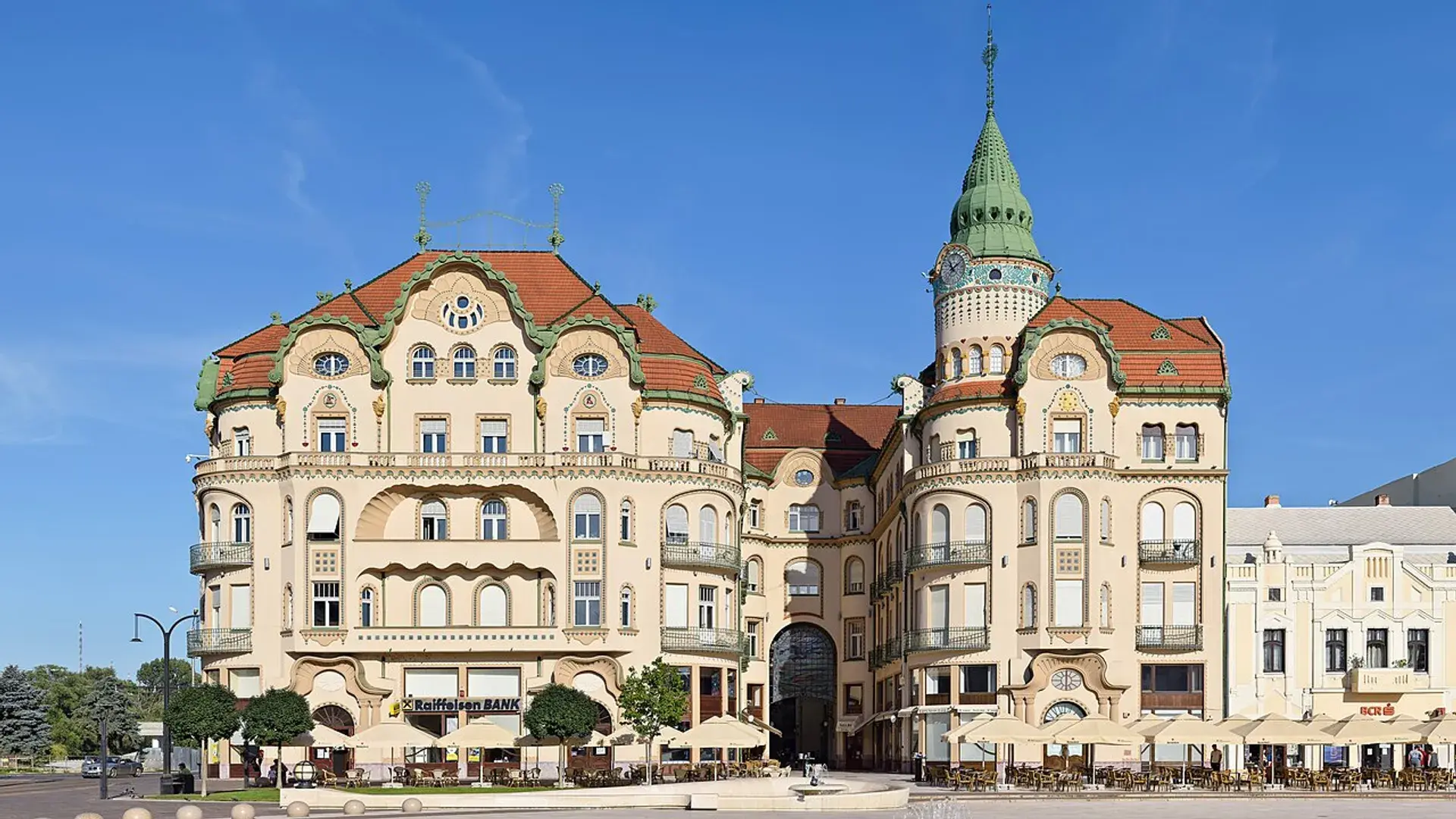
The Black Eagle Palace stands as the most spectacular masterpiece of Secession architecture in Oradea and a symbol of the city's early 20th-century ambition. This iconic building, with its famous glass-covered passage, was conceived as a modern center for commerce and urban sophistication.
A Vision of Modernity
Constructed between 1907 and 1908, the Black Eagle Palace was designed by architects Marcell Komor and Dezső Jakab, leading figures of the Hungarian Secession movement. The project was built under the supervision of engineer Sztarill Ferenc, who completed the impressive structure in just over one year. The palace replaced the former Eagle Inn, a public venue that had occupied the site since 1714.
Remarkably, the construction was financed from the personal savings of two local Jewish lawyers and entrepreneurs, Dr. Kurländer Ede and Dr. Adorján Emil. Their vision was to create a multi-functional complex for the city. The architectural style is a prime example of Art Nouveau, featuring rich floral and zoomorphic ornamentation with some eclectic elements recalling the Baroque style.
Architectural and Cultural Hub
The Black Eagle Palace was pioneering in its design as a 'living public space.' From its grand opening in 1909, it housed a hotel, ballrooms, a theatre, a casino, shops, and even a bank. The building's centerpiece is a Y-shaped passage covered by a glass roof, which features a stunning stained-glass window depicting a black eagle, the emblem of the complex. This iconic glasswork was crafted in 1909 in Neumann K.'s workshop.
The palace's Grand Hall hosted numerous shows and concerts before it was later converted into a cinema. The project highlights the significant contributions of Oradea's diverse communities, though it is also tied to a tragic history. One of its principal architects, Marcell Komor, was deported and died in 1944 during World War II, a fate shared by many in Oradea's Jewish community.
The Palace Today
Today, the Black Eagle Palace continues to be a vibrant cultural and social hub in the heart of Oradea. Its interior passage is lined with numerous cafes, clubs, shops, and restaurants, making it a popular destination for locals and visitors alike. The building also contains hotels and offices.
The facade and the internal gallery are publicly accessible 24/7 for viewing, allowing everyone to appreciate its architectural details at any time. The commercial establishments within operate on their own schedules, generally opening around 10 AM and often staying open late into the night. Parts of the restored building are also used as a museum and for cultural events.
FAQ
When was the Black Eagle Palace built?
The Black Eagle Palace was constructed between 1907 and 1908, with its festive opening taking place in 1909.
What is the architectural style of the Black Eagle Palace?
The palace is a celebrated example of the Hungarian Secession style, a form of Art Nouveau. It is characterized by rich floral and zoomorphic ornamentation.
Who funded the construction of the Black Eagle Palace?
The palace was notably funded by two Jewish lawyers and entrepreneurs, Dr. Kurländer Ede and Dr. Adorján Emil, who used their personal savings to finance the project for the city.
Is the Black Eagle Palace open to the public?
Yes, the palace's iconic Y-shaped glass passage is publicly accessible 24/7. It houses numerous cafes, shops, and restaurants that have their own operating hours.