The Bridge of Lies: Sibiu's Historic Iron Span
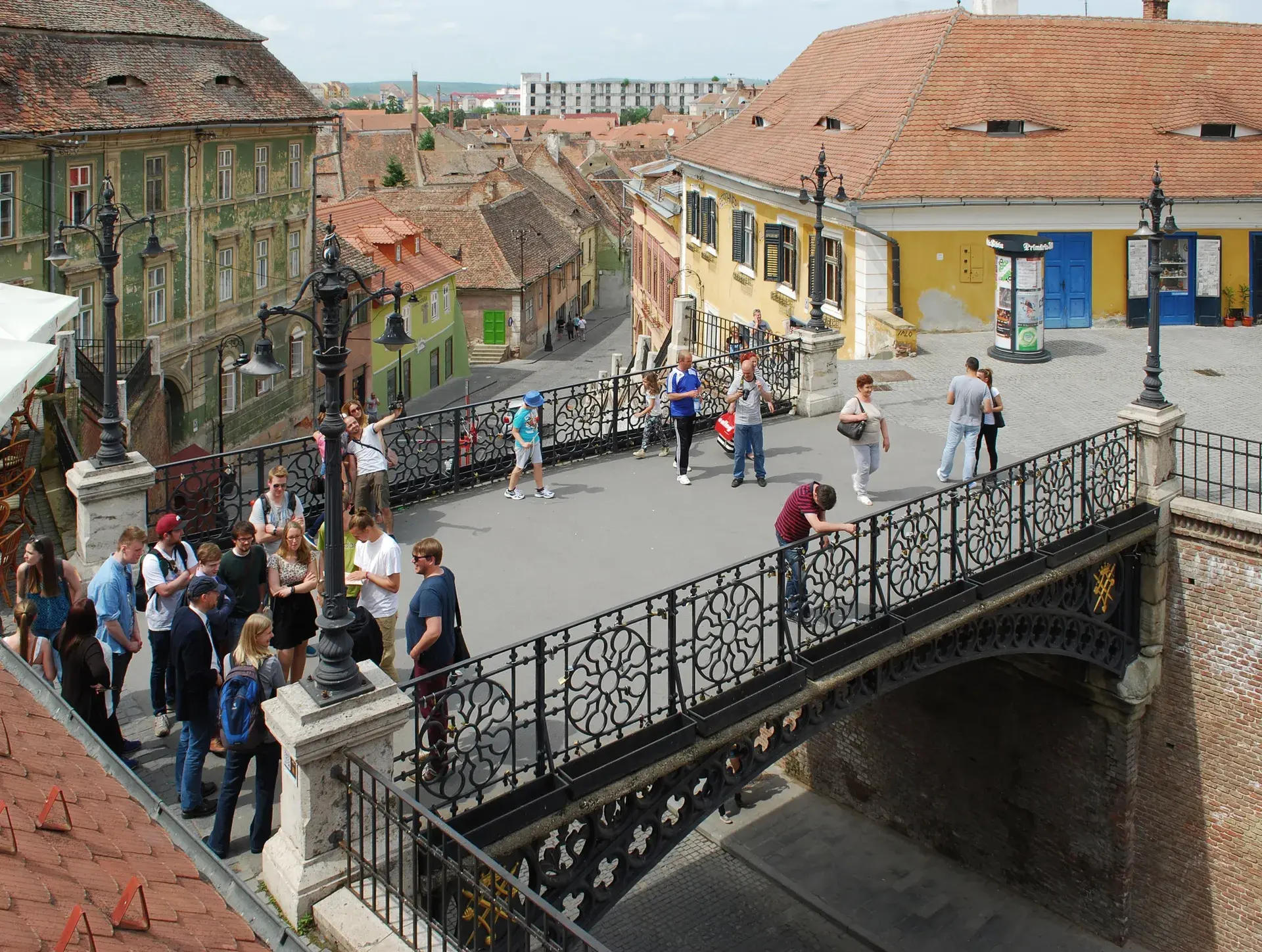
In the heart of Sibiu, Romania, the Bridge of Lies stands as a celebrated landmark and a marvel of 19th-century engineering. This pedestrian bridge connects the city's Lesser Square (Piața Mică) with Huet Square, crossing over Strada Ocnei. Inaugurated on December 17, 1860, it holds the distinction of being the first cast-iron bridge built in Romania.
Engineering and Neo-Gothic Design
The Bridge of Lies was a significant infrastructural project for its time, notable for being the first bridge in the country constructed without supporting pillars. Its ironwork was fabricated by the German foundry Friedrichshütte, based in Laubach, Hesse. The structure measures 10.40 meters in length and 6 meters in width.
The design features elegant Neo-Gothic motifs across four cast-iron arches. The northernmost arch bears the inscriptions "1859," marking its construction year, and "FRIEDRICHS HÜTTE," crediting its creator. The southernmost arch proudly displays the coat of arms of Sibiu. Four cast-iron lampposts at its ends complete the historic aesthetic.
The Truth Behind the Name
Contrary to the many legends it inspires, the name "Bridge of Lies" originates not from tales of deceit but from a linguistic evolution. Its original German name was likely "Liegenbrücke," meaning "lying bridge" in the sense of it lying flat without pillars. This phonetically resembles "Lügenbrücke," the German for "bridge of lies." Over time, the misinterpretation stuck, creating the name known today. The bridge's reputation as a hub for exchanging town news and gossip may have helped cement its legendary name.
A Historic Landmark Today
Before the current structure, a wooden bridge stood in its place, which itself replaced a tunnel system connecting the two squares. Today, the Bridge of Lies remains a vital pedestrian thoroughfare and a major tourist attraction. It is a popular spot for photography, and some visitors attach "love locks" to its railings. During the winter holidays, the bridge is adorned with festive lights, adding to the charm of the nearby Christmas Market. Its historical significance and unique story make it a central piece of Sibiu's cultural identity.
FAQ
Why is it called the Bridge of Lies?
The name is believed to originate from a phonetic confusion. Its German name, "Liegenbrücke" (meaning a bridge that lies down, as it has no pillars), sounds very similar to "Lügenbrücke" (Bridge of Lies).
When was the Bridge of Lies built?
Construction on the Bridge of Lies began in 1859, and it was officially inaugurated on December 17, 1860.
What is historically significant about the Bridge of Lies?
The Bridge of Lies is the first cast-iron bridge ever built in Romania. It was also the first bridge in the country to be constructed without supporting pillars.
Where is the Bridge of Lies located?
The bridge is located in Sibiu, Romania. It serves as a pedestrian crossing between the Lesser Square (Piața Mică) and Huet Square.