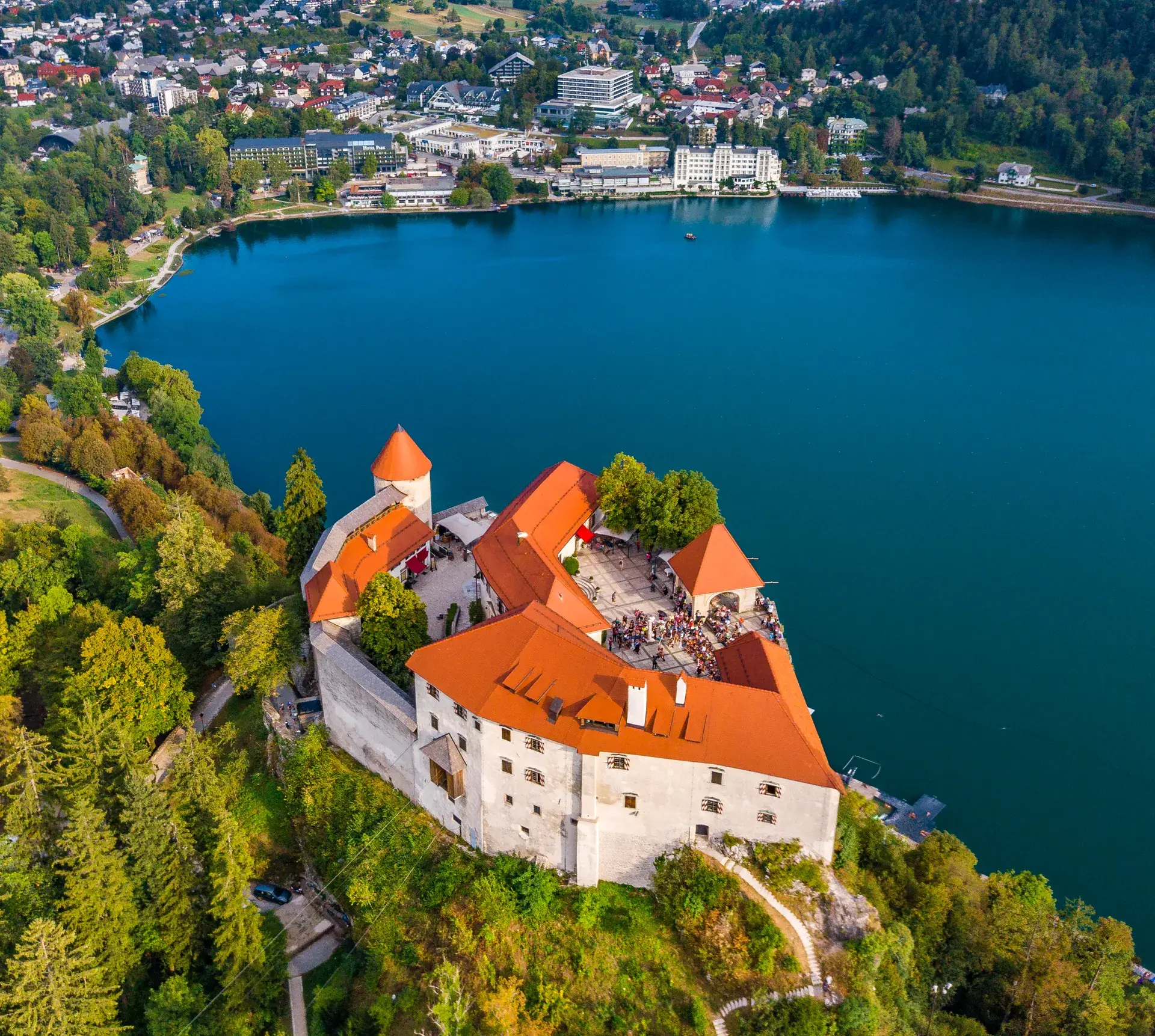
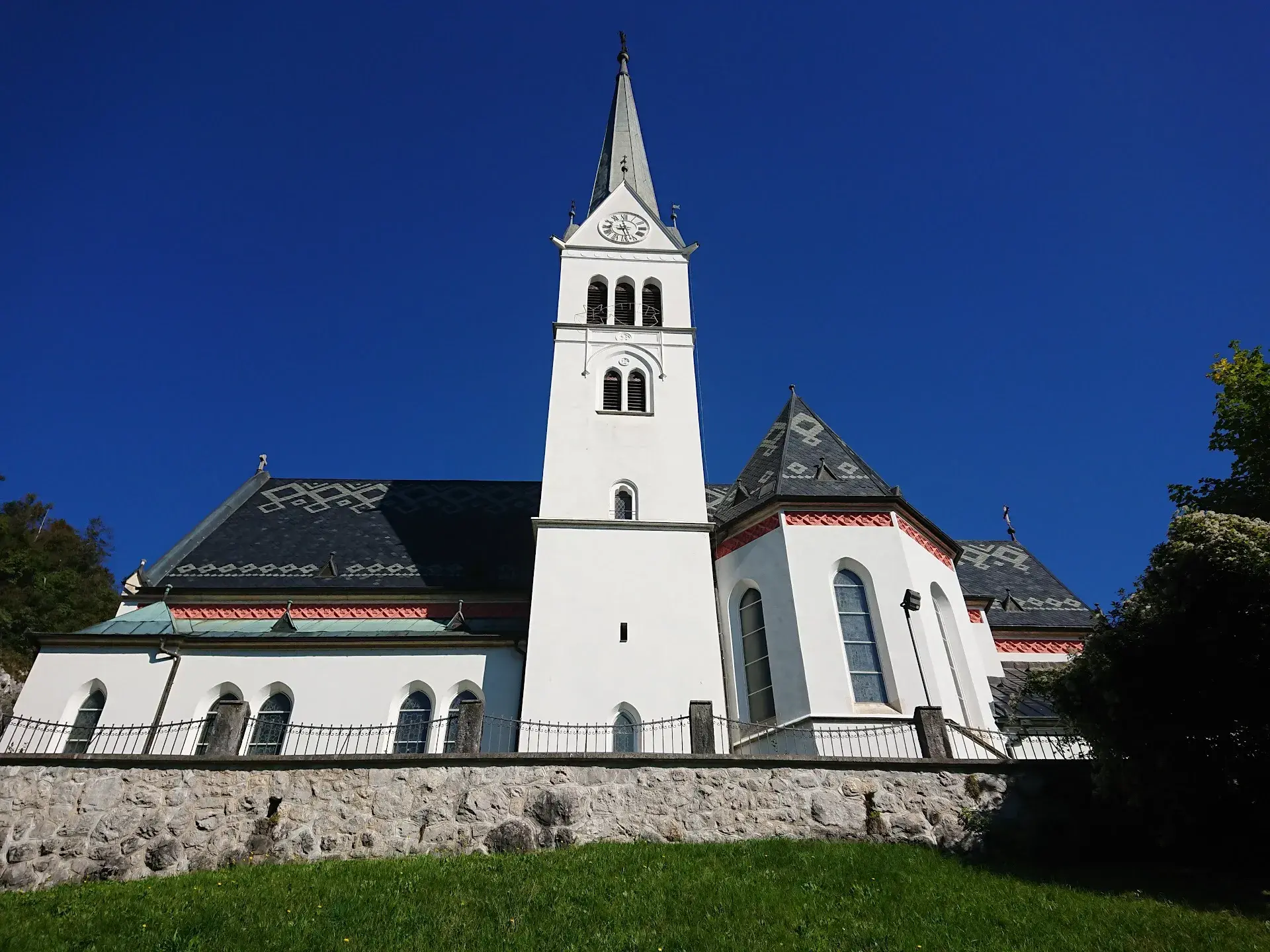
Saint Martin's Parish Church in Bled, Slovenia
Saint Martin’s Parish Church (Župnijska cerkev sv. Martina) is a Roman Catholic place of worship standing at the base of the Castle Hill cliff in Bled, Slovenia. Positioned in Grad, the oldest medieval village among the settlements that eventually merged into modern Bled, the church acts as an architectural link between the lake promenade and the paths ascending to Bled Castle. Its tall Neo-Gothic spire rises against the dark limestone bluff, where the resonance of its parish bells echoes across the lower slopes.
A Thousand Years of History
Christian worship on this site dates to before the year 1000, beginning with a wooden and stone chapel equipped with a crypt. During the 14th and 15th centuries, a Gothic structure replaced the earlier chapel, incorporating a star-vaulted presbytery around 1440. In the late 15th century, local inhabitants constructed a fortified stone perimeter wall (tabor) around the churchyard to provide refuge against Ottoman raids. Preserved segments of this defensive wall still remain on the grounds.
By the late 19th century, the Gothic church had fallen into severe disrepair. The sanctuary floor had settled noticeably below the surrounding cemetery, leading parishioners to describe entering the nave as stepping down into a cellar. In 1903, the parish demolished the decaying Gothic building to make way for the present structure.
Neo-Gothic Architecture and Furnishings
The current Neo-Gothic church was designed by Austrian architect Friedrich von Schmidt, known for his work on Vienna City Hall. Architect Josip Vancaš contributed modifications to the interior layout, and the Ljubljana-based Gustav Tönnies construction company carried out the build between 1903 and 1905. Prince-Bishop Anton Bonaventura Jeglič consecrated the church on August 27, 1905.
Inside, the church combines vibrant wall paintings with pale stone craftsmanship. Sculptor Ivan Vurnik of Radovljica crafted the altars and interior furnishings from Carrara marble. In the choir gallery, the church houses a 32-stop pipe organ built in 1910 by Ivan Milavec of Ljubljana.
Slavko Pengov Frescoes and Political Critique
Between 1932 and 1937, academic painter Slavko Pengov decorated the nave and presbytery with extensive fresco cycles. Pengov introduced an unexpected political critique into the biblical imagery: in his scene of the Last Supper, the figure of Judas Iscariot is depicted with the distinct facial features of Bolshevik leader Vladimir Lenin, reflecting the artist's anti-Bolshevik views.
The Marian Column by Jože Plečnik
The exterior churchyard features a stone Marian column crowned with a statue of Mary and the Christ Child. Renowned Slovenian architect Jože Plečnik designed the monument in 1934, and sculptor Božidar Pengov carved it. Originally erected at Villa Epos, the monument was relocated to the churchyard after 1965. On the reverse side of Mary's cloak, the carving displays a historical forerunner to the Slovenian coat of arms: the three-peaked silhouette of Mount Triglav situated beneath the six-pointed star of the Counts of Celje.
Present-Day Parish Role and Pilgrimages
Saint Martin’s remains the active mother church of the Parish of Bled. It regularly hosts Roman Catholic masses, weddings, and sacred music concerts, while welcoming cultural visitors during the day. The plaza fronting the church serves as an intersection for three pilgrimage corridors: the Way of Saint James (Pot sv. Jakoba), the European Cultural Route of Saint Martin (Via Sancti Martini), and Saint Emma’s Pilgrimage Route (Emina romarska pot).
FAQ
Who designed Saint Martin’s Church in Bled?
The church was designed by Austrian architect Friedrich von Schmidt, with interior layout adjustments planned by Josip Vancaš.
Why is Vladimir Lenin depicted in the church’s frescoes?
Painter Slavko Pengov painted the likeness of Vladimir Lenin onto the figure of Judas Iscariot in his 1930s Last Supper fresco to express an anti-Bolshevik stance.
What historical structures surround Saint Martin’s Church?
The church grounds feature surviving sections of a late-15th-century fortified stone wall built to shield villagers during Ottoman incursions, as well as a 1934 Marian column designed by architect Jože Plečnik.
Which pilgrimage routes pass by Saint Martin’s Church?
The front plaza intersects three pilgrimage routes: the Way of Saint James, the Via Sancti Martini, and Saint Emma’s Pilgrimage Route.
Discover Bled like never before
Dive into Bled hidden stories and secret spots with Ciceru interactive tours.
Explore tour
Audioguide
Quizzes
Maps
Solo
Couples
Groups & families

© Photo by Shotaro Ishibashi via Google Maps · Google Places