Oratorio de San Felipe Neri: Cradle of Spanish Liberalism
The Oratorio de San Felipe Neri in Cádiz stands as a monument of immense historical and architectural importance. This Baroque church is not only a place of worship but also revered as the birthplace of modern Spanish constitutionalism, where a unique design feature played an unexpected role in shaping the nation's future.
Architectural History
Construction on the Oratorio de San Felipe Neri took place between 1685 and 1719, based on an initial design by master builder Blas Díaz. The church is distinguished by its rare elliptical floor plan, an unusual choice for Andalusian Baroque architecture of the era. The structure's original dome suffered significant damage during the 1755 Lisbon earthquake and was subsequently reconstructed in 1764 by Pedro Afanador. Inside, the main altarpiece is adorned with Bartolomé Esteban Murillo's masterpiece, 'Immaculate Conception,' one of the artist's final major works.
The Cradle of 'La Pepa'
During the Napoleonic invasion of Spain, Cádiz remained one of the few unoccupied cities, becoming the center of the Spanish resistance government. From 1811, the Oratorio de San Felipe Neri served as the meeting hall for the Cortes of Cádiz, a body of deputies from Spain and its colonies. The church's elliptical interior proved to be an ideal setting for parliamentary debate, functioning as a natural amphitheater with excellent acoustics.
On March 19, 1812, this assembly proclaimed the Spanish Constitution of 1812. Known as 'La Pepa,' it was Spain's first liberal constitution, a groundbreaking document that declared national sovereignty and abolished feudalism. This event cemented the Oratorio's place in history and established Cádiz's identity as the 'cradle of liberalism' in Spain. The constitution's influence would later spread across Latin America and Portugal.
A Lasting Legacy
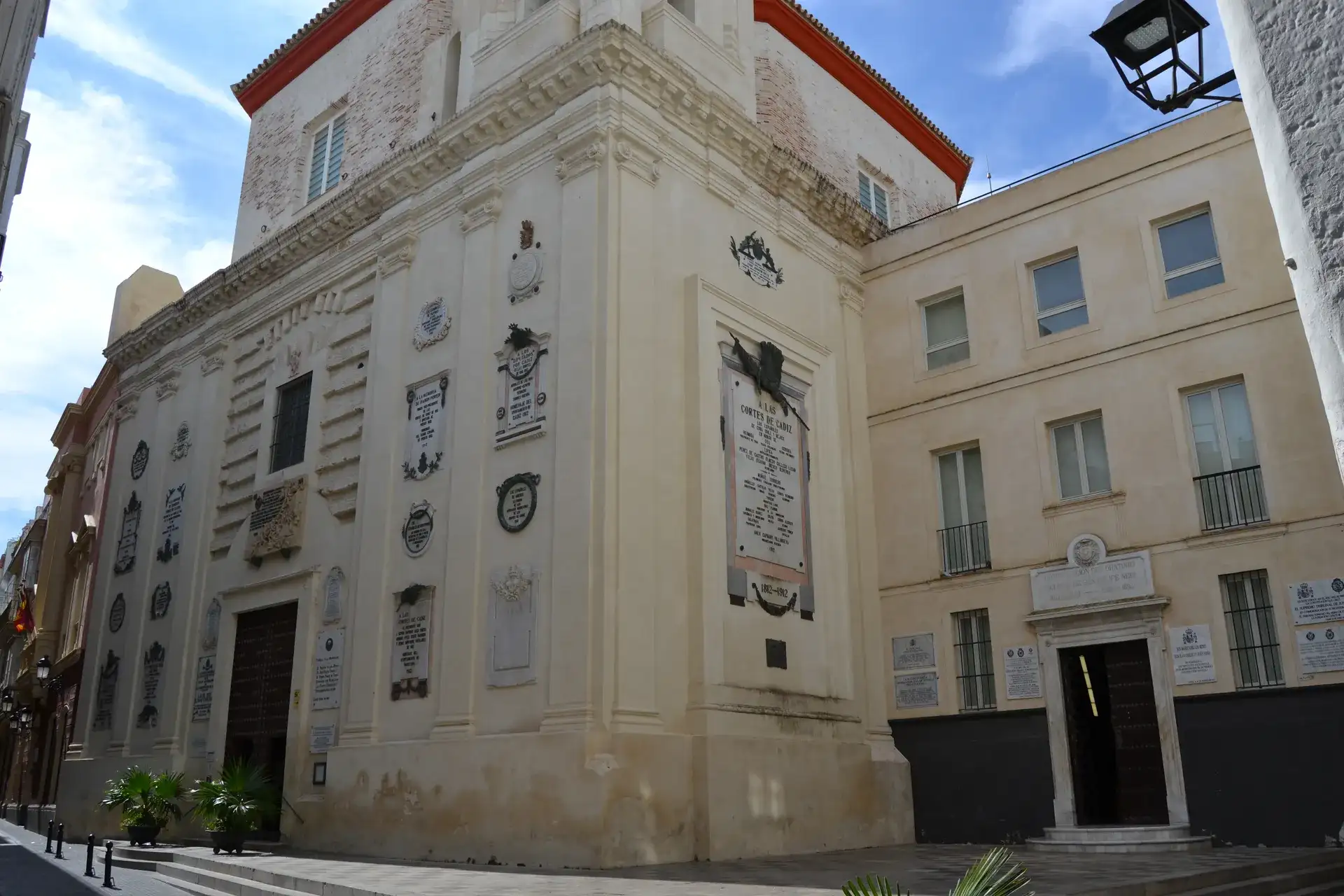
The Oratorio was declared a Bien de Interés Cultural (Property of Cultural Interest) in 1907. In 1912, to mark the centenary of the constitution, numerous commemorative plaques honoring the deputies were placed on the building's exterior. Beneath the temple, a crypt serves as a pantheon for the 'doceanista' deputies associated with the 1812 Constitution and holds an urn commemorating victims of the 1820 military uprising. The Oratorio also hosted the Cortes that brought an end to the Liberal Triennium in 1823.
The Oratorio Today
Today, the Oratorio de San Felipe Neri continues its dual role as an active church and a significant historical site. It hosts traditional Latin Mass on Sundays and is open to the public, with an annexed building housing the Interpretation Centre of the 1812 Constitution to provide historical context. The building remains in excellent condition, having undergone restorations for the bicentennial celebrations in 2012. It also continues to host annual religious services and investiture ceremonies for the Hospitaller Knights of San Juan.
FAQ
Why is the Oratorio de San Felipe Neri historically significant?
It is where the Cortes of Cádiz proclaimed Spain's first liberal constitution, known as 'La Pepa,' on March 19, 1812, making it the cradle of Spanish constitutionalism.
What is unique about the architecture of the Oratorio de San Felipe Neri?
It features a rare elliptical floor plan for a Baroque church, a design by Blas Díaz. This shape unintentionally created a natural amphitheater, which was ideal for the parliamentary debates held there.
What famous artwork is inside the Oratorio de San Felipe Neri?
The main altarpiece features the 'Immaculate Conception,' a painting by the renowned artist Bartolomé Esteban Murillo, completed in 1680.
Is the Oratorio de San Felipe Neri still an active church?
Yes, it continues to function as an active church, hosting traditional Latin Mass on Sundays, alongside being a major historical site open to the public.