Plaza de España & 1812 Monument in Cádiz
The Plaza de España in Cádiz is a significant public square centered around the impressive Monument to the 1812 Constitution. This landmark commemorates a pivotal moment in Spanish history and is set within a grand space created through early 20th-century urban expansion.
A Monument to Liberalism
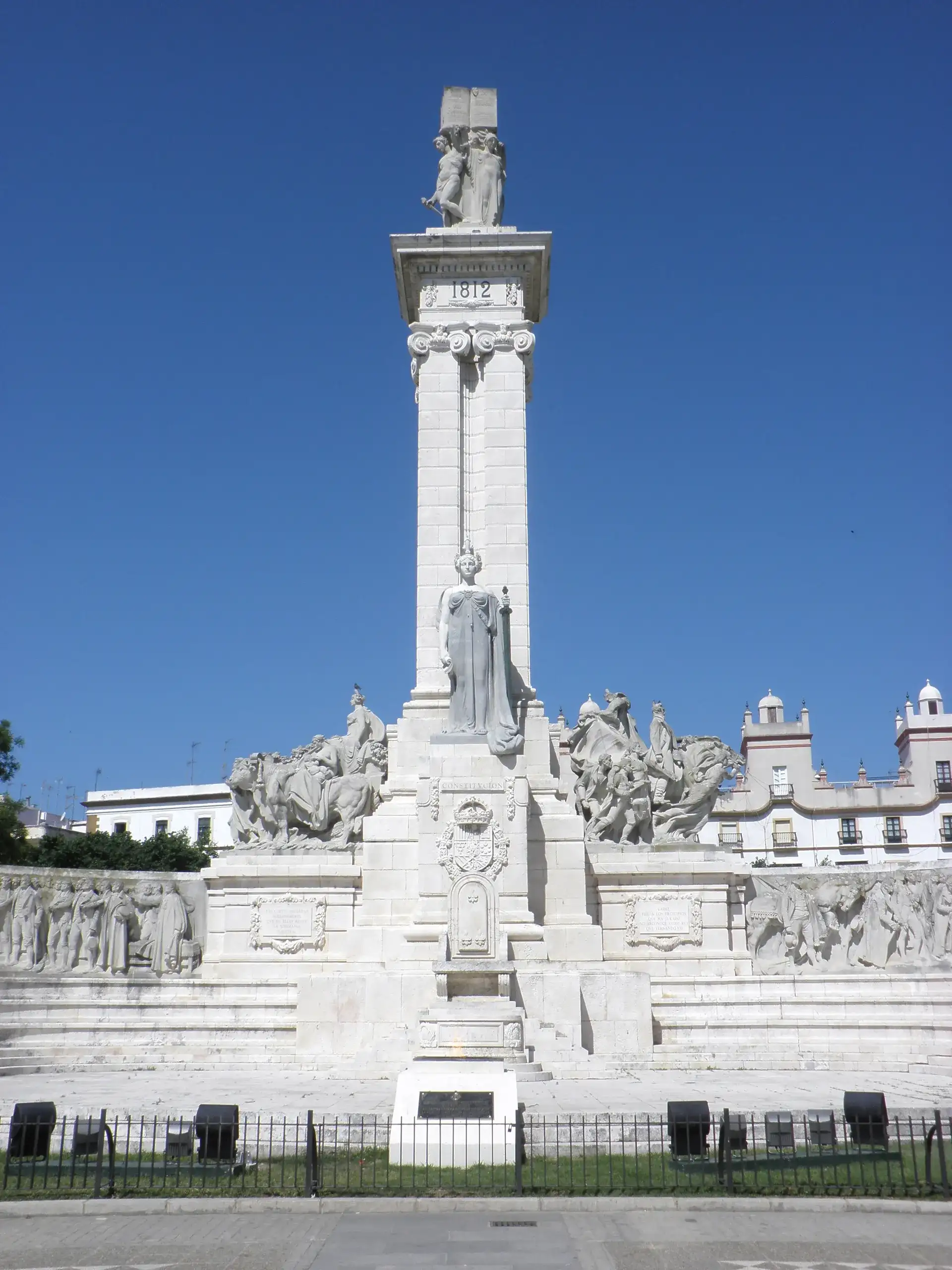
At the heart of the plaza stands the Monument to the 1812 Constitution, also known as 'La Pepa'. This structure honors Spain's first liberal constitution, which was drafted and promulgated in Cádiz on March 19, 1812. During the Peninsular War, Cádiz was one of the few Spanish cities free from Napoleonic occupation, allowing the Cortes de Cádiz (parliament) to convene and establish foundational principles of freedom and civil rights.
The idea for a monument was first proposed by the deputies of the Cortes in 1812. However, the project was commissioned a century later, in 1912, to mark the constitution's centenary. Designed by architect Modesto López Otero and sculptor Aniceto Marinas García, the monument was finally completed in 1929.
Symbolic Design and Artistry
The monument is rich with allegorical figures sculpted by Aniceto Marinas García. A central female figure represents Spain, while other sculptures symbolize peace and war. The design also incorporates a figure of Hercules, the mythical founder of Cádiz, linking the city's ancient past to this foundational moment of Spanish liberalism.
One of the most notable features is an empty throne bearing the Bourbon family insignia. This element symbolically acknowledges the legitimacy of King Ferdinand VII, who was absent at the time, while also reflecting the constitution's liberal aim to limit the power of the monarchy.
The Evolution of the Plaza
The Plaza de España is an expansion of the former Plazuela del Carbón. To create a grand setting for the monument, a section of the old city walls was demolished between 1906 and 1910, and the plaza was built on land largely reclaimed from the sea.
The square is surrounded by buildings showcasing a mix of architectural styles, including late Cádiz Baroque, Art Deco, and early Neo-Classical. A prominent example is the former Palacio de la Aduana (Customs Palace), a Neoclassical building which now serves as the headquarters of the Provincial Council.
The Plaza de España Today
Currently, the Plaza de España is a popular public space for both locals and visitors. It is a freely accessible gathering point for strolling and contemplation, offering a quieter atmosphere than other parts of the city. Since 2022, the area has been undergoing a pedestrianization process to reduce traffic and enhance the experience for foot traffic.
FAQ
When was the Monument to the 1812 Constitution built?
The monument was commissioned in 1912 to mark the centenary of the constitution. Construction began that year and was completed in 1929.
Why is the 1812 Constitution known as 'La Pepa'?
The Constitution of 1812 was promulgated in Cádiz on March 19, which is the feast day of Saint Joseph. 'Pepe' is a common nickname for Joseph in Spanish, leading to the constitution's popular nickname, 'La Pepa'.
What is the significance of the empty throne on the monument?
The empty throne, adorned with the Bourbon insignia, symbolizes the legitimacy of King Ferdinand VII. Its emptiness is also significant, as the 1812 Constitution was a liberal document created in the king's absence that sought to limit monarchical power.
Is it free to visit the Plaza de España in Cádiz?
Yes, the Plaza de España is a public square and is freely accessible 24 hours a day.