Casa Casals, Figueres: Modernisme and the Rambla Clock
Architectural Origins and Modernista Facade
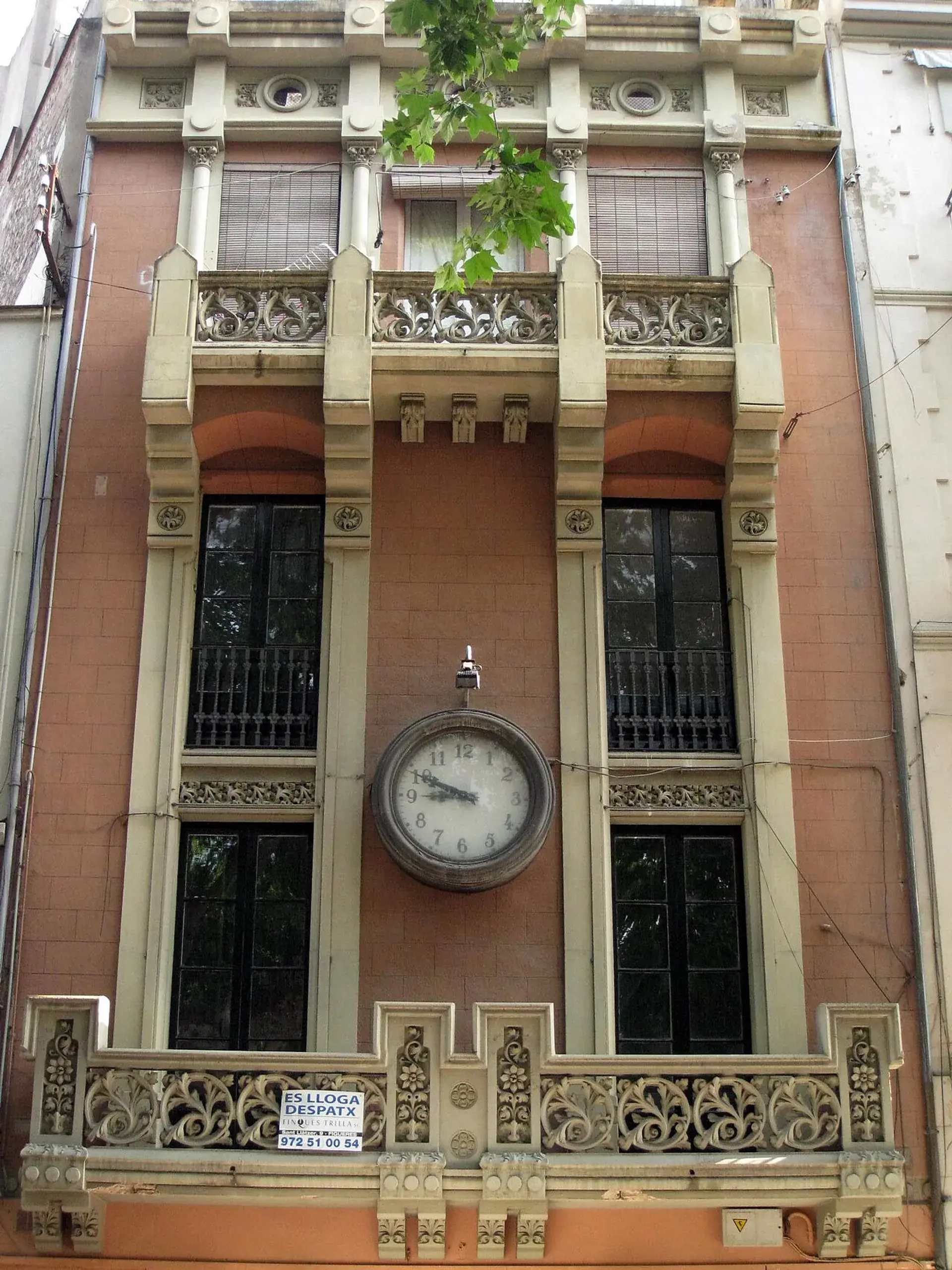
Casa Casals stands at Rambla, 6 in Figueres, Alt Empordà. Built in 1898, the narrow terraced residence (casa entre mitgeres) consists of a ground floor and three upper levels. It was commissioned by Àngel Casals i Matabosch, a carbonated beverages merchant originally from Olot who served as a federal-republican councillor on the Figueres City Council. The building is officially catalogued under multiple names, including Casa Àngel Casals i Matabosch and Casa Junyent, though the origin of the latter designation is undocumented in available historical records.
The structure was designed by Josep Cordomí i Bosch (d. 1907), a master builder (mestre d'obres) and surveyor rather than a titled architect. Cordomí i Bosch—who later served as a military master builder in Seville in 1905 and was the uncle of noted Modernista architect Simó Cordomí i Carrera—crafted a facade in the Modernisme style blended with eclectic touches and references to Catalan civil Gothic.
Two continuous balconies on the first and third floors feature openwork floral stone balustrades supported by carved corbels (mènsules). Above the first level, vertical stone mouldings frame the second-floor windows and rise into pinnacles, flanking circular oeil-de-boeuf openings just beneath the cornice and rooftop balustrade. This pierced stonework creates a shifting play of light and shadow characteristic of late-19th-century Catalan Modernisme.
From Bourgeois Residence to Local Bank
Following its years as a family home, Casa Casals took on an important financial role in early-20th-century Figueres. In 1920, the original owner's son, Àngel Casals i Noguer—who had studied law and trained in finance in Germany—established a currency exchange (Casa de Canvi i Monedes) inside the building.
Between 1925 and 1930–1931, the premises operated as Banca Casals i Llorens, a local bank co-directed with Roses businessman and politician Baldiri Llorens i Rahola. Its independent run concluded in 1931 when the institution was absorbed by the Banc de Catalunya.
The Clock of La Rambla and Its Caretaker
Locally, Casa Casals is widely known as la casa del rellotge (