Puerta de la Justicia: Alhambra's Historic Gate of Justice
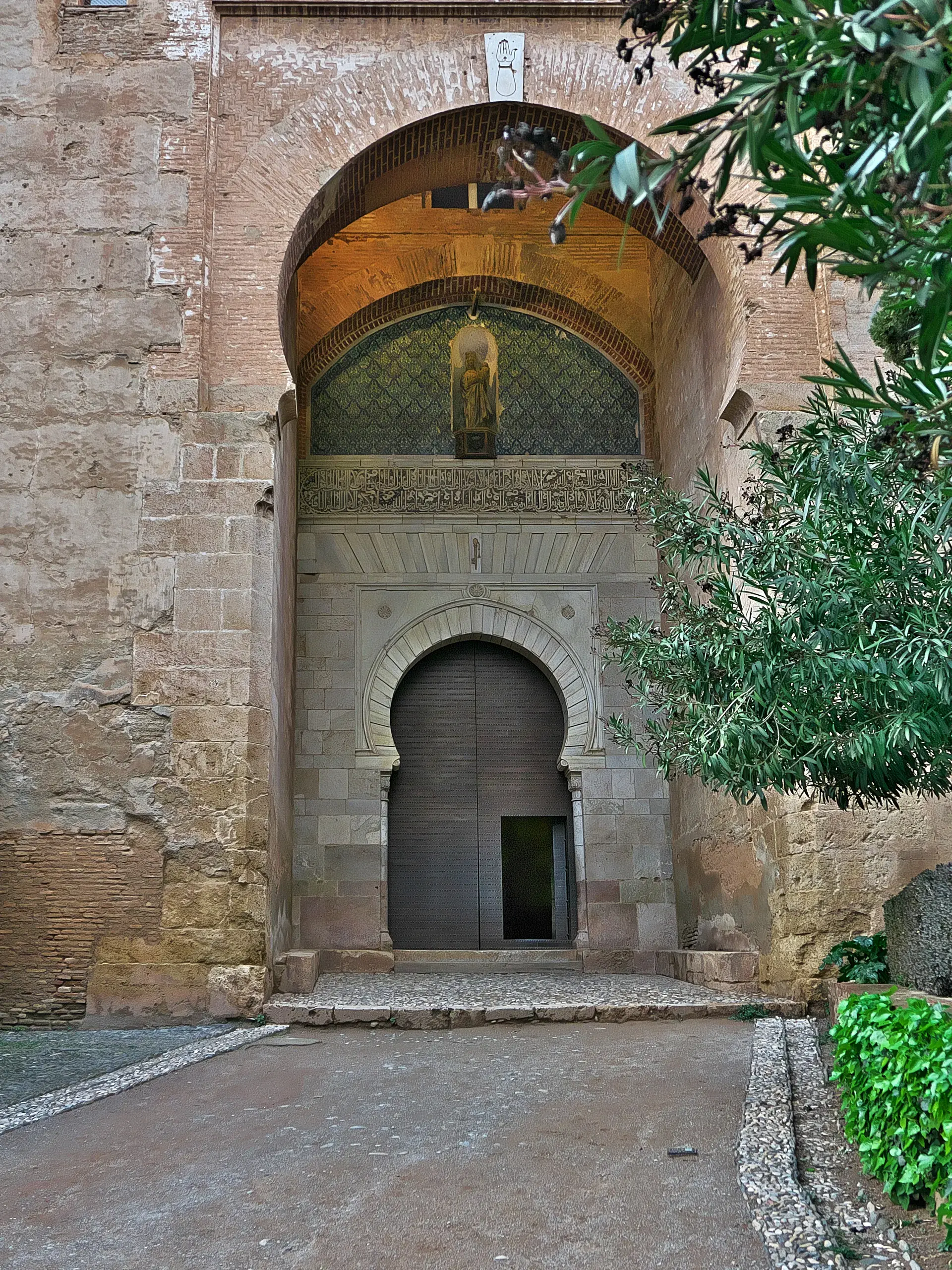
The Puerta de la Justicia, or Gate of Justice, stands as a colossal and imposing entrance to the Alhambra complex in Granada. Constructed in 1348 under the rule of Sultan Yusuf I, this monumental gateway showcases the strength and artistry of Nasrid Islamic military architecture. It originally served as the main entrance to the fortified palatine city.
Architectural Details and Symbolism
The gate is distinguished by its prominent pointed horseshoe arch, a hallmark of Nasrid design. Significant symbolic carvings adorn the structure: a hand is carved on the exterior arch, representing the five pillars of Islam, while a key on the interior arch symbolizes authority. The interior passage features vaults painted with a false red brick pattern, a characteristic Nasrid decorative technique. The original wooden doors, reinforced with iron plates, have been preserved and restored, offering a direct link to the gate's medieval past.
A History of Change
Originally known as Bib-Xaria, meaning 'Gate of the Esplanade', its current name stems from a misunderstanding of a similar Arabic term, Bib-Xarea, or 'Gate of the Law'. This reflects its historical function as a place where justice was administered under Islamic law. The gate's history is marked by profound cultural shifts. In 1492, it witnessed the triumphant entry of the Catholic Monarchs, Ferdinand and Isabella, after their conquest of Granada, signaling the end of Muslim rule in Spain.
Following the conquest, the monarchs ordered significant alterations. An artillery bulwark was added, and in 1501, a Gothic sculpture of the Virgin and Child by Roberto Alemán was placed within the gate, directly above the original Arabic inscriptions. This juxtaposition of Islamic and Christian iconography serves as a tangible symbol of the Reconquista. Much later, during the Franco dictatorship, the gate was temporarily used as a prison for political dissidents.
The Gate Today
Today, the Puerta de la Justicia functions as a primary historical entrance to the Alhambra, and it is accessible to visitors without a ticket. It provides a monumental introduction to the scale of the complex and offers passage to the ticketed areas. The upper part of the structure, the Torre de la Justicia, has been restored and now houses an exhibition space with historical documents and drawings. Near the gate, a pillar commemorates the American writer Washington Irving, whose 'Tales of the Alhambra' brought international fame to the site.
FAQ
Why is it called the Puerta de la Justicia (Gate of Justice)?
Its name comes from a historical misinterpretation of its original Arabic name. It was once known as Bib-Xaria ('Gate of the Esplanade'), which was mistaken for 'Bib-Xarea' ('Gate of the Law'), reflecting its past use as a site for settling legal matters.
What do the hand and key symbols on the gate mean?
The hand carved on the exterior arch symbolizes the five pillars of Islam. The key carved on the inner arch is a symbol of authority in Islamic tradition. A local legend claimed the Alhambra would not fall until the hand could grasp the key.
Can you visit the Puerta de la Justicia without an Alhambra ticket?
Yes, the Puerta de la Justicia serves as one of the historical entrances to the Alhambra complex and is accessible to the public without a ticket.
Why is there a Christian statue on an Islamic gate?
After the Christian conquest of Granada in 1492, the Catholic Monarchs commissioned a Gothic sculpture of the Virgin and Child. It was installed in 1501 above the original Arabic inscriptions as a symbol of the religious and cultural shift in the region.