Guide to Augustiner Brunnen: Basel's Basilisk Fountain
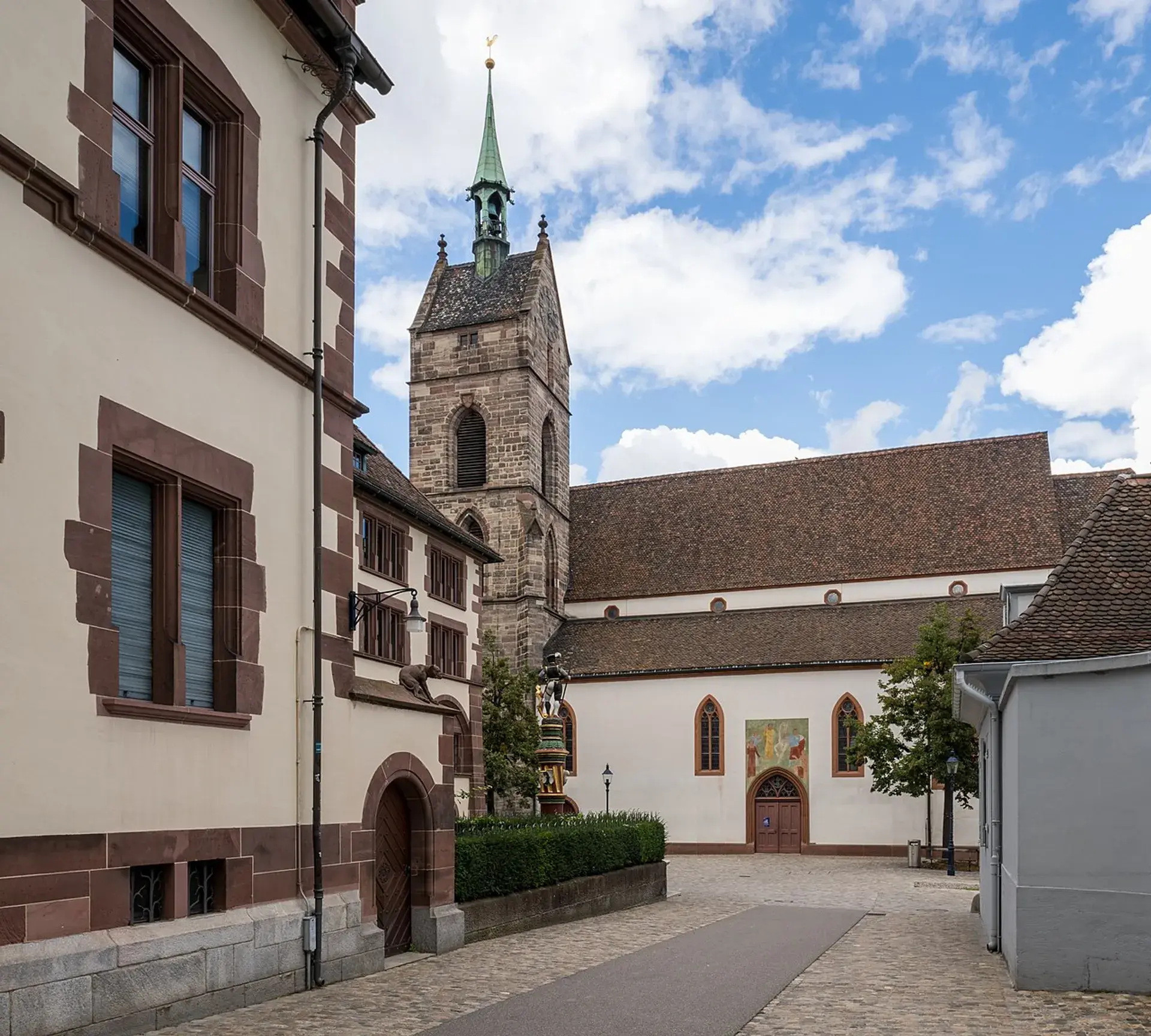
A historic heraldic beast watches over the ceremonial climb from the Rhine to the Minster, having survived centuries of change and a modern-day encounter with a delivery truck. Located at the junction of Augustinergasse and Rheinsprung, the Augustiner Brunnen stands against the city's old-world streetscape. Designated as a protected historic monument in 1915, it remains an active piece of civic infrastructure in Grossbasel.
A Renaissance Design and a Mythical Guardian
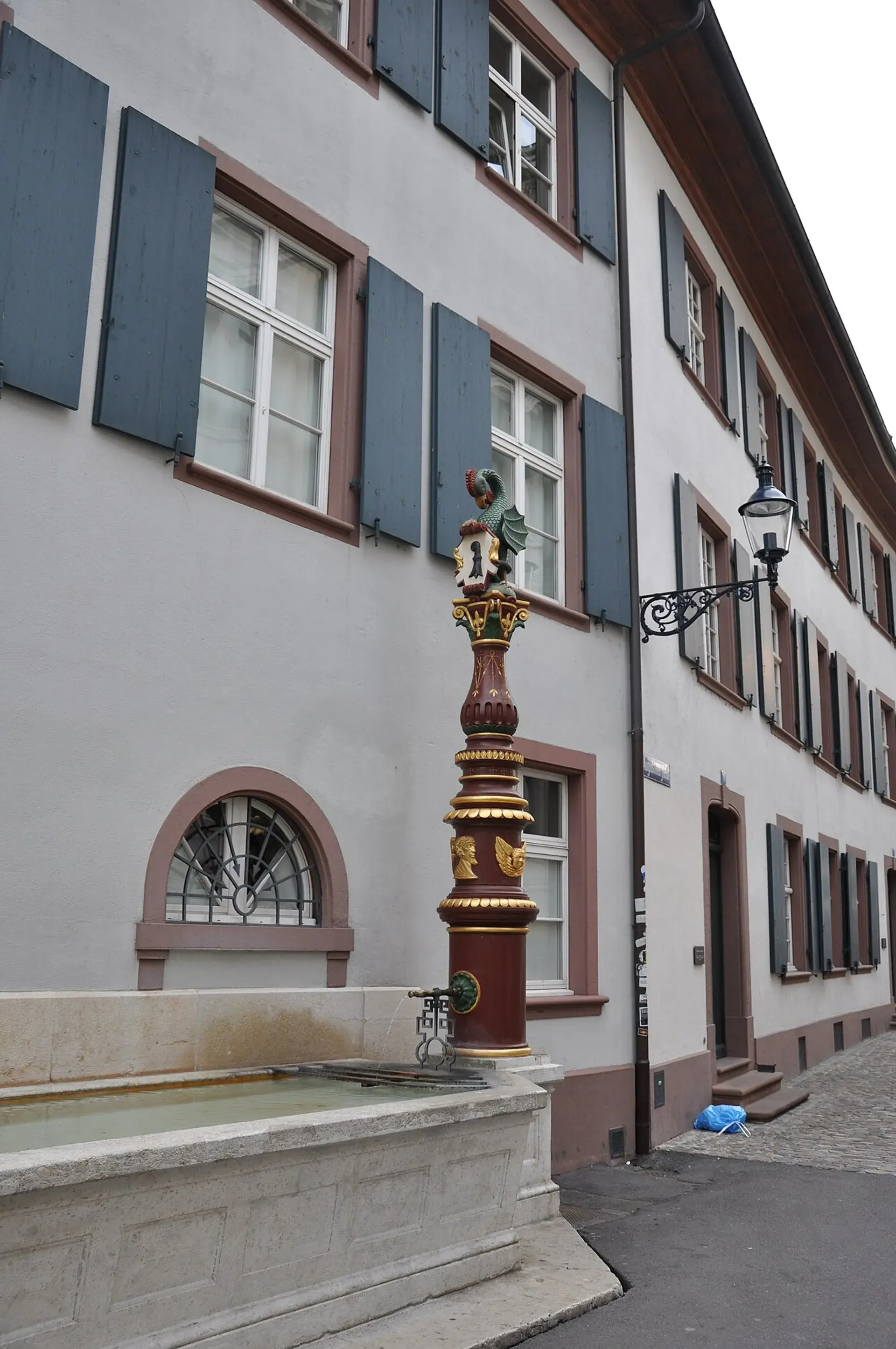
The Augustiner Brunnen features a rectangular limestone trough and a multi-tiered, ornate fountain pillar known as a Brunnstock. This column displays a striking visual contrast against the sandstone and plaster of the old town alley. It is coated in caput mortuum, a historic deep red pigment with violet undertones, and accented by bright gilded scrollwork and carved cherubs.
Atop the pillar sits a sculpted basilisk, a mythical creature that is half-rooster and half-serpent. This beast holds the Basel coat of arms, or Baslerstab, acting as the city's historic heraldic shield-bearer and civic guardian. Accompanied by the quiet sound of a steady stream of running water, the fountain is part of a network of over 170 public fountains in Basel that served as essential communal meeting spots before the advent of indoor plumbing.
Monastic Origins and Relocation
A fountain at this location is documented as early as 1441. It originally consisted of a wooden trough fed by wooden piping from the Münsterbrunnwerk. The structure was named after the monastery of the Augustinian Hermits, which was established on the Münster hill in the late 13th century. Between 1530 and 1550, following the Reformation, the wooden structure was transformed into a stone fountain complete with its heraldic basilisk column.
Significant changes occurred in 1846. After the medieval Augustinian monastery was demolished to construct a grand museum building, the freestanding fountain was found to block traffic where Augustinergasse, Martinsgasse, and Rheinsprung converged. Consequently, it was halved in size, rebuilt directly against the wall of Augustinergasse 1, and its water supply was switched to the St. Alban-Brunnwerk.
The 2005 Truck Collision and Replica
The original 16th-century basilisk sculpture was transferred to the Basel Historical Museum in 1876 for conservation, a decision that proved vital to the monument's future. In 2005, a delivery truck struck the fountain, entirely smashing the column and destroying the stone basilisk figure present at the time.
Because the 16th-century originals were safely preserved in the museum, master stone sculptors were able to carve a highly accurate replica to restore the monument. Furthermore, chemical and microscopic analyses of the original stone pillar conducted in 1986 allowed restorers to precisely reproduce the exact 16th-century Renaissance color scheme and gilding that are currently visible on the replica.
Today, the Augustiner Brunnen operates as an active, year-round drinking water fountain. It provides cold, clean spring water for pedestrians and cyclists navigating the historic lane linking the lower merchant port at the Rhine to the ecclesiastical center atop the Münster hill.
FAQ
Is the water in the Augustiner Brunnen safe to drink?
Yes, it operates as an active, year-round public drinking fountain, providing cold, clean spring water.
What is the creature on top of the Augustiner Brunnen?
The fountain is topped by a sculpted basilisk, a mythical creature that is half-rooster and half-serpent. It acts as Basel's historic heraldic shield-bearer and civic guardian.
Why was the Augustiner Brunnen moved from its original location?
In 1846, following the demolition of the nearby Augustinian monastery, the original freestanding fountain blocked traffic. It was subsequently halved in size and rebuilt against the wall of Augustinergasse 1.