Fischmarkt-Brunnen: Basel's Historic Gothic Fountain
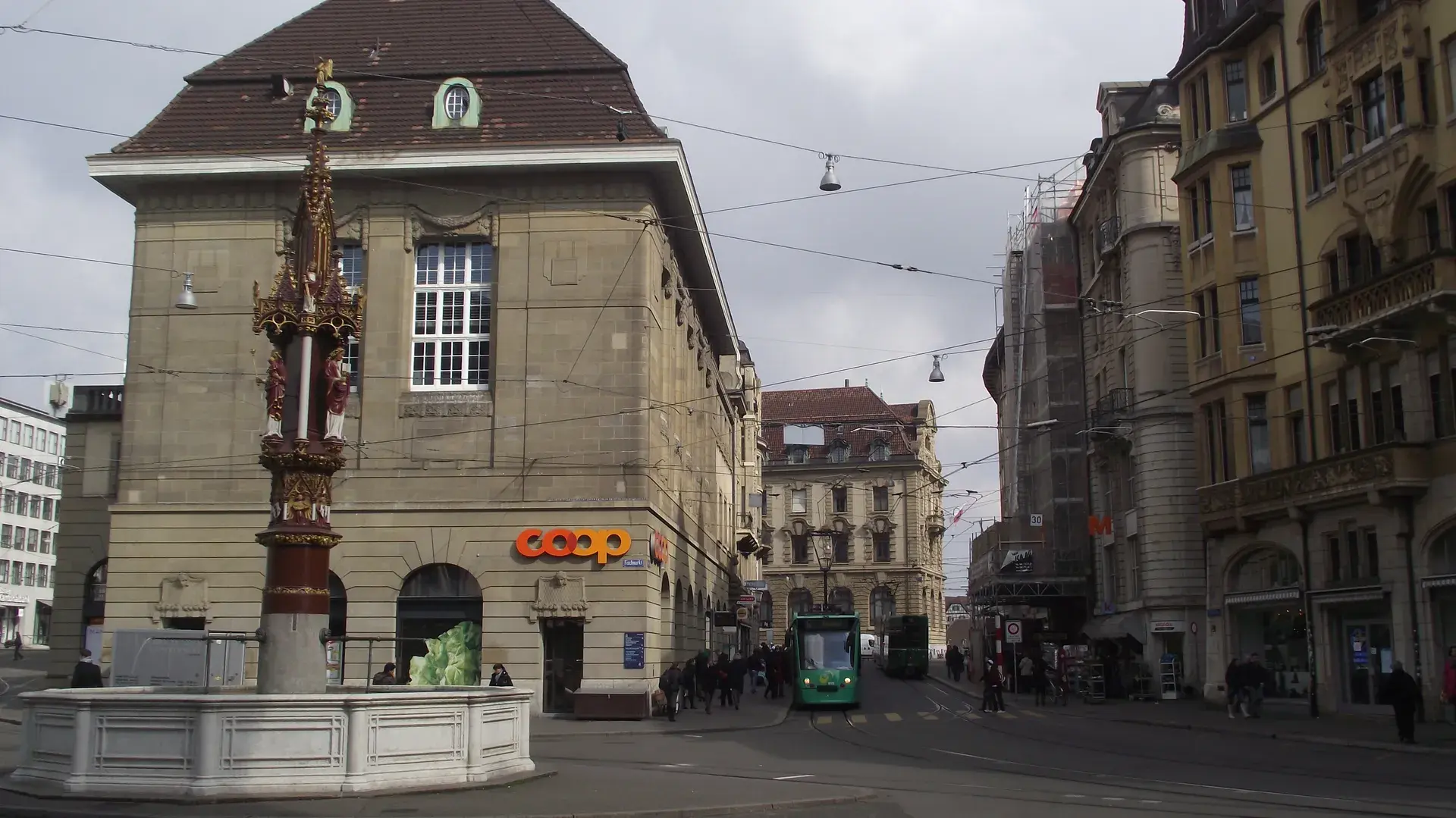
Discover the ornate detailing of the historic Fischmarkt-Brunnen right in the heart of the old town's Fischmarkt square. Switzerland's most ornate late-Gothic fountain was built not just for civic pride, but to keep live river fish swimming in submerged wooden cages. Today, it serves as a major visual anchor and meeting point on the pedestrian route connecting Marktplatz and the Rhine riverfront.
Gothic Artistry and Design
Created circa 1390, the Fischmarkt-Brunnen is widely regarded as the most ornate late-Gothic public fountain in Switzerland. The structure features a 12-sided stone basin and a central Gothic spire that rises approximately 11 meters high. Art historians link the fountain's stylistic origins to the workshop of master stonemason Johannes Parler III, who worked in Basel following the 1356 earthquake.
The soaring pillar is decorated with gilded Gothic pinnacles and over 20 brightly polychromed figures. The three main statues depict the Virgin Mary with Child and Sceptre, Saint Peter holding a key, and Saint John the Evangelist. These central figures are surrounded by prophets, saints such as Agnes, Barbara, and Catherine, as well as angels carrying musical instruments and the Basel coat of arms. Water streams continuously from gargoyle spouts into the wide basin below, providing a constant splashing soundtrack to the square.
A Thriving Medieval Marketplace
The fountain's creation followed the 1386 culverting of the Birsig river, marking the historic boundary where the water formerly flowed out in the open before draining into the Rhine. This monument was constructed primarily to serve the local fishermen's guild, whose headquarters were situated on the square.
During market operations, vendors utilized the large basin to keep their fresh Rhine catch alive by submerging perforated wooden cages directly into the water. This practice caught the attention of Venetian council secretary Andrea Gattari during the 1433 Council of Basel. While admiring the submerged fish boxes, Gattari noted with astonishment that local fishmongers sold their catch as expensive as blood.
Preservation and Modern Status
In 1468, master mason Jakob Sarbach was commissioned to renovate the monument and reconstruct its basin. This led to a centuries-long misconception that Sarbach had carved the entire Gothic structure, a belief later corrected by 20th-century art historians.
By the early 20th century, the fountain faced severe weathering. Between 1908 and 1910, the original 14th-century column and its sculptures were relocated to the Historisches Museum Basel, housed in the Barfüsserkirche. The monument standing on the square today is an exact replica. During these same renovations, the fountain was moved a few meters northwest to align with modern street layouts. Despite these changes, the Fischmarkt-Brunnen remains a fully operational public drinking fountain, continuing a centuries-old tradition of providing fresh water to the city.
FAQ
Is the Fischmarkt-Brunnen the original 14th-century fountain?
No, the monument currently standing on the square is an exact replica. Due to severe weathering, the original 14th-century column and sculptures were relocated to the Historisches Museum Basel between 1908 and 1910.
What was the original purpose of the fountain's large basin?
The large 12-sided stone basin was used by the local fishermen's guild to keep freshwater fish from the Rhine alive. Fishmongers submerged perforated wooden cages directly into the basin during market hours.
Can visitors drink from the Fischmarkt-Brunnen today?
Yes, the Fischmarkt-Brunnen remains an active, fully operational public drinking fountain maintained by the canton and utility services.
Why did citizens complain about a nearby fountain in 1679?
In 1679, citizens complained of foul-tasting water from an adjacent fountain. Investigators discovered that a cesspit from the nearby St. Peter's church had overflowed eight feet deep into the water conduit.