Spalentor: Basel's Grandest Medieval Gate
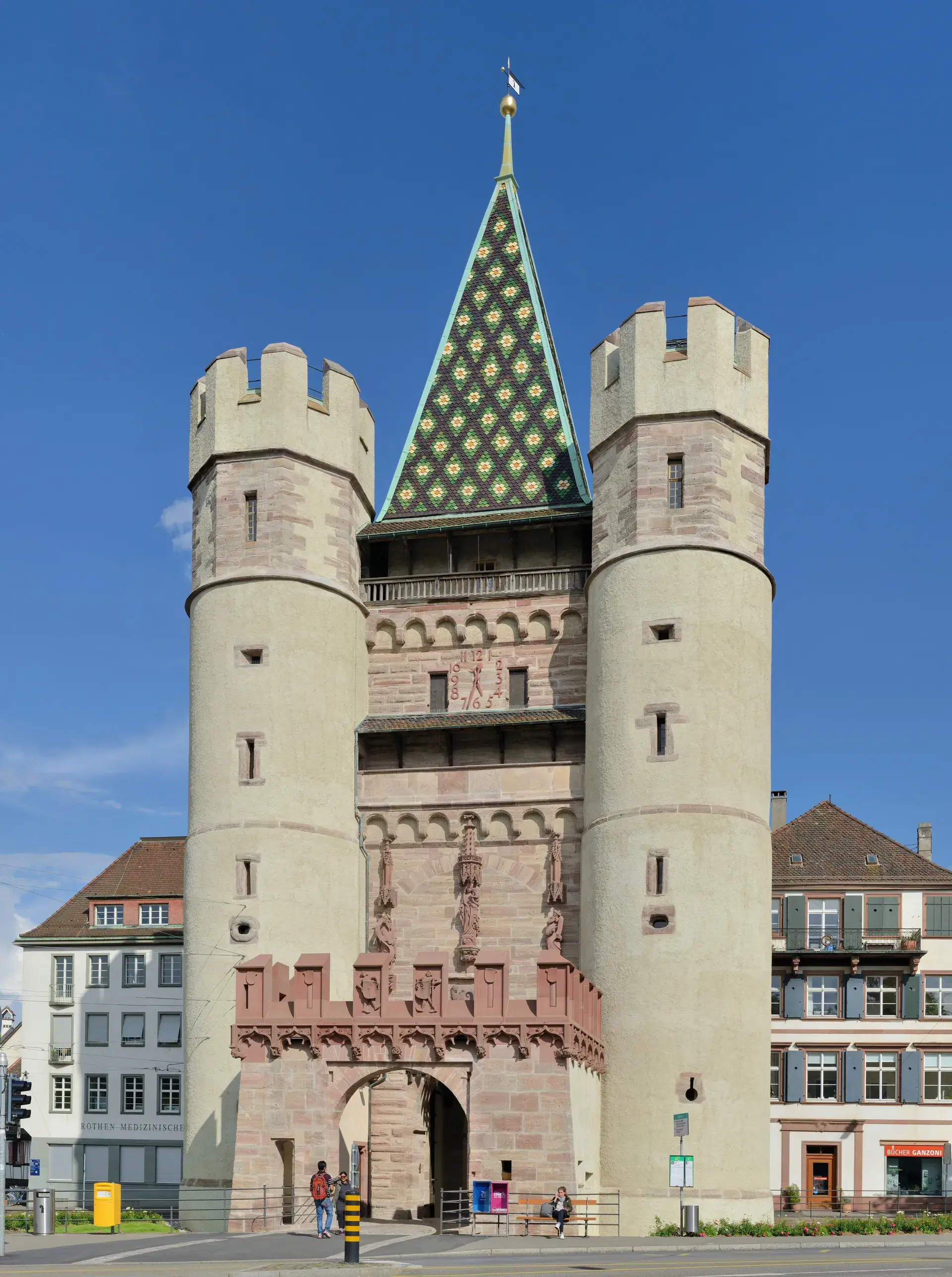
For centuries, travelers and traders arriving from Alsace had to pass beneath the 40.3-meter central tower and heavy oak portcullises of the Spalentor to enter Basel. It stands today as the city's largest surviving medieval gateway and one of only three remaining defensive portals from the ancient outer walls.
A Medieval Fortification
Completed around 1398–1400, the gate was constructed as part of the Outer City Wall following a devastating earthquake in 1356. Functioning as a heavily guarded customs checkpoint on the western trade route to Alsace, the structure controlled the flow of goods and people into the city.
Imposing Architecture
The gate features a prominent 40.3-meter square central tower built of red sandstone and limestone, capped with a steeply pitched, polychrome glazed tile roof. Two 28.15-meter circular round towers flank the main structure. Passing through the gateway reveals an immediate acoustic shift, transitioning from the hum of modern traffic outside to a quieter, enclosed stone passageway that opens onto the cobbled streets of the Old Town. Original defensive hardware remains visible within this passage, including heavy timber outer gates and thick oak portcullises.
Civic Symbols and Hidden Curiosities
The outward-facing facade was designed to project civic authority and faith to arriving travelers. It displays 15th-century statues of a Madonna flanked by two prophets, alongside carved lions holding the municipal Basel staff. Inside the gateway, a statue of Saint Barbara, the patron saint of artillerists, remains honored by local guilds.
Preservation and Modern Use
In 1859, the Grand Council opted to demolish most of Basel's medieval walls and gates to accommodate urban expansion. Spalentor was spared alongside the St. Alban-Tor and St. Johanns-Tor due to its recognized historical value. Today, the site operates as an open pedestrian and cycling gateway connecting the historic core with western districts. Attached to the structure is an 1844 green cast-iron mailbox designed by architect Melchior Berri. It features a relief of the 'Basel Dove' postal stamp and continues to function as an active letterbox. While the upper towers are closed for regular walk-ins, they are accessible during specific heritage events through guided public tours.
FAQ
When was Spalentor built?
Spalentor was completed around 1398–1400. It was constructed as part of Basel's Outer City Wall following the devastating 1356 earthquake.
Can visitors go inside the Spalentor towers?
The upper towers are closed for regular walk-ins, but the interior is opened for guided tours during specific city heritage events. The ground-level gateway remains open at all times for pedestrians and cyclists.
What is the green mailbox attached to the Spalentor?
The green cast-iron mailbox was designed in 1844 by Basel architect Melchior Berri. It features a relief of the historic 'Basel Dove' postal stamp and is still a functioning Swiss Post letterbox today.
Why was Spalentor not demolished like the rest of the city walls?
During the 1859 urban expansion when most of Basel's medieval walls and gates were demolished, the Grand Council spared Spalentor, St. Alban-Tor, and St. Johanns-Tor because of their perceived historical value.