Käppelijoch: Basel's Historic Rhine Bridge Chapel
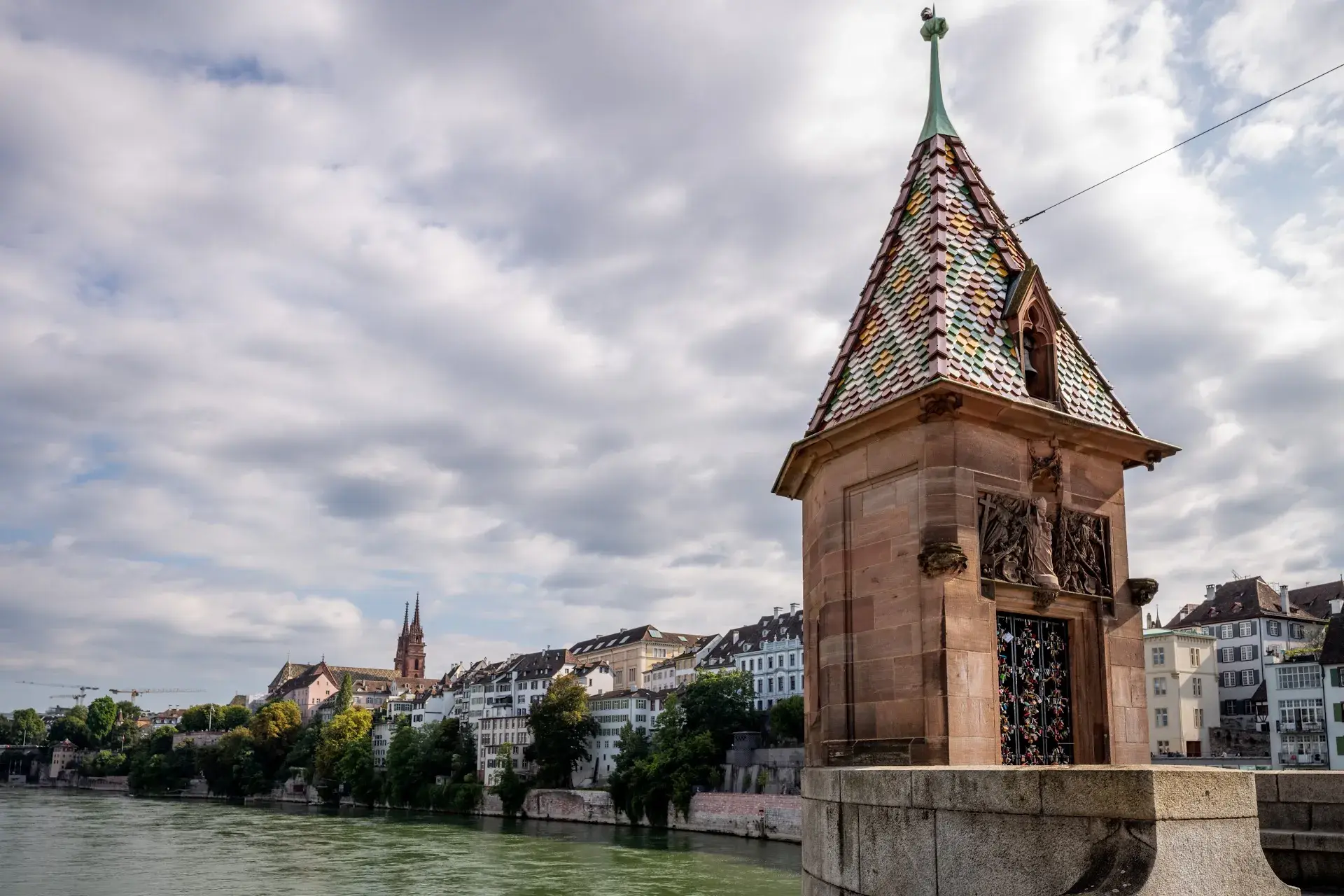
Observe the historic memorial of Käppelijoch positioned near the bustling span of the Mittlere Brücke. This tiny bridge chapel once served as both a territorial border and a site of medieval execution.
A Medieval Boundary over the Rhine
Constructed around 1225 under Prince-Bishop Heinrich von Thun, the Mittlere Brücke was the only fixed crossing over the Rhine between Lake Constance and the sea for centuries. This crossing transformed medieval Basel into a wealthy trans-Alpine trading hub. The Käppelijoch, translating to "little chapel on a bridge pier," originally sat on the fifth stone pier. Before Greater and Lesser Basel united politically in 1392, an early wooden shrine at this location marked the exact midpoint, territorial border, and diocesan line between the two sides of the city. Municipal records from the 1433 Council of Basel indicate that visiting Hussite delegates pelted the chapel's crucifix with snowballs and fists, proving the early wooden shrine had an open layout.
Architectural Evolution
In 1478, the original wooden structure was rebuilt as a durable stone chapel. This heavy construction served a dual purpose, functioning as essential ballast to stabilize the bridge pier against the severe flood currents of the Rhine River. During 19th-century renovations, the chapel was shifted to a new central pier. When the old bridge was eventually replaced with a modern granite structure to accommodate electric trams between 1903 and 1905, an exact replica of the Käppelijoch was built. Today, fragments of the medieval stone original are housed in the Basel Historical Museum.
The current structure features weathered stone walls, arched viewing windows, and a colorful pitched tile roof. It displays a sculpted relief of Prince-Bishop Heinrich von Thun holding a model of the arched bridge, flanked by angels bearing a cross and a lance for divine protection.
A Dark Judicial Past
During the late Middle Ages and early modern era, the Käppelijoch served as a site for public drowning executions. Convicts, often women condemned for infanticide, adultery, or witchcraft, were bound, weighted, and plunged from the chapel into the river. According to local penal tradition, if a condemned individual managed to survive the swift currents and reach the riverbank alive downstream near the St. Johanns-Tor, they received a reprieve from execution and were instead banished from the city.
Modern Traditions and the Basel Soundscape
Today, the chapel functions as a pedestrian landmark and a scenic overlook midway across the bridge. The site is characterized by the contrasting sounds of modern city life—clattering electric trams crossing above—and the rushing roar of the Rhine immediately beneath the arches. Locals and visitors frequently attach engraved padlocks to the chapel's metal grates and railings. Furthermore, the Käppelijoch remains an active ceremonial point during the annual Vogel Gryff folk festival, where traditional guild figures perform ritual dances facing Lesser Basel.
FAQ
Where is the Käppelijoch located?
It is positioned on the central stone pier of the Mittlere Brücke (Middle Bridge) crossing the Rhine River in Basel, Switzerland.
What does Käppelijoch mean?
The name translates to "little chapel on a bridge pier."
What is the history of executions at the Käppelijoch?
In the late Middle Ages and early modern era, the site was used for public drownings. Convicts were thrown into the Rhine, but those who survived the current and reached the bank near the St. Johanns-Tor were banished rather than executed.
How is the Käppelijoch used today?
The chapel functions as a pedestrian landmark and scenic overlook. It is also an active ceremonial site during the annual Vogel Gryff folk festival, where traditional guild figures perform ritual dances facing Lesser Basel.
Discover Basel like never before
Dive into Basel hidden stories and secret spots with Ciceru interactive tours.
Explore tour
Audioguide
Quizzes
Maps
Solo
Couples
Groups & families

© Photo by Christian Rüfli via Google Maps · Google Places