Conquest House: Where Becket's Murder Was Planned
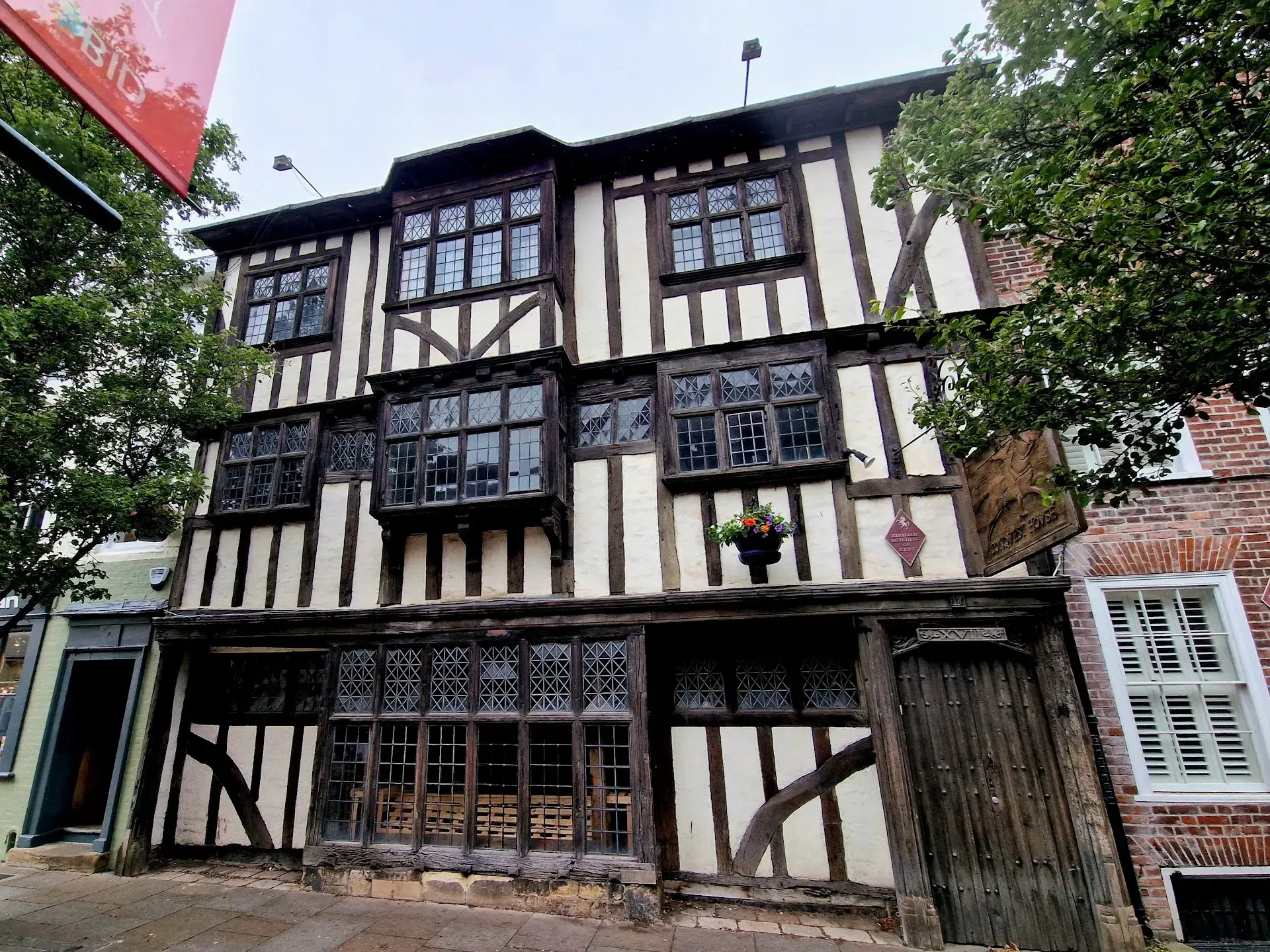
On Palace Street in Canterbury stands Conquest House, a captivating building whose timber frames are steeped in the city's ancient past. While its appearance suggests a purely medieval origin, the building's story is a complex tapestry of architectural layers and pivotal historical events.
A Deceptive Facade
The elaborate half-timbered exterior of Conquest House, which many assume to be original, is predominantly a 19th-century addition created in a late Tudor or Jacobean style. This later facade masks a much older structure. The building's true origins date back to the Norman period, and it retains significant early features, including a Norman undercroft and a 14th-century galleried hall. Evidence even suggests Roman-era predecessors on the site, making the building a physical timeline of Canterbury's development.
The Plot to Murder an Archbishop
Conquest House holds a dark but central place in English history. On December 29, 1170, this house, then owned by a man named Gilbert the Citizen, became the meeting point for four knights: Reginald FitzUrse, Hugh de Moreville, William de Tracy, and Richard le Breton. Spurred by King Henry II's frustrated outbursts against Archbishop Thomas Becket, the knights gathered here to plan his demise.
They first left their weapons at the house to confront Becket at the nearby Bishop's Palace. After failing to force the Archbishop to yield to their demands, the knights returned to Conquest House to arm themselves. They then proceeded to Canterbury Cathedral and murdered Becket in the area now known as The Martyrdom. This event transformed Becket into a saint and established Canterbury as a major European pilgrimage destination.
Royal Connections and Modern Use
Beyond its connection to the Becket murder, the house bears witness to other historical moments. A 17th-century fireplace inside features an ornate carving of a coat of arms, commemorating the 1625 marriage of King Charles I to Henrietta Maria, which took place in Canterbury Cathedral.
Today, Conquest House continues to be a part of Canterbury's active city life. The ground floor operates as a grocery store focusing on fresh produce and eco-friendly items. The upper floors house a contemporary art gallery that exhibits works by local and international artists and hosts various classes and craft fairs. The property also contains residential accommodation.
FAQ
What is Conquest House in Canterbury famous for?
Conquest House is most famous for being the location where four knights met on December 29, 1170, to plan the murder of Thomas Becket, the Archbishop of Canterbury.
Is the timber frame of Conquest House original?
No, the prominent half-timbered facade is largely a 19th-century addition. The building's core structure is much older, with origins in the Norman period, and includes a Norman undercroft and a 14th-century hall.
What is inside Conquest House today?
Currently, the ground floor of Conquest House is a grocery store. The upper floors contain a contemporary art gallery, and the building also includes residential accommodation and spaces for hire.
Are there other historical features inside Conquest House?
Yes, inside the house there is a 17th-century fireplace with a carved coat of arms celebrating the 1625 marriage of King Charles I and Henrietta Maria in Canterbury Cathedral.
Discover Canterbury like never before
Dive into Canterbury hidden stories and secret spots with Ciceru interactive tours.
Explore tour
Audioguide
Quizzes
Maps
Solo
Couples
Groups & families

© Photo by Markus Pruschowitz via Google Maps · Google Places