Kings Bridge Canterbury: History Over the River Stour
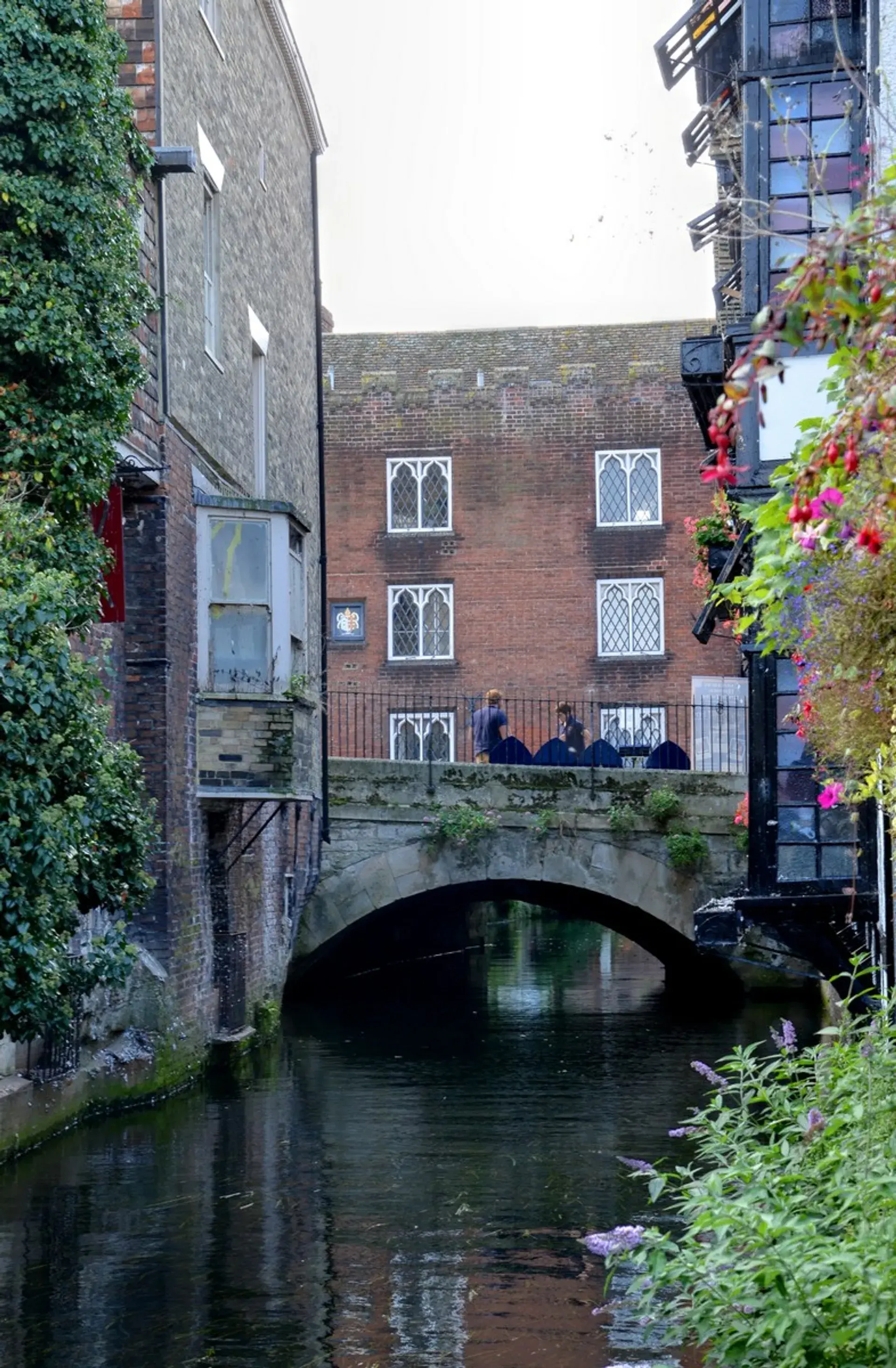
Kings Bridge is a picturesque crossing over the River Stour in Canterbury, offering charming views of punting on the river and the historic buildings that line its banks. The bridge and its surroundings are central to Canterbury's identity, telling a story of royalty, industry, and migration.
History of the Bridge and Mill
Also known as Eastbridge, the current Kings Bridge was rebuilt and widened by 10 feet in 1769. This expansion was significant enough to require the removal of the porch and bell tower of the adjacent All Saints' Church, which encroached on the roadway.
The bridge gets its name from the nearby King's Mill. The mill's history traces back to 1144 when King Stephen granted it to St Augustine's Abbey. It was later repossessed by Henry II in 1174 before being returned to public ownership during Henry III's reign. The mill was eventually demolished in 1799 by Alderman James Simmons to improve the river's flow.
The Old Weavers and Huguenot Legacy
Prominently located beside the bridge is a group of three timber-framed Grade II Listed Buildings known as The Old Weavers. Although a sign on the building displays the date '1500', the structure is largely a reconstruction from the second half of the 16th century, though its foundations may be as old as the 14th century.
From the mid-16th century, these buildings became workshops for Walloon and Huguenot weavers. These refugees, fleeing religious persecution in France and the Low Countries, were permitted to settle in Canterbury by Queen Elizabeth I. They established a prosperous silk-weaving industry, and by 1675, Huguenot weavers made up about a third of the city's population. The industry saw a brief resurgence around 1787 with the introduction of 'Canterbury Muslins' but declined in the early 19th century. A later revival effort in 1897 saw the establishment of the 'Canterbury Weavers' in the same building, creating employment for women.
A Curious Sight: The Ducking Stool
Extending over the River Stour from the rear of the Old Weavers House is a medieval-style ducking stool. Historically, such devices were used for public humiliation, particularly for women accused of being 'scolds'. However, the Canterbury example is most likely a late Victorian or Edwardian replica. There is no verified historical evidence that this specific stool was ever used, especially not for the 'swimming' of witches.
Kings Bridge Today
The Old Weavers buildings at 1, 2, and 3 St Peter's Street now house popular riverside restaurants. The area is a hub for tourism, with historical punt tours often departing from the landing behind The Weavers Restaurant, offering a unique perspective of the bridge and historic architecture from the water.
FAQ
Why is it called Kings Bridge?
Kings Bridge is named after the adjacent King's Mill, which was granted to St Augustine's Abbey by King Stephen in 1144. The mill itself was demolished in 1799.
Is the Old Weavers building really from the year 1500?
While the sign on the Old Weavers building says '1500', its visible structure is mostly a reconstruction from the mid-16th century. However, its foundations are believed to be even older, possibly dating to the 14th century.
Was the ducking stool at the Old Weavers House used for witch trials?
There is no historical evidence that the ducking stool in Canterbury was used for witch trials. It is widely believed to be a late Victorian or Edwardian mock-up rather than a genuine medieval artifact.
Who were the weavers of Canterbury?
The weavers were primarily Walloon and Huguenot refugees who fled religious persecution in the 16th century. They were skilled artisans who established a thriving silk-weaving industry in Canterbury, significantly impacting the city's economy and population.