Fyndon's Gate: History of an Abbey Gatehouse
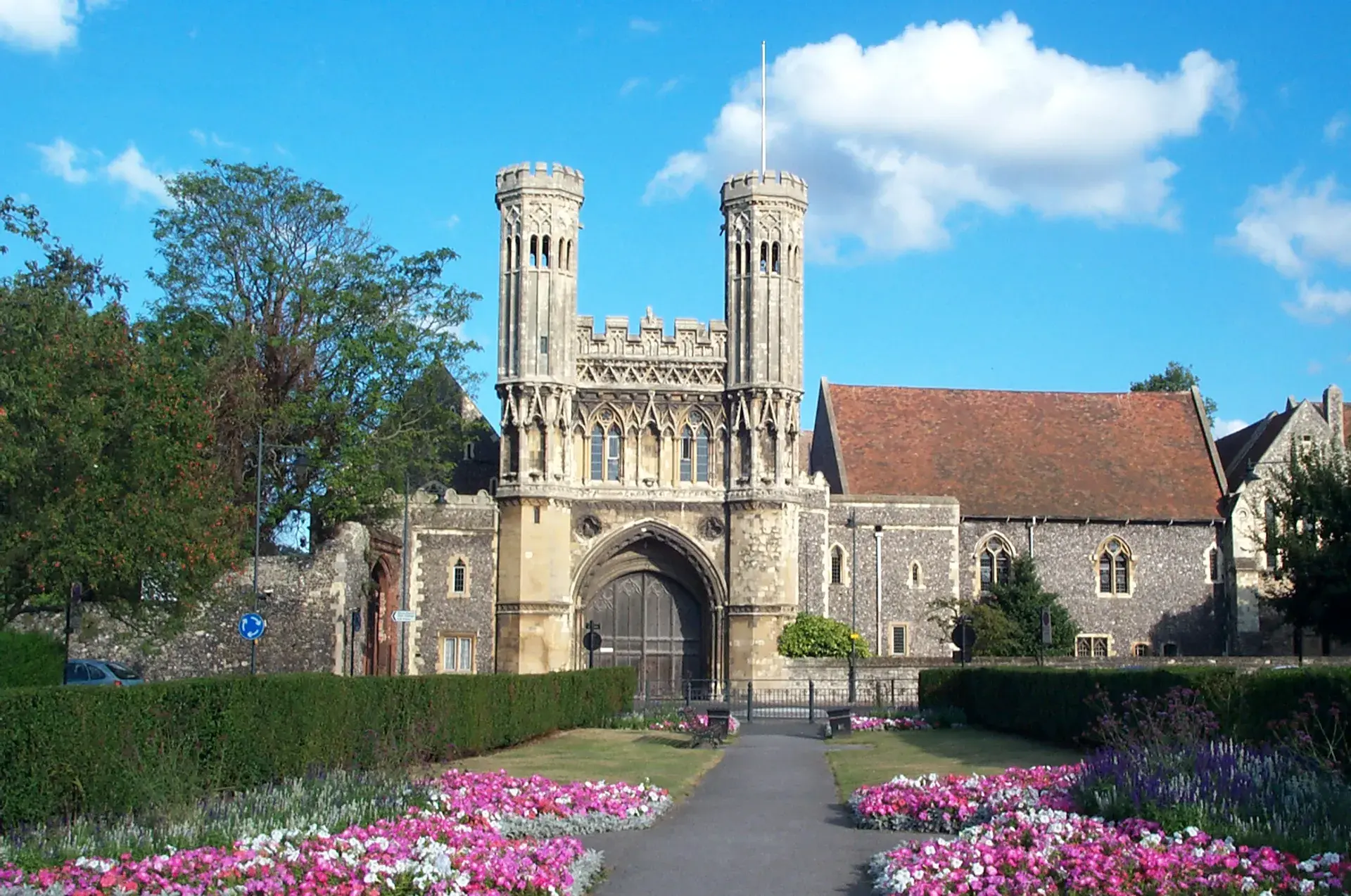
Gaze upon Fyndon's Gate, also known as St Augustine's Abbey Great Gate, an imposing medieval entrance that hints at the grandeur of the abbey within. This historic structure in Canterbury served as the original gatehouse to a Benedictine monastery founded in 598 AD.
Construction and Design
The gatehouse was rebuilt between 1301 and 1309 under the direction of Abbot Fyndon. In 1300, the abbot secured a charter to enlarge the monastery's great court, and in 1309, he received permission from King Edward II to embattle the gate.
The gate's architecture is notable for its two octagonal towers, a pointed arch, traceried windows, and canopied niches. Its decorated battlement has been described as resembling "an exquisite piece of lacework translated to stone."
A Chamber for Royalty
The chamber located above the gate served as the monastery's state bed-chamber, hosting several royal figures. In 1625, King Charles I and Queen Henrietta Maria slept in the chamber following their marriage in Canterbury Cathedral.
Later, in 1660, King Charles II, along with his brothers, the Dukes of York and Gloucester, stayed in the gatehouse on their way to London after the Restoration. It is also reputed that Queen Elizabeth I once stayed here.
From Monastery to Brewery
Following the dissolution of St Augustine's Abbey in 1538, the gatehouse was repurposed for secular uses. It was converted into a brewery that produced 'St Augustine's beer'. During this period, the once-royal chamber was reportedly used for cock-fighting, and another part of the building served as a fives-court or racket-ground. The steam from the brewing process "miserably defaced" the chamber's painted ceiling.
Resilience and Modern Use
Fyndon's Gate has demonstrated remarkable resilience. It suffered extensive damage from German bombs during the Second World War in 1942 and had to be rebuilt. This restoration work is visible in some of the stonework, which has a slightly different color compared to the original fabric.
Today, Fyndon's Gate serves as the main entrance to the grounds of The King's School, which adjoins the abbey site. The historic chamber above the entrance is now used by the school for educational purposes.
FAQ
When was Fyndon's Gate built?
Fyndon's Gate was rebuilt between 1301 and 1309 by Abbot Fyndon. In 1309, King Edward II granted permission to add battlements to the structure.
Did any royalty stay at Fyndon's Gate?
Yes, the chamber above the gate was a state bed-chamber. It hosted King Charles I and Queen Henrietta Maria in 1625, and King Charles II with his brothers in 1660. Queen Elizabeth I is also said to have stayed there.
What happened to Fyndon's Gate after the abbey was dissolved?
After the abbey's dissolution in 1538, the gatehouse was converted into a brewery. The state chamber was reportedly used for cock-fighting, and another section was used as a racket-ground.
What is Fyndon's Gate used for today?
Currently, Fyndon's Gate is the main entrance to The King's School grounds in Canterbury. The chamber above the gate is utilized for educational purposes by the school.